Scalloped potatoes come out tender all the way through when every slice is the same thickness, about one-eighth of an inch. Cut a flat side on each potato so it cannot roll, slice straight down in even strokes with a sharp chef’s knife or a mandoline set to one-eighth inch, and shingle the rounds into the dish while they are fresh. Uneven slices are the reason for the classic holiday gratin that is crunchy in one bite and mush in the next.
The dish itself is generous and plain: potatoes baked in seasoned milk or cream until the top browns. Wikipedia’s entry on gratins notes that in North America, au gratin potatoes traditionally included cheese and scalloped potatoes did not, a distinction it says has since been lost. Whichever name your family uses, the knife work is the same.
What to buy and set out
For a 9 × 13-inch dish, enough for 8 to 10 people as a side:
- 4 pounds of potatoes
- 2½ cups whole milk and 1 cup heavy cream
- 3 cloves of garlic, a few sprigs of thyme, salt, pepper and nutmeg
- 3 tablespoons of butter, plus extra for the dish
- 1 cup grated Gruyère or white cheddar, if you want it
Which potatoes. Potatoes USA’s consumer guide describes yellow potatoes as having a smooth, buttery texture and calls russets fluffy; it notes that red potatoes are waxy and stay firm through cooking. For a creamy gratin with slices that still look like slices, use yellow potatoes such as Yukon Gold. Russets give a softer, fluffier dish, and half of each works too. Pick potatoes of similar width, so the rounds come out a similar size and layer flat.
Set up before you slice: the dish buttered, the milk and cream warming in a saucepan with the garlic and thyme, and the oven heating to 375°F. Rinse and scrub the potatoes under running water, as the FDA advises for all produce, then peel them or leave the skins on.
Slice by knife
Even rounds by hand take one setup step and some rhythm.
Make a flat side. Lay the potato on its side and cut a thin slice off the long edge. Turn it onto that flat face. A potato that cannot roll is far safer to slice. The same move is the first step in breakfast potatoes: how to dice for even crisping.
Hold it in a claw. Curl the fingertips of your guiding hand under, knuckles forward, so the side of the blade rides against the knuckles. Each slice is set by how far the knuckles move back, not by how hard you push. The grip is explained in knife grips: pinch and claw.
Slice straight down. Use the full length of a sharp chef’s knife, forward and down in one stroke, and keep the blade vertical. A blade that leans makes rounds that are thick on one edge and thin on the other, and the thin edge overcooks.
Check the first few. Lay the first three rounds side by side and compare them before you carry on. If one is visibly thicker, slow down; speed comes once the rhythm is even.
This is different work from Hasselback potatoes, where the cuts stop short of the base. Here every cut goes all the way through, and consistency matters more than depth.
Slice by mandoline
A mandoline set to one-eighth of an inch gives even rounds in a fraction of the time, which matters when four pounds are waiting. Always use the hand guard that came with it, or a cut-resistant glove. When the potato gets too short to hold safely, stop and slice the last piece by hand on the board.
Whichever tool you use, work potato by potato and move the slices straight into the dish or into the warm milk. Wikipedia’s entry on enzymatic browning lists potatoes among the foods that brown once cut and notes that the reaction needs oxygen, so slices left sitting in the air darken at the edges.
Layer for even cooking
Rub the dish with butter. Shingle the rounds in overlapping rows, each slice covering about half of the one before, like roof tiles. Season every layer lightly with salt, pepper and a little nutmeg, and scatter cheese between the layers if you are using it.
Pour the strained warm milk and cream over the potatoes until it comes almost to the top layer. Press the top flat with a spatula so every round sits under the liquid, then dot with butter.
Bake and rest
Cover the dish with foil and bake at 375°F for 30 minutes. Uncover and bake another 45 to 60 minutes, until the top is deep golden and a paring knife slides through the center with no resistance. If the top browns before the center is tender, lay the foil back on loosely.
Let it rest 15 minutes before serving, so the portions hold together when spooned or cut.
The board for the job
Four pounds of potatoes go through in batches. Slice two or three potatoes, move the rounds to the dish, and clear the board before the next batch, so slices never pile up and slide.
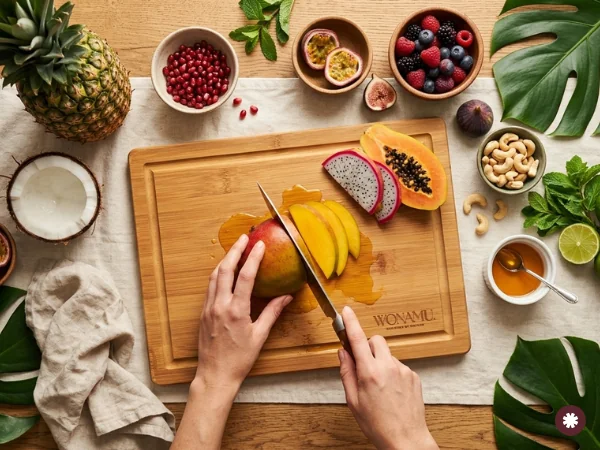
A WONAMU. bamboo cutting board is 12 × 9 inches, enough room for one potato, its row of rounds and a corner for the garlic and thyme. Its perimeter juice groove keeps the starchy liquid from the cut potatoes on the board.
A damp towel under the board stops it from sliding, which matters with wet, starchy potatoes.
Make it ahead and keep leftovers safe
Scalloped potatoes can be baked a day ahead, cooled, covered and refrigerated, then reheated covered at 350°F until hot through. Refrigerate them within 2 hours of baking, as the CDC advises for cooked food, and reheat leftovers to 165°F, the FDA’s figure for leftovers and casseroles. A Christmas dinner plan that uses make-ahead sides like this one is in how to host Christmas dinner for the first time.
Wash the board in hot, soapy water as soon as the slicing is done, before the starch dries on it. Towel it dry and stand it on edge.
The short version
Choose yellow potatoes, or half yellow and half russet. Cut a flat side, hold the potato in a claw grip, and slice straight down into one-eighth-inch rounds, or use a mandoline with its guard. Move the slices straight into the dish or warm milk.
Shingle the rounds, season every layer, cover with warm cream and milk, and bake covered, then uncovered, until a knife slides through. Rest 15 minutes, then serve.
❋
WONAMU. makes a bamboo cutting board, 12 × 9 inches, bamboo, with a perimeter juice groove, in gift-ready packaging with a cotton care cloth. Available on Amazon.
Designed by nature.