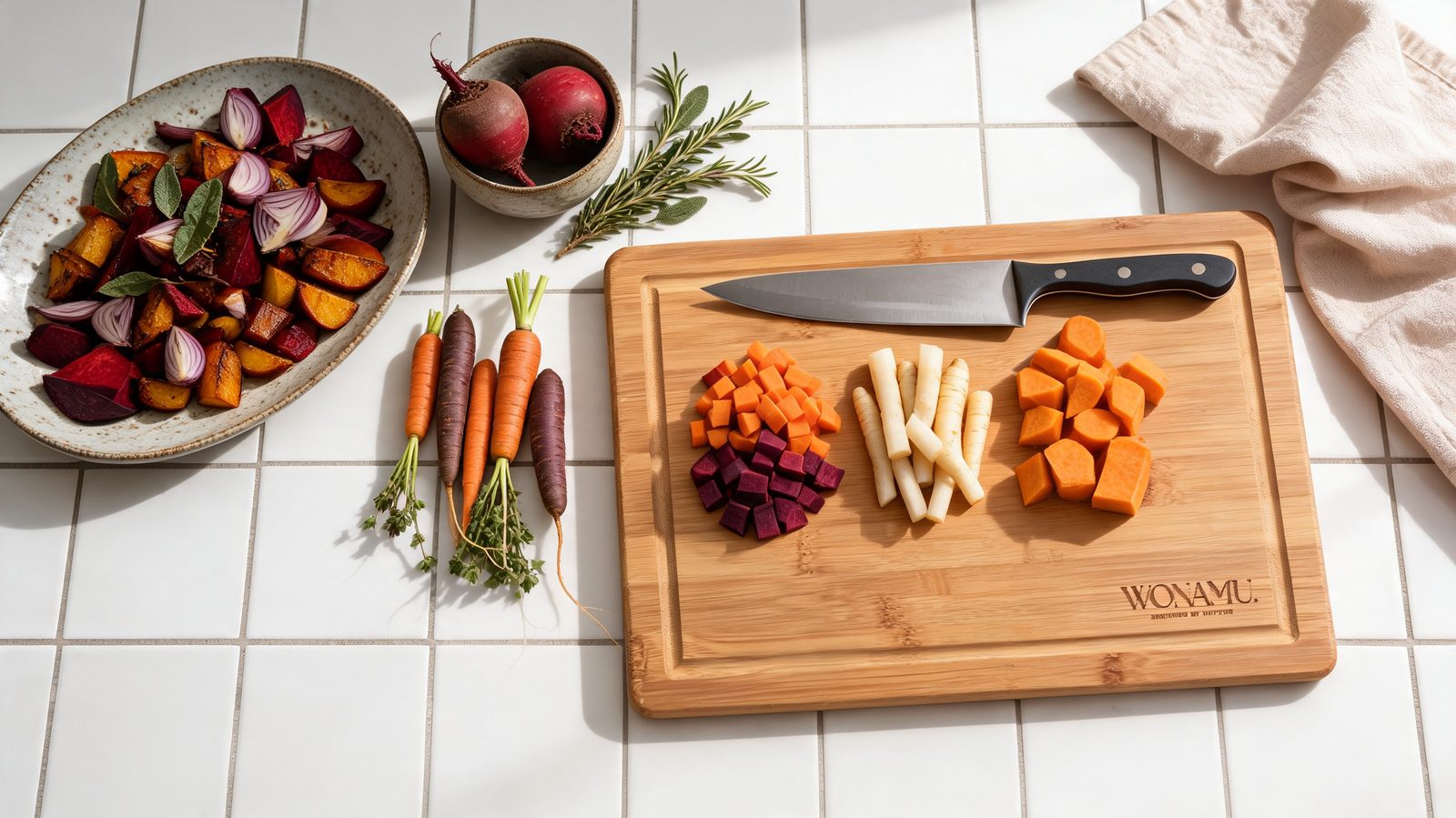
Roasted root vegetables turn out evenly browned when each vegetable is cut to suit how fast it cooks: dense carrots, parsnips and beets into pieces of about three-quarters of an inch, sweet potatoes and red onion a little larger. Toss them in oil and salt, spread them out in one layer with room between the pieces, and roast at 400°F until the edges caramelize. Roast the beets on their own pan, so their color stays where it belongs.
It is one of the least fussy dishes on a Christmas table and one of the most forgiving to make ahead. It also takes up a lot of oven and counter space, so it is worth cutting with a plan.
What to buy
For 8 to 10 people as a side:
- 1½ pounds carrots, ideally a mix of colors
- 1½ pounds parsnips
- 1 pound beets, red or golden or both
- 1½ pounds sweet potatoes
- 2 red onions
- About ⅓ cup olive oil, kosher salt, black pepper
- A few sprigs each of rosemary, thyme and sage
- Optional finish: a spoonful of maple syrup or a squeeze of orange
Parsnips suit a winter table. University of Illinois Extension notes that their flavor develops after the roots have spent 2 to 4 weeks at near-freezing temperatures, as the starch in the root changes to sugar.
Clean and peel
Scrub everything under running water before any knife touches it, as the FDA advises for all produce. Montana State University Extension recommends scrubbing beets thoroughly to remove dirt and sand. Peel the beets, sweet potatoes and parsnips. Carrots can be peeled or scrubbed well and left with their skins.
Set up the counter: a damp towel under the board, a large mixing bowl for the cut vegetables, a separate small bowl for the beets, and two sheet pans lined with parchment. The oven goes on to 400°F.
Cut each vegetable to match
The rule is the same one that governs any sheet-pan roast, explained at length in sheet-pan dinners: why cut size is everything. Pieces of similar size and density finish together. Pieces that are too small burn before the large ones soften.
Carrots. Halve very thick tops lengthwise first, so no piece is much thicker than three-quarters of an inch. Then cut them on a sharp diagonal into 1½-inch lengths, or use the roll cut: one diagonal cut, a quarter turn, another diagonal cut. The techniques are in how to cut carrots.
Parsnips. Parsnips have a fat top and a thin tail, so cut them in two first. Quarter the thick top lengthwise and halve the thin end. University of Illinois Extension advises digging out the woody core of large parsnips; with the top quartered, the core is easy to slice away. More detail is in how to cut parsnips.
Sweet potatoes. Make a flat side so the potato cannot roll, cut it into planks about an inch thick, then into chunks of about an inch to an inch and a quarter. A slightly larger piece than the carrots helps them hold their shape.
Red onions. Leave the root end on, peel, and cut each onion into eight wedges through the root. The root holds each wedge together in the oven.
Beets last. Cut the beets after everything else, into wedges or three-quarter-inch chunks, and put them straight into their own bowl. Montana State University Extension notes that beets can leave red stains on fabric and hands, and advises adding them to mixed dishes right before serving to prevent their color from bleeding onto other foods. Roasting them on a separate pan, or at least on their own side of one, does the same job. The details are in how to cut beets.
Cutting one vegetable at a time keeps the board clear. A WONAMU. bamboo cutting board is 12 × 9 inches, enough for one vegetable and its finished pieces, and its perimeter juice groove holds the liquid from the sweet potatoes and beets. Sweep each batch into the bowl before starting the next.
Season and roast
Toss the mixed vegetables with most of the oil, salt, pepper and the leaves from the thyme and rosemary. Toss the beets separately with the rest. Spread everything in a single layer with space between the pieces, so each one has room to brown. Use a third pan rather than piling.
Roast at 400°F for 35 to 50 minutes, turning the pieces once halfway through and swapping the pans between racks. Montana State University Extension gives 30 to 40 minutes at 400°F for roasted beet pieces, so check the beet pan first. Everything is done when a knife slides into the largest piece and the edges are deep brown.
In the last five minutes, add whole sage leaves to the pans so they crisp. If you are using maple syrup or orange, toss it through as the pans come out.
Serve
Combine everything on a warm platter, beets added at the end and scattered over the top, so the colors stay separate. A Christmas table with a roast, a starch and a green vegetable needs no more than this. Like every cooked dish, it should not sit out for more than 2 hours. For timing a full menu around the oven, see how to host Christmas dinner for the first time.
Make ahead
Cut the vegetables a day ahead and refrigerate them in covered containers, the beets on their own. Roast on the day. Or roast fully a day ahead, refrigerate within 2 hours of roasting, as the CDC advises for cooked food, and reheat on sheet pans at 400°F until they reach 165°F, the CDC’s figure for leftovers.
Wash the board in hot, soapy water as soon as the beets are done, then towel it dry and stand it on edge.
The short version
Scrub and peel. Cut carrots, parsnips and beets to about three-quarters of an inch, sweet potatoes and onion wedges a little larger, and core thick parsnips. Cut the beets last and keep them apart.
Toss with oil, salt and herbs, spread in one layer with room to breathe, and roast at 400°F for 35 to 50 minutes, turning once. Add the beets to the platter at the end.
❋
WONAMU. makes a bamboo cutting board, 12 × 9 inches, bamboo, with a perimeter juice groove, in gift-ready packaging with a cotton care cloth. Available on Amazon.
Designed by nature.

