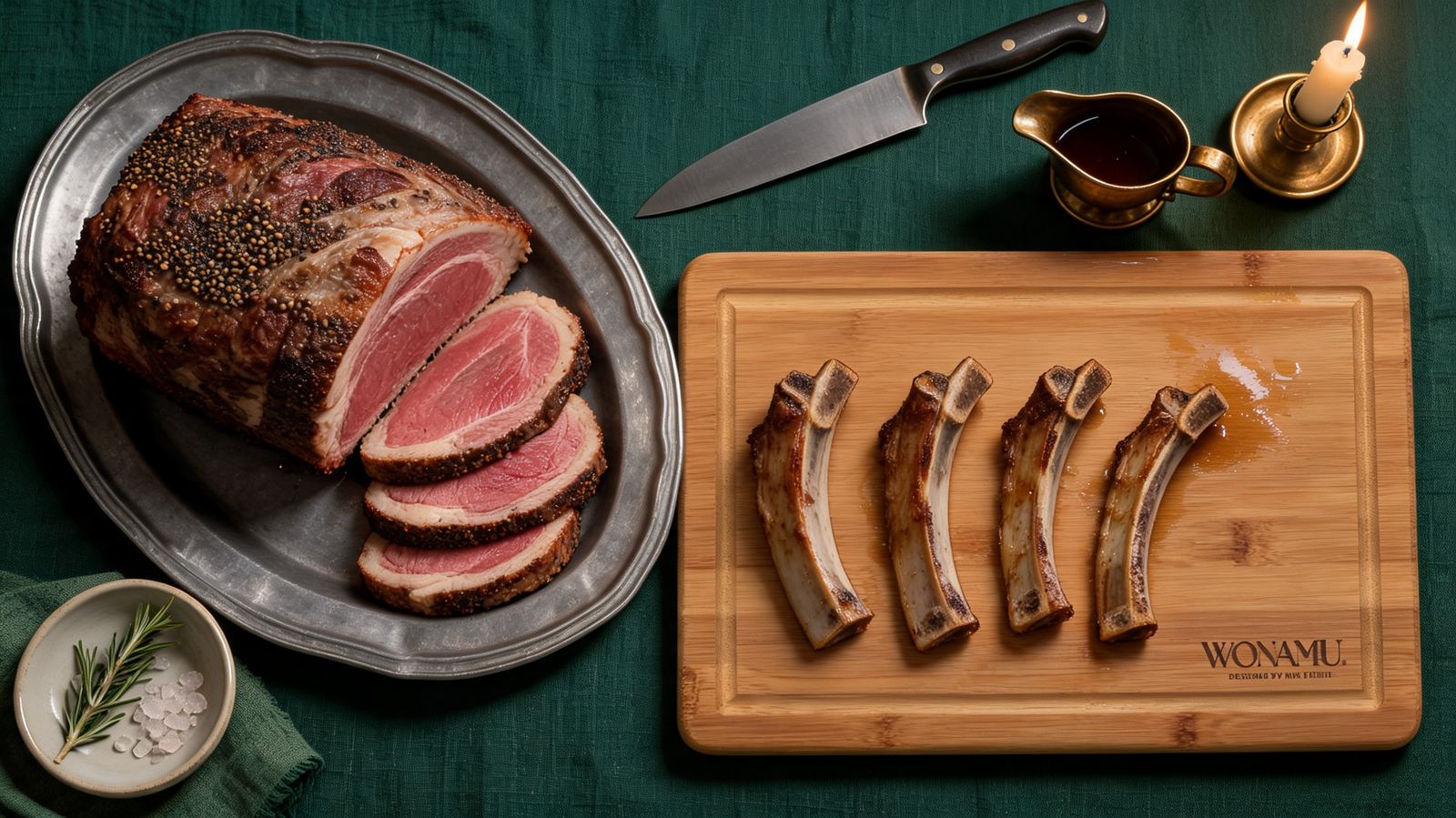
To slice prime rib, rest the roast, cut the rib bones away in one piece by running the knife along their curve, then lay the boneless roast flat and slice it across the grain, half an inch to an inch thick. Cut the bones apart afterward and serve them on the side. The meat comes off cleanly, every slice is the same shape, and nobody has to saw around a rib at the table.
Prime rib is the one roast where the bones make carving harder rather than easier. Take them off first and the rest is straight slicing.
What you are carving
Prime rib is another name for a standing rib roast, a beef roast cut from the primal rib. Wikipedia notes that a roast may hold anywhere from two to seven ribs, and that the name does not mean USDA Prime: the USDA does not require the cut to come from Prime grade beef. The ribs are left on so the roast stands on them in the pan.
Wikipedia describes the ribeye steak as the same cut as prime rib without the bone. That is a useful map for carving: slice the roast in the same direction the bones run and every slice is, in effect, a boneless ribeye, cut across the grain the way a steak is.
If you have not bought the roast yet, ask the butcher to cut the bones off and tie them back on with twine. The roast cooks on its bones the same way, and carving becomes a matter of snipping the string.
Before the knife: temperature and rest
Use a thermometer in the thickest part of the eye, away from the bone. The FDA’s safe minimum for beef roasts is 145°F with a three-minute rest. Illinois Extension lists 145°F as medium-rare, 160°F as medium and 170°F as well-done for beef roasts.
Move the roast to a large carving board or a rimmed platter and tent it loosely with foil. A rest of 20 to 30 minutes is a practical window: the roast stays hot, the surface firms up, and you have time to finish the jus and the sides. A roast this size holds its heat well.
Set up the station
A whole rib roast belongs on a large carving board with room on every side. The bones, once they come off, move to a second board where they can be cut apart without crowding the roast.
Two knives cover the job. A long carving knife, 10 to 12 inches, takes each slice in a single stroke; a boning knife or a sharp chef’s knife follows the curve of the ribs. Keep a carving fork or a clean folded towel at hand to steady the meat, and warm the serving platter in a low oven while the roast rests.
Long, smooth strokes beat pressure. A sharp knife glides through the crust; a dull one crushes it and pushes juice out of the slice. Reading the grain works the same way on any big cut of beef, and how to cut a brisket shows it on a roast where the grain changes direction.
Step 1: Take off the bones
Snip and pull away any twine. Turn the roast so the bones stand upright, curving away from you, with the fat cap facing out.
Hold the tips of the bones with a towel. Set the knife against the inside of the first rib and cut down along the curve of the bones, keeping the blade pressed against them, until the rack comes free in one piece. Short strokes follow the curve better than long ones. Leave as little meat on the bones as you can; what does stay on them is the cook’s reward later.
You now have a boneless roast with a flat face where the bones were, and a rack of ribs.
Step 2: Slice across the grain
Lay the boneless roast on that flat face, fat cap up. It will sit still.
Slice straight down, in the same direction the bones ran, so the knife crosses the grain. Thickness is a matter of taste:
- About half an inch for thin, even slices that fan well on a buffet
- Three-quarters of an inch to an inch for the classic thick restaurant cut, one slice per plate
Use the full length of the blade and let the knife do the work in one or two long strokes. Saw back and forth and the crust tears away from the meat.
The ends of the roast are more cooked than the center. Offer them to the guests who prefer their beef well done.
Step 3: Cut the bones apart
Move the rack of ribs to the second board. Stand it on edge and cut down between each pair of bones into single ribs. Serve them on a separate plate for the guests who want them, or wrap them for the next day.
A 12 × 9 inch WONAMU. bamboo cutting board suits this part of the job: a rack of ribs fits it with room to work, and the perimeter juice groove catches the drippings that run off the bones. The whole roast stays on the big carving board, where it belongs.
Serving
Lay the slices on the warm platter, overlapping a little, with the pink centers facing up. Spoon any juice from the carving board over the top. Serve the jus and a horseradish sauce at the table.
Slice only what the first round of plates needs. An unsliced piece of roast stays warmer and juicier than a stack of slices, and carving a second round takes a minute. The same thinking about when to cut cooked meat is in when to slice a steak after cooking.
For the larger plan of the evening, from timing the roast to setting the table, see how to host Christmas dinner for the first time.
Leftovers and cleanup
Refrigerate leftover roast within two hours, the FDA’s limit, in shallow containers. Illinois Extension says to eat cooked leftovers within three to four days and to reheat them to 165°F. Thin slices warmed gently in a little jus reheat more evenly than thick ones, and cold prime rib makes an excellent sandwich.
The carving board will be greasy. Wash it in hot water with dish soap, scrubbing the groove, then dry it on edge. How to clean grease off a cutting board after carving walks through it.
The short version
Roast to at least 145°F and rest 20 to 30 minutes. Cut the rib bones off in one piece along their curve. Lay the boneless roast on its flat side and slice across the grain, half an inch to an inch thick.
Cut the ribs apart on a second board and serve them on the side. Slice only what you will serve, and refrigerate the rest within two hours.
❋
The WONAMU. bamboo cutting board — 12 × 9 inches, bamboo, with a perimeter juice groove and a cotton care cloth in the box — is available on Amazon.
Designed by nature.