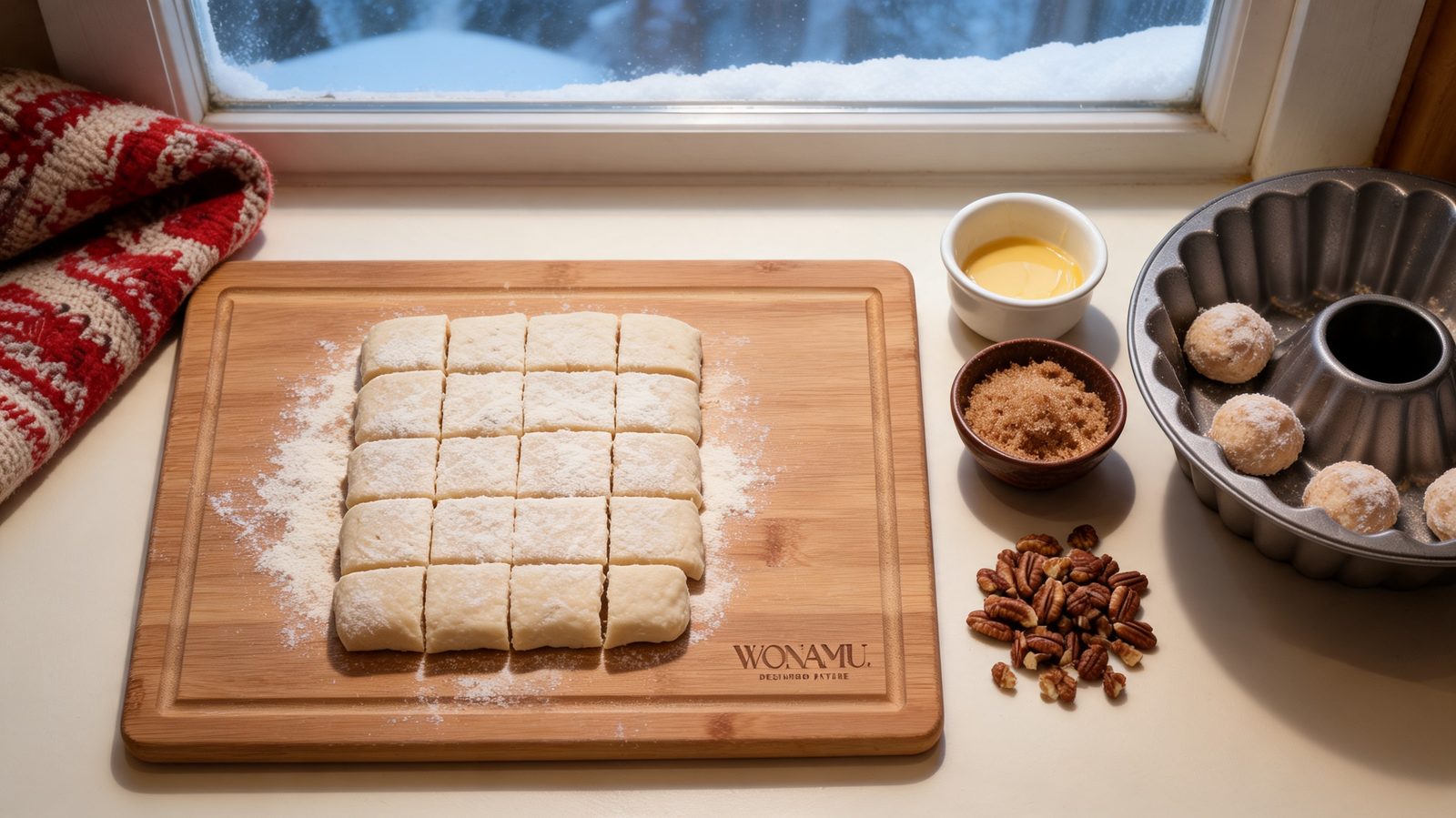
Monkey bread for Christmas morning is a Christmas Eve job. Make a soft yeast dough, pat it into a rectangle about 8 by 9 inches on a floured board, cut it into 64 small pieces, roll each one in melted butter and cinnamon sugar, and pile them into a buttered Bundt pan. Cover the pan and refrigerate it overnight. In the morning, let it warm up on the counter for about an hour, bake it at 350°F for 30 to 40 minutes, and turn it out onto a platter.
It is a pull-apart bread. Nobody slices it. It is served hot so the pieces tear away with the fingers, which makes it a good fit for a morning spent on the living room floor.
How it differs from cinnamon rolls
Monkey bread and cinnamon rolls use almost the same dough and the same flavors. The work is different. Cinnamon rolls are about one large sheet, rolled into a tight spiral and cut into even rounds, which is the subject of Christmas morning cinnamon rolls.
Monkey bread is about many small pieces. There is no spiral to keep tight and no rolled sheet larger than the counter. The dough is patted into a small rectangle and cut into a grid, and every piece is coated on its own. It forgives uneven cuts, and children can help with the coating.
Wikipedia’s entry on monkey bread says the origin of the name is unknown. One theory points to the bread being finger food; another to its resemblance to the monkey puzzle tree. The same entry credits Nancy Reagan with popularizing it at Christmas during the 1980s, when it became a staple of the Reagan White House Christmas.
The dough
This makes one 10- or 12-cup Bundt pan.
- 1⅓ cups milk, warmed to 110°F
- 1 tablespoon instant or active dry yeast
- ¼ cup sugar
- 2 tablespoons butter, melted
- 3¼ cups all-purpose flour, plus a little for kneading
- 1½ teaspoons salt
Stir the yeast and sugar into the warm milk and let it stand for five minutes. Add the melted butter, the flour and the salt, mix, and knead for about eight minutes, until smooth and soft. Cover the bowl and let the dough rise in a warm spot until doubled, about an hour.
For the coating:
- 6 tablespoons butter, melted, in a small bowl
- 1 cup packed brown sugar mixed with 1 tablespoon ground cinnamon, in a second bowl
- ½ cup pecans, chopped (optional)
- 2 tablespoons soft butter for the pan
Pat and cut on the board
This is where the board earns its place. A rectangle of about 8 by 9 inches is all the dough needs, and it fits on a cutting board with room to spare.
- Flour the board lightly. Dust a teaspoon or two of flour over the surface and spread it with your palm.
- Pat, do not roll. Turn the risen dough out, press it flat with your fingertips, and pat it into a rectangle about 8 by 9 inches and about 1 inch thick. No rolling pin is needed.
- Cut a grid. With a bench scraper or a chef’s knife, cut the rectangle into 8 strips one way and 8 the other, for 64 pieces. Press straight down rather than sawing; a bench scraper cuts soft dough cleanly in one push.
- Do not fuss over size. Uneven pieces bake together into one loaf. Aim for pieces about the size of a large grape.
A WONAMU. bamboo cutting board is 12 × 9 inches, the size of this whole step: the dough rectangle on one side and the cut pieces pushed to the other. A damp towel underneath stops the board from moving under the scraper.
Chop the pecans first
If you are adding pecans, chop them before the dough comes out, on a clean, dry board. Rock a chef’s knife through a small pile until most pieces are about the size of a pea, and sweep them into a bowl with the bench scraper. The method is in how to chop nuts.
Scatter a third of the pecans into the bottom of the buttered pan before the dough goes in, and toss the rest with the cinnamon sugar.
Coat and pan
Butter the Bundt pan generously with the soft butter, into every ridge. Avoid a pan with a removable bottom; the butter and sugar leak out.
Work in an assembly line: board, butter bowl, sugar bowl, pan. Pick up a few pieces, roll each loosely into a ball, dip it in the melted butter, roll it in the cinnamon sugar, and drop it into the pan. Do not pack the pieces down. Scatter any sugar left in the bowl over the top.
The overnight rest
Cover the pan tightly with plastic wrap and put it in the refrigerator. The dough keeps rising slowly overnight.
On Christmas morning, take the pan out about two hours before you want to eat. Leave it covered on the counter for 45 minutes to an hour. Heat the oven to 350°F for the last 15 minutes.
Uncover the pan and bake for 30 to 40 minutes, until the top is deep brown and the sugar is bubbling at the sides. Let it stand for five minutes, no more, then set a platter over the pan and turn it out, using thick oven mitts.
A glaze of ½ cup powdered sugar stirred with a tablespoon of milk is optional. Most of the sweetness is already there.
Serving and clean-up
Put the bread in the center of the table with a stack of napkins and no knife. It goes well with the rest of a slow morning spread; the Christmas morning breakfast board has ideas for what goes around it.
Raw dough is a raw food. The FDA advises never eating raw dough and washing cutting boards, utensils and counters with warm, soapy water afterward. Scrape the flour from the board with the bench scraper into the trash, wash it in hot soapy water, rinse, dry it with a towel and stand it on its edge while the bread bakes.
The short version
On Christmas Eve, make the dough and let it rise. Pat it into an 8 by 9-inch rectangle on a floured board, cut it into 64 pieces with a bench scraper, roll each in butter and cinnamon sugar, and pile them into a buttered Bundt pan. Cover and refrigerate.
On Christmas morning, give it an hour on the counter, bake at 350°F for 30 to 40 minutes, wait five minutes, and turn it out. Then let everyone pull.
❋
WONAMU. makes a bamboo cutting board designed for daily prep, 12 × 9 inches, bamboo, with a perimeter juice groove. Available on Amazon.
Designed by nature.

