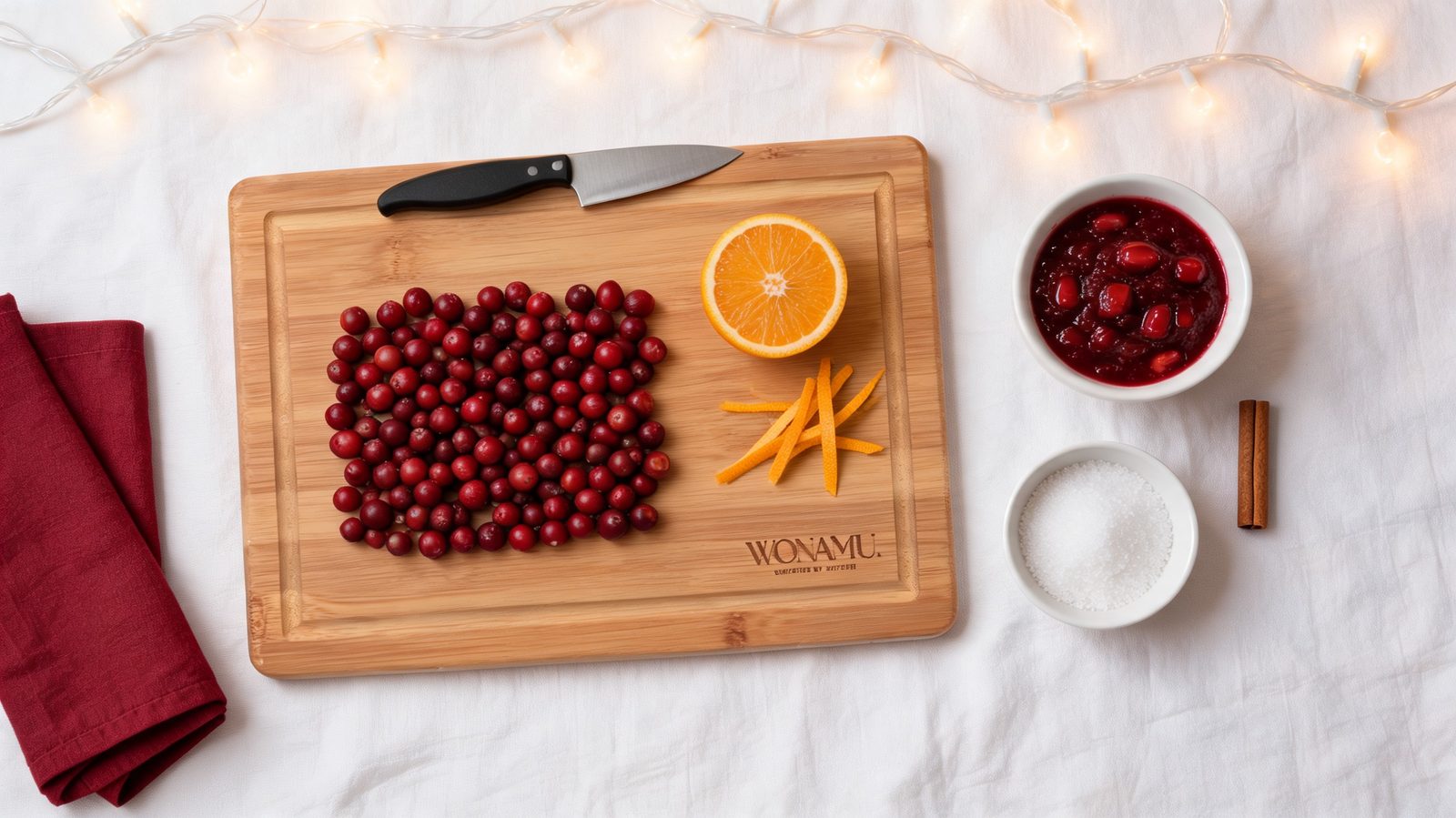
To make cranberry sauce from scratch, bring 1 cup of sugar and 1 cup of water to a boil, add a 12-ounce bag of fresh cranberries, and simmer for about 10 minutes, until most of the berries have burst and the sauce coats a spoon. Stir in orange zest and a pinch of salt, take it off the heat, and let it cool. It will look loose in the pan and set in the bowl.
What separates a good sauce from a forgettable one is the prep around it: sorting the berries, taking zest without the bitter pith, and knowing when to stop the simmer.
What to set out
- One 12-ounce bag of fresh cranberries (frozen work too; add them straight from the freezer)
- 1 cup granulated sugar
- 1 cup water, or 3/4 cup fresh orange juice and 1/4 cup water
- One navel orange
- A pinch of salt
- Optional: a cinnamon stick, a few thin coins of fresh ginger, or a splash of port stirred in at the end
You also need a medium saucepan, a wooden spoon, a fine grater or a vegetable peeler, a paring knife and a board. Choose a pan with some room in it. The berries foam and spit as they burst, and a small pan boils over.
Sort the berries on the board
Tip the bag onto the board and spread the berries out in one layer. Pick out any that are soft, shriveled or brown, along with stray stems. A bag usually holds a few, and one mushy berry is easy to spot once nothing is piled on top of it.
Rinse the sorted berries in a colander and let them drain. They do not need to be dry; the water goes into the pan anyway.
Take the zest, not the pith
Orange juice and orange zest are common additions to cranberry sauce, and this recipe uses both. Wash and dry the orange first.
With a fine grater: hold the orange in one hand and run it over the grater in short strokes, turning it as each patch turns pale. Stop when you see white. The white pith under the skin is bitter, and a teaspoon of it in a small pot of sauce is noticeable.
With a peeler: take three or four wide strips from top to bottom, pressing lightly so the blade lifts only the orange layer. Lay each strip skin side down on the board and shave off any white with the paring knife held almost flat. Then cut the strips into very thin threads, or leave them whole to simmer in the sauce and pull out at the end.
Halve the zested orange across the middle and squeeze it if you are using juice in place of some of the water. If you want orange segments in the sauce, cut them out with a knife before squeezing; the method is in how to supreme an orange.
The simmer: listen for the pop
Put the sugar and water (or juice and water) in the saucepan, stir, and bring it to a boil so the sugar dissolves. Add the cranberries and the cinnamon or ginger if you are using them. Bring it back to a boil, then lower the heat to a steady simmer.
Within a few minutes the berries start to split, with a soft popping sound. Stir now and then and press a few against the side of the pan with the spoon. After about 10 minutes most of the berries will have burst, the liquid will have turned a deep, glossy red, and the sauce will coat the back of the spoon.
The set comes from the fruit itself. The Exploratorium’s cooking pages describe cranberries as naturally rich in pectin, released as the berries pop open, and note that the sauce thickens as it cools. A Science Buddies cranberry experiment published by Scientific American explains the mechanism: cooked with sugar, the long pectin molecules tangle into a net that traps the dissolved sugar, and longer cooking makes a firmer sauce.
That gives you the control:
- For a loose, spoonable sauce with whole berries in it, stop when about two thirds of the berries have burst.
- For a firmer sauce that holds its shape, cook another 3 to 5 minutes, stirring, until nearly all the berries have collapsed.
Do not cook it until it looks thick in the pan. Overcooked, it sets rubbery once cold. The Exploratorium also points out that a recipe with too much sugar is harder to bring to its gel point, which is one more reason to keep to a cup per bag.
Take the pan off the heat, fish out the cinnamon stick or ginger, and stir in the zest, the salt and the port if you like it. Taste once it has cooled a little; a spoonful more sugar dissolves into warm sauce without trouble.
A raw relish, if you prefer it bright
Some tables want something sharper next to a rich roast. A raw cranberry-orange relish uses the same bag of berries and the board does most of the work.
Cut a whole washed orange, peel and all, into eight wedges, and flick out any seeds with the tip of the paring knife. Put the wedges, the sorted cranberries and 1/2 to 3/4 cup of sugar in a food processor and pulse until everything is finely chopped but not puréed. Refrigerate it for a few hours so the sugar draws out the juice. A handful of toasted pecans, chopped on the board, gives it crunch; how to chop nuts covers getting even pieces without dust.
Make it ahead
Cranberry sauce is the side that should be made first. Cook it two or three days before the dinner, cool it, and keep it covered in the refrigerator. The CDC’s food safety guidance is never to leave perishable food out for more than 2 hours and to keep the refrigerator at 40°F or below.
Take it out half an hour before dinner. Cold from the fridge, it is very firm and the flavor is muted; at cool room temperature it loosens and the orange comes back.
Serving
Serve it in a small bowl with its own spoon. For a buffet, two small bowls at either end of the table beat one large one.
If you want the firm, sliceable style, pour the hot sauce into a small loaf pan or a straight-sided bowl, cover and chill it overnight, then turn it out and cut it into thick slices with a thin knife dipped in hot water. Wikipedia’s article on cranberry sauce says canned cranberry sauce appeared on the market in 1941; its jellied form slips out of the can onto a dish in one piece. Homemade sauce sets softer than that, so cut it gently and serve it from the board it was sliced on.
A WONAMU. bamboo cutting board suits the prep end of this recipe: 12 by 9 inches is room to spread out a whole bag of berries for sorting, with the orange and zest to one side, and its perimeter juice groove keeps the orange juice off the counter. Wash the board in hot, soapy water when you are done, rinse, and towel it dry.
For where the sauce fits in the rest of the meal plan and the cooking schedule, see how to host Christmas dinner for the first time. Leftover sauce has plenty of uses the next morning, a few of which are in what to do with Christmas leftovers.
The short version
Sort one 12-ounce bag of cranberries on the board and zest an orange without the white pith. Boil 1 cup sugar with 1 cup water, add the berries, and simmer about 10 minutes, until most have burst. Stir in the zest and a pinch of salt and let it cool; it sets as it cools.
Stop early for a loose sauce, cook a few minutes longer for a firm one, and never cook it until it looks thick in the pan. Make it two or three days ahead and refrigerate it within 2 hours.
❋
WONAMU. makes a bamboo cutting board designed for daily prep, 12 × 9 inches, bamboo, with a perimeter juice groove. Available on Amazon.
Designed by nature.

