The masa for Puerto Rican pasteles is a grated paste of green bananas, green plantains and root vegetables, and the work is mostly peeling and grating. Peel everything on the board, drop the pieces into salted water as you go so they do not darken, grate them on the fine side of a box grater or in batches in a food processor, then season the paste with annatto oil and a little liquid. Cut the banana leaves to size while the masa drains, and the assembly line is ready.
Wikipedia’s entry on pasteles calls them a cherished recipe in Puerto Rico, especially around Christmas, and notes that because they are so labor-intensive, families often make anywhere from 50 to 200 or more at a time. The prep is shared out, and most of it happens on a cutting board.
What goes into the masa
The masa is typically made from grated green bananas, green plantains, white yautía, potato and calabaza, a tropical pumpkin. The proportions change from family to family, and so does the list; some recipes leave out the potato or the calabaza.
For about 20 pasteles, a workable starting point:
- 10 green bananas, very firm, no yellow
- 2 green plantains
- 1 pound white yautía
- ½ pound calabaza
- ½ cup annatto (achiote) oil, plus more for the leaves
- ½ cup milk or liquid from the cooked filling
- 2 teaspoons salt
Make the meat filling first, the day before. The filling is a stew, often of pork, with any combination of Boston butt, ham, bacon, raisins, chickpeas, olives and capers.
Cut the raw pork on its own board, not the one you will use for the vegetables. The FDA advises one cutting board for fresh produce and a separate one for raw meat, poultry and seafood. Cool the cooked filling and refrigerate it within two hours.
Set up before you peel
Fill a large bowl with cold water and stir in a tablespoon of salt. Every peeled piece goes straight into it. Peeled green bananas and plantains start to darken in the air, and the salted water holds them pale until you grate.
Wear disposable gloves. Uncooked plantains stain hands and kitchen towels.
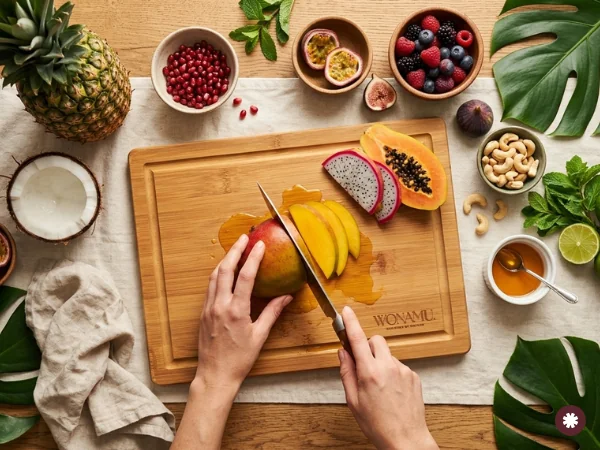
Set the board on a damp towel so it stays put, with the salted water to one side and a bowl for peels on the other. A WONAMU. bamboo cutting board is 12 × 9 inches, enough for a few bananas at a time with room to work the knife. Peel in rounds rather than piling everything up at once.
Peeling green bananas and plantains
Green bananas do not peel like ripe ones. The skin clings, and it has to be cut off.
- Trim the ends. Cut off both tips with a paring knife.
- Score the skin. Run the knife tip lengthwise along the ridges, through the skin but not deep into the flesh. Three or four cuts per banana.
- Pry it off. Slide your thumb or the side of the knife under one strip and lift. Work strip by strip around the fruit.
- Trim and drop. Shave off any green patches left on the flesh, cut the banana into two or three pieces, and put them in the salted water.
Plantains peel the same way, with a thicker skin. Score along the ridges, lift the skin in sections, trim, and cut into chunks.
Yautía and calabaza
Yautía has a rough brown skin. Cut off both ends, stand it on one flat end and slice the skin away from top to bottom with a chef’s knife, following the curve. Rinse the peeled root, cut it into chunks and add it to the salted water.
For calabaza, scoop out the seeds, cut the squash into wedges, lay each wedge flat on the board and cut the rind off with a knife. Wedges lying flat are steadier than a round half rocking under the blade.
Grating the masa
Drain the pieces and pat them dry.
By hand: Grate on the fine side of a box grater set in a wide bowl. Hold each piece at a low angle and use long strokes. Stop when the piece gets short; finger ends are the price of grating the last inch. The stubs go into the food processor at the end.
With a food processor: Process the grated pieces, or the raw chunks in small batches, until the paste is smooth and creamy. For the finest texture, grate first and then blend.
Then drain the masa. Set it in a fine-mesh sieve or a cheesecloth-lined colander over a bowl for at least 3 hours in the refrigerator so the excess liquid drips out.
Stir in the salt, the annatto oil and enough milk or filling liquid to make a soft paste that holds its shape on a spoon. It should be orange-gold and spreadable. If you have grated potatoes for latkes, the box-grater rhythm is the same; how to grate potatoes for latkes covers grip and grater safety.
Cutting the banana leaves
While the masa drains, prepare the leaves. If they are frozen, thaw them in the refrigerator first.
- Wipe them clean. Wipe both sides with a damp cloth.
- Cut them to size. Unfold a leaf on the board and cut along the grain with a knife or scissors. Recipes use rectangles of about 10 by 5 inches with parchment underneath, or squares of about 12 inches; choose one size and keep to it.
- Make them supple. Pass each piece briefly over a gas flame or a hot burner until it softens and turns supple.
- Stack them. Stack the trimmed leaves beside the board, ready for the line.
Brush a little annatto oil in a rectangle on the center of each leaf on a tray, not on the board.
Assembly and cooking
Lay a sheet of parchment, then a leaf. Spread a couple of spoonfuls of masa in the center, add a spoonful of filling, cover with a little more masa, fold the leaf over into a packet, wrap the parchment around it and tie it with kitchen string in both directions.
Lower the pasteles into a large pot of salted boiling water, make sure they are submerged, and simmer for about an hour. Cut the string and unwrap at the table. The day runs like a tamale party; how to host a tamalada has the assembly-line plan.
Uncooked pasteles can be frozen. Bag, date and freeze any you will not cook right away. Cooked leftovers go into the refrigerator within two hours.
The short version
Make the filling a day ahead, on its own board. Peel the green bananas, plantains, yautía and calabaza in rounds, and hold every piece in salted water. Grate fine or process to a smooth paste, drain it, and season it with annatto oil, salt and liquid.
Cut the banana leaves to one size, pass them over a flame, and stack them beside the board. Then fill, fold, tie and simmer for an hour.
❋
WONAMU. makes a bamboo cutting board designed for daily prep, 12 × 9 inches, bamboo, with a perimeter juice groove. Available on Amazon.
Designed by nature.