To chop nuts without them flying across the kitchen, keep the pile small, hold the knife with your free palm flat on the spine, and rock the blade through the nuts instead of bringing it down hard. Chop raw nuts first and toast them after if you want clean pieces, because toasted nuts are brittle and shatter into dust. Then stop at the size the recipe needs: rough for toppings, fine for crusts and fillings.
Pistachios turn up all through holiday cooking, in cookies, on crostini, folded into bark and scattered over cocktails. They are also the nut most likely to end up under the refrigerator. A few habits fix that.
Why nuts scatter
Nuts are round, hard and light. A heavy downward chop hits one, it squirts sideways, and the rest of the pile follows. The problem gets worse the more you put on the board at once, because every nut that rolls away pushes another.
The cure is to stop chopping and start pressing. A rocking motion keeps the blade in contact with the nuts almost the whole time, so there is nothing to bounce off. The tip stays on the board and only the heel lifts.
Shell and sort first
Shelled pistachios save time. If yours are in the shell, split the shells with your thumbnails along the open seam. For the stubborn ones that are barely cracked, twist half of an empty shell into the gap like a key and turn it.
Rub the shelled nuts between your palms or in a clean kitchen towel to loosen the papery skins. Some will come off, some will not. For most baking, leftover skin is fine. For a bright green garnish, blanch the nuts in boiling water for one minute, drain, and the skins slip off between your fingers.
Pick out any shell fragments now. A tiny piece of shell in a cookie is the kind of thing a guest remembers.
The rocking chop, step by step
- Put no more than about half a cup of nuts on the board at a time. Spread them in a low mound, not a tall heap.
- Hold a chef’s knife in your dominant hand. Lay the palm of your other hand flat on the spine of the blade, near the tip, fingers straight and well clear of the edge.
- Keep the tip on the board. Rock the heel down through the pile and back up, moving the knife across the mound in a fan.
- Every few passes, use the spine of the knife to sweep the scattered pieces back into the center.
- Turn the board or your angle and work across the pile in the other direction.
Stop and look often. Nuts go from rough to fine faster than you expect, and the last few passes turn fine into crumbs.
If a few nuts still escape, roll a kitchen towel into a rope and lay it around the edge of the board as a low wall. It catches strays and gives the board a little extra grip on the counter. A board that holds still matters more than any knife trick; why your cutting board slides covers the damp towel method underneath.
Rough, medium and fine
Match the size to what the nuts are doing in the recipe.
- Rough chop, pieces about the size of half a nut: toppings for salads, roasted vegetables, yogurt and oatmeal, where you want a visible bite.
- Medium chop, pieces about the size of a lentil: cookie dough, brownies, quick breads and holiday bark, where nuts should be spread through every bite without dominating it.
- Fine chop, pieces like coarse sand: crusts for fish or lamb, the coating on a cheese ball, fillings for baklava and pastries, and garnishes that need to cling.
For a fine chop, sift the pile through a coarse sieve when you are close. Return what stays behind to the board for a few more passes, and the rest is done. The fine dust that falls through is worth keeping for dusting over a frosted cake.
Chop first, toast second
Toasting deepens flavor, but it also dries nuts out and makes them fragile. A toasted pistachio under a knife cracks into irregular shards and a lot of powder. Chop raw nuts to the size you want, then toast the chopped pieces.
Spread them on a sheet pan and toast at 350°F. Chopped pistachios need about five to seven minutes; whole walnuts and pecans need closer to eight to ten. Stir once halfway and watch the last two minutes closely, because chopped nuts burn faster than whole ones. Tip them onto a plate as soon as they smell toasty so the hot pan does not keep cooking them.
The exception is a recipe that calls for whole toasted nuts chopped afterward. Let them cool completely before they meet the knife, and expect a bit more dust.
When a knife is not the right tool
For a pound of pecans headed into pie, a food processor is faster. Pulse in short bursts and check after every few pulses. Nuts are full of oil, and a processor left running turns them into paste.
For a cup of nuts and no processor, put them in a heavy zip-top bag, press out the air and roll a rolling pin over it. You get rough, uneven pieces that suit streusel or a crumble topping, and nothing escapes the bag.
A knife still gives the most control over size and the fewest crumbs, which is why it is worth learning. It also means one less appliance to wash during a December baking week.
Holiday uses for chopped pistachios
- Bark: medium-chopped pistachios with dried cranberries over dark chocolate for green and red without food coloring.
- Crostini: finely chopped pistachios over ricotta with a drizzle of honey.
- Shortbread: medium chop folded into the dough, or rolled around the log before slicing.
- Roasts: a fine chop mixed with herbs and mustard as a crust for rack of lamb or salmon.
- Cocktail rims: finely chopped pistachios mixed with sugar on the rim of a glass.
The same technique works for almonds, walnuts, pecans and hazelnuts. Walnuts and pecans are softer and break more readily. Hazelnuts and almonds are harder and need a little more pressure on the spine.
Care for the board after nuts
Nut oils leave a light sheen on a wooden board. Wipe away the crumbs, wash the board with warm soapy water and dry it on edge. If someone in the house has a nut allergy, wash the board and knife thoroughly before cutting anything they will eat, and consider keeping a separate board for nuts during the holidays.
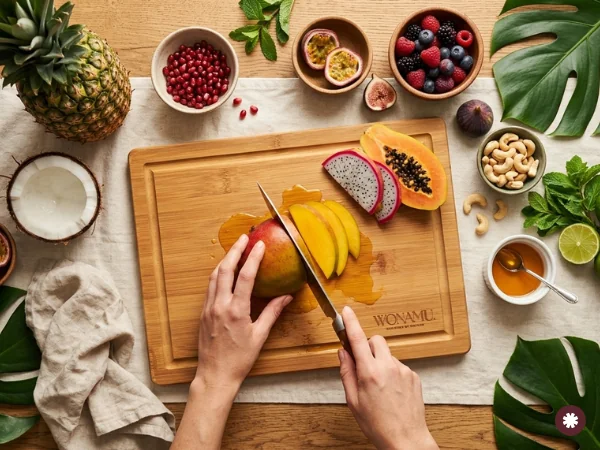
A steady, generous surface makes the rocking chop easier, since the pile has room to spread and the knife has room to fan. The WONAMU. bamboo cutting board is 12 by 9 inches, enough room for a half cup of pistachios to stay where you put them.
The short version
Work in small batches, keep the knife tip down and rock the blade with a flat palm on the spine, and sweep the pile back to the center as you go. Chop raw nuts, then toast them. Stop at rough, medium or fine depending on whether the nuts are a topping, a mix-in or a coating.
❋
WONAMU. makes a bamboo cutting board designed for daily prep, 12 × 9 inches, bamboo, with a perimeter juice groove. Available on Amazon.
Designed by nature.