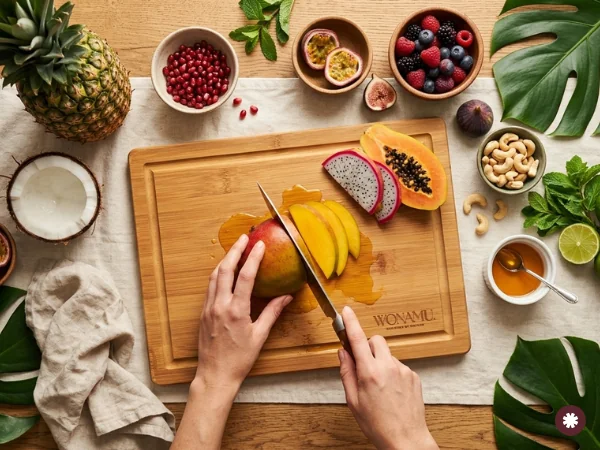
For mashed potatoes that are smooth all the way through, cut every potato into chunks of the same size, about 1½ inches, so the whole pot finishes cooking at the same moment. Peel and cut in batches, drop each batch into a pot of cold water as you go, then salt it and bring it all up to a simmer together. For a crowd, the cutting is most of the work, and doing it evenly is what saves the dish.
Mashed potatoes are the side that every Christmas table expects and nobody wants to run out of. Ten pounds of potatoes is a lot of knife work, and it is where the usual problems start: big chunks that stay hard in the center while small ones fall apart into water, and a mash that ends up both lumpy and gluey.
How many potatoes to buy
Plan on about half a pound of raw potatoes per guest, a little more if mashed potatoes are the main side or you want leftovers. For 20 people, that is 10 pounds.
Which potatoes. Wikipedia’s entry on mashed potato notes that most authors recommend floury potatoes for a fluffy result, and names the russet as the floury variety in North America. Potatoes USA’s consumer guide also calls russets ideal for light and fluffy mashed potatoes. Yellow potatoes such as Yukon Gold, which the same guide describes as smooth and buttery, give a richer mash, and mixing the two works well.
Buy potatoes of similar size. Matching potatoes means fewer awkward pieces and more chunks that come out the same.
Set up for volume
Ten pounds does not fit on any home cutting board at once, and it should not. Set up a line instead:
- A bowl or sheet pan of whole, scrubbed potatoes on the left
- The cutting board in the middle, a damp towel underneath so it cannot slide
- The stockpot of cold water on the right, close enough to slide chunks straight in
- A bowl for peels
Scrub the potatoes under running water first, as the FDA advises for all produce, even the ones you plan to peel. A sharp vegetable peeler is faster than a knife for peeling; a sharp chef’s knife does the cutting.
How to cut the potatoes
Peel, then halve lengthwise. Laying each half flat on its cut side gives you a stable potato that cannot roll.
Cut into long strips. Slice each half lengthwise into strips about 1½ inches wide. Small potatoes may need only one cut; large russets may need two or three.
Cross-cut into chunks. Turn the strips and cut across them every 1½ inches. The goal is chunks of roughly the same size, not exact cubes. A chunk that is twice as big as its neighbors will still be firm in the middle when the rest are ready.
Trim the tapered ends. The narrow ends of each potato make thin, small pieces that overcook. Cut them a little longer to match the others, or put them in the pot a few minutes later.
The reasoning on cut size and cooking time is the same as in potato salad: how big to cut the potatoes, only here the pieces are bigger because they are going to be mashed, not held whole.
Work in batches
Cut two or three potatoes, slide the chunks into the pot, clear the board and start again. A full board of chunks waiting to go in is how pieces end up on the floor.
The cold water does a second job. Wikipedia’s entry on enzymatic browning lists potatoes among the foods that brown once cut and notes that the reaction requires oxygen, so chunks that go straight under water stay pale while the rest of the batch is cut.
A WONAMU. bamboo cutting board is 12 × 9 inches, a good fit for this rhythm: room for one potato at a time and its chunks, with a perimeter juice groove that holds the starchy liquid from the cut potatoes.
Cook and mash
Once every chunk is in the pot, top up the cold water so it covers the potatoes by an inch and salt it well. Bring it to a boil, then lower to a steady simmer. Starting cold is one method, not the only one, and some cooks drop potatoes into water that is already boiling. The Irish Times, rounding up advice on mash, quotes Kelli Foster of The Kitchn, who prefers the cold start and warns that potatoes added to boiling water can end up overcooked on the outside while the inside stays firm and underdone.
Test a few chunks from different parts of the pot with a paring knife. When the knife slides in with no resistance, drain the potatoes well and let them steam in the colander for a minute or two.
Mash by hand. The same Irish Times piece quotes Martha Stewart’s advice never to use a food processor, because the sharp blades break down the potatoes’ starch granules and make them gluey, and adds that over-mashing by hand can do the same. Wikipedia notes that a ricer produces a uniform, lump-free mash. For 10 pounds, rice or mash in two or three batches, folding in warm milk and melted butter as you go, then season.
Keep it hot and safe
Mashed potatoes for a crowd often sit while the roast is carved. Keep them covered in a low oven, in a slow cooker on warm, or in a heatproof bowl set over a pot of barely simmering water. The CDC calls the range between 40°F and 140°F the danger zone, where bacteria can multiply rapidly, so the goal is to keep the potatoes hot rather than lukewarm.
On a buffet, the same rule applies: never leave the bowl out for more than 2 hours, or 1 hour above 90°F, as the CDC advises. Setting up the line so hot dishes stay hot is covered in how to set up a holiday buffet.
Leftovers and cleanup
Refrigerate leftovers within 2 hours, and reheat them to 165°F, the CDC’s figure for all leftovers, with a splash of milk to loosen them. Ideas for the days after are in what to do with Christmas leftovers.
Wash the board in hot, soapy water when the cutting is done, before the potato starch dries on it. Towel it dry and stand it on edge to finish drying.
The short version
Buy about half a pound of potatoes per guest. Scrub, peel, halve lengthwise, cut into 1½-inch strips, then cross-cut into even chunks.
Cut in batches and slide each batch into a pot of cold, salted water. Simmer until a knife slides through, drain, mash by hand or with a ricer, never in a food processor, and keep the pot hot until it is served.
❋
WONAMU. makes a bamboo cutting board, 12 × 9 inches, bamboo, with a perimeter juice groove, in gift-ready packaging with a cotton care cloth. Available on Amazon.
Designed by nature.