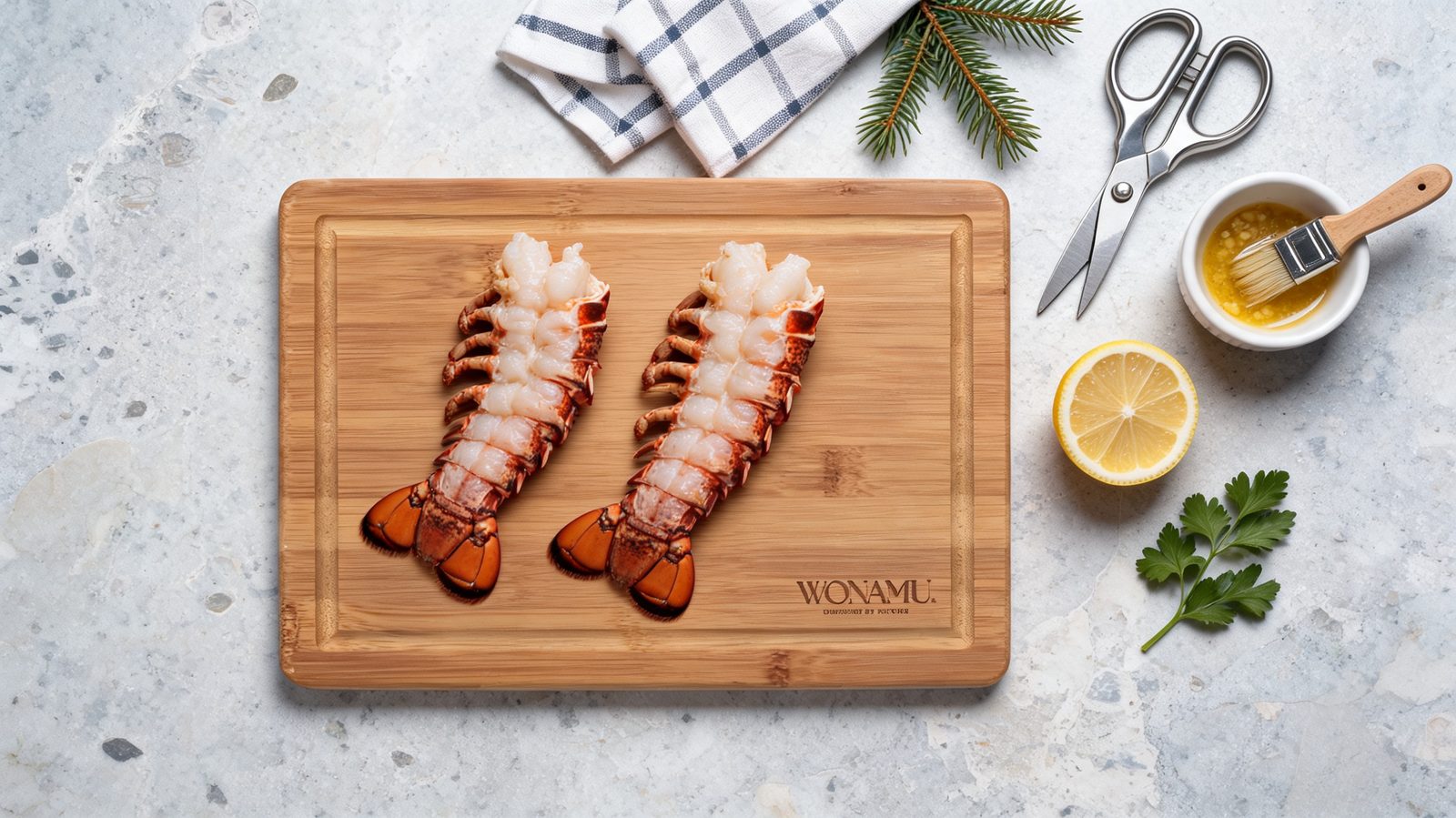
To butterfly a lobster tail, cut straight down the center of the top shell with kitchen shears, stopping at the tail fan. Spread the shell open, loosen the meat from the sides with your fingers while leaving it attached at the tail end, then lift it up and rest it on top of the closed shell. Brush it with butter and broil it until the meat is firm, pearly and opaque.
The lifted meat cooks evenly under the broiler, browns on top, and sits on its own shell like a small platter. It is the restaurant presentation, and it needs nothing more than a pair of shears and a paring knife.
What you need
- Lobster tails, one per person as a main course with sides, or one tail split between two as part of a larger seafood dinner. Tails of 5 to 8 ounces are the easiest to butterfly and broil evenly.
- Sturdy kitchen shears.
- A small paring knife.
- A board for raw seafood, a sheet pan and a bowl of melted butter.
When buying frozen tails, the FDA advises skipping packages that are open, torn or crushed on the edges, packages with frost or ice crystals, and anything that is not frozen hard. Thaw the tails in the refrigerator overnight, the gradual thaw the FDA recommends. A thawed tail is far easier to cut than a half-frozen one, and it cooks evenly.
Butterflying, step by step
Pat the tails dry and work one at a time.
- Position the tail. Lay it on the board with the hard, rounded top shell facing up and the tail fan pointing away from you.
- Cut the top shell. Slide the lower blade of the shears under the shell at the open end, right along the center line, and cut toward the fan. Keep the blade riding just under the shell and above the meat. Stop where the shell meets the fan; do not cut through it.
- Open the shell. Put both thumbs into the cut and push the two halves apart. They will crack a little at the sides, which is what you want.
- Loosen the meat. Slide a finger between the meat and the shell on each side, working down the length of the tail. Leave the meat attached at the fan end.
- Lift it out. Raise the whole piece of meat up through the opening. Press the empty shell halves back together underneath it.
- Set it on top. Lay the meat on the closed shell, still joined at the tail end.
- Finish with the knife. Make a shallow cut down the center of the meat with the paring knife, about a quarter inch deep, and spread it slightly so it fans. If there is a dark vein, lift it out with the knife tip.
The shell keeps the meat off the pan and the fan keeps it anchored, so the tail holds its shape as it cooks.
Keeping the board safe
Lobster tails are raw shellfish, and raw seafood gets its own board. The FDA advises one cutting board for fresh produce and a separate one for raw meat, poultry and seafood. With only one board, mince the garlic and chop the parsley for the butter first, set them aside, and then butterfly the tails.
Shell cutting releases a fair amount of liquid. A WONAMU. bamboo cutting board, 12 by 9 inches with a perimeter juice groove, holds it on the board while you work through the tails.
When you finish, wash the board, shears and knife with soap and hot water. For added protection, sanitize the board with 1 tablespoon of unscented liquid chlorine bleach per gallon of water, let it stand for several minutes, then rinse and dry it. Wash your hands for at least 20 seconds with soap and warm water. More on wood, bamboo and raw seafood is in can you use a wooden cutting board for raw fish.
Garlic butter
For four tails, melt 4 tablespoons of butter with 2 cloves of garlic, minced fine, and add ½ teaspoon of paprika, a pinch of salt, the zest of half a lemon and a tablespoon of chopped flat-leaf parsley. Mince the garlic fine so it spreads evenly in the butter; how to mince garlic covers the knife work, and how to chop fresh herbs the parsley.
Broiling
- Heat the broiler with a rack about 6 inches below the element.
- Set the tails on a sheet pan and brush the meat generously with the garlic butter.
- Broil until the meat is firm, pearly and opaque all the way through and lightly browned on top. For 6- to 8-ounce tails, start checking at 7 minutes; larger tails take longer. Baste once halfway through.
- Check the thickest part with an instant-read thermometer. The FDA’s guidance is that most seafood should be cooked to an internal temperature of 145°F.
If the tops brown before the centers are done, move the rack down a notch and finish the cooking there.
Serving
Move the tails to warm plates or a platter with a spoonful of the pan butter over each. Add lemon wedges and a little more parsley.
Lobster tails fit into a larger Christmas Eve seafood dinner or stand alone with a baked potato and greens. For pacing a holiday meal so the last-minute dishes are few, how to host Christmas dinner for the first time has a timeline.
Cooked seafood should not sit out for more than 2 hours, or 1 hour when the temperature is above 90°F. Leftover lobster goes into the refrigerator within that window, at 40°F or below. Reheat it to 165°F, or eat it cold, chopped into a salad with celery, lemon and mayonnaise.
The short version
Thaw the tails overnight in the refrigerator. Cut down the center of the top shell with shears, stop at the fan, spread the shell, loosen the meat and lift it onto the closed shell.
Use a separate board for the raw tails or prep the garlic and parsley first, then wash and sanitize. Brush with garlic butter and broil 6 inches from the heat until the meat is firm, pearly and opaque, and 145°F in the thickest part.
❋
WONAMU. makes a bamboo cutting board designed for daily prep, 12 × 9 inches, bamboo, with a perimeter juice groove. Available on Amazon.
Designed by nature.