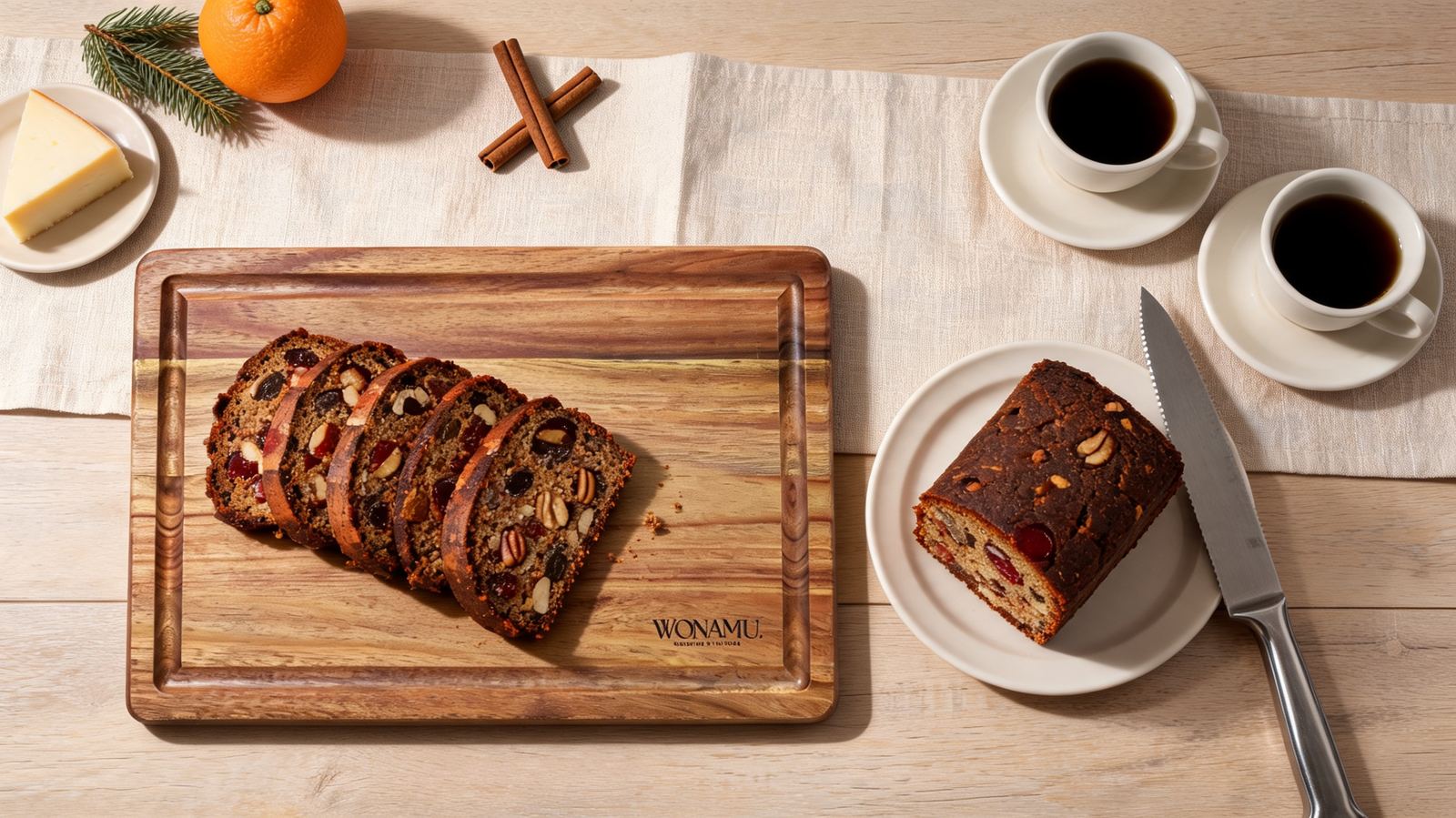
To slice fruitcake thin, chill it until firm, set it on a steady board, and cut with a long, thin serrated knife using light sawing strokes instead of pressing down. Wipe the blade every few slices and aim for about 1/4 inch. A dense cake full of fruit and nuts holds together well at that thickness, and a thin slice is the right amount of something this rich.
Thick, crumbling wedges are what give fruitcake its reputation. Thin, clean slices on a board are what change minds at the table.
Why fruitcake falls apart under the knife
Fruitcake is mostly fruit and nuts with a little batter holding them together. Wikipedia’s entry defines it as a cake made with candied or dried fruit, nuts and spices, optionally soaked in spirits. There is not much crumb to support each slice, and the pieces inside are heavier and harder than the cake around them.
When a knife presses down, it shoves those heavy pieces through the crumb, and a whole pecan or a cherry catches the blade and tears the slice open. A thin serrated bread knife, drawn gently back and forth, separates a slice instead. Pushing straight down drives the mix-ins toward the bottom and breaks the slice apart.
The fix is a firm cake, a steady surface and a stroke that cuts instead of crushes.
Set up: a cold cake, a steady board, the right knife
Chill the cake. Leave it wrapped and refrigerate it for a few hours, or overnight. A cold cake is firmer, and a firm cake slices thinner without the edges breaking. If it was wrapped in a spirit-soaked cloth, unwrap it on the board so any drips stay there.
Steady the board. Lay a damp towel or a sheet of damp paper towel under the board so it cannot slide. A board that shifts mid-stroke is how slices tear and fingers get cut.
Check the size. A loaf fruitcake fits on a 12 × 9 inch board with room to lay slices beside it. A large ring or round cake does not; cut it on a platter or cake stand and move the pieces to the board as you go.
Choose the knife. A serrated bread knife longer than the cake is wide does the most work for the least pressure. The teeth cut through candied fruit and nuts without needing force. Why a bread knife works on a board, and how to saw so the teeth cut the food and not the board, is covered in can you use a serrated bread knife on a bamboo board.
The cut, step by step
- Trim the end. If the outside is dry or hard, take a thin slice off the end first. That piece is the cook’s share.
- Hold the cake lightly. Curl your fingertips and rest them on top of the loaf, about an inch back from the cut. The grip is the same claw used for vegetables, explained in knife grips: the pinch and the claw.
- Start the stroke with the blade level. Set the knife about 1/4 inch from the end and draw it back toward you in a long, light stroke, then forward again. Let the teeth do the cutting.
- Keep the blade upright. A knife that leans makes a slice that is thick at the bottom and paper-thin at the top, and the thin edge breaks.
- Finish through the base. When the knife reaches the bottom, finish with one more full stroke. Do not lever the slice off; that is when the base cracks.
- Wipe the blade. Candied fruit leaves a sticky film on the teeth. Wipe the knife with a damp cloth, then a dry one, every two or three slices.
Lay each slice flat on the board as it comes off. Stacked slices stick together.
For a cheese or dessert board, cut slices a little thinner still, close to 1/8 inch, and halve each one into two fingers. Small rectangles hold together better than a full thin slice and are easier to pick up.
Thin pieces from a round cake
A round fruitcake is usually served in wedges, and a thin wedge breaks at the point. For thin pieces, cut differently.
Cut a straight band about 1 1/2 inches wide across the cake. Lay the band on its side on the board, so it looks like a short loaf, and slice it crosswise into thin pieces with the same sawing stroke. Every piece comes out the same size and none has a fragile tip.
Serving thin slices
Fan the slices on a board in an overlapping row, with the cut faces showing; the fruit and nuts are the decoration. Fruitcake’s entry on Wikipedia notes that it is often served with cheese in Yorkshire and eaten with butter or custard in Australia, and a sharp cheddar beside thin slices is an easy way to bring it into a holiday spread. How to slice cheese for a board covers the cheese side.
A WONAMU. acacia cutting board works as both the slicing surface and the serving board here. At 12 × 9 inches it holds a loaf and a row of slices, and its perimeter juice groove gathers the crumbs and sticky drips that thin slicing leaves behind.
Coffee, tea or a small glass of something sweet sits well beside it. Cut only what will be eaten; the uncut cake keeps far better than slices do.
Storing the rest
Press plastic wrap or beeswax wrap directly against the cut face, then wrap the whole cake again. The cut face is where it dries out.
Spirit-soaked fruitcakes keep a long time. Wikipedia’s entry says that wrapping the cake in alcohol-soaked linen is one way to lengthen its shelf life, and that a fruitcake with a good deal of alcohol can be preserved for many years; it mentions one baked in 1878 that a family in Tecumseh, Michigan, has kept as an heirloom. For eating, follow your recipe’s storage advice or the instructions that came with a bakery cake.
When you are done, scrape crumbs off the board, wash it with warm water and dish soap, towel it dry and stand it on its edge. Sugar left on wood turns tacky by morning.
The short version
Chill the fruitcake, steady the board with a damp towel, and use a thin serrated knife longer than the cake is wide. Saw with long, light strokes, keep the blade upright, and wipe it every few slices. Aim for 1/4 inch, or thinner fingers for a cheese board. Wrap the cut face tightly and slice only what you will serve.
❋
WONAMU. makes an acacia cutting board designed for daily prep, 12 × 9 inches, acacia, with a perimeter juice groove. Available on Amazon.
Designed by nature.

