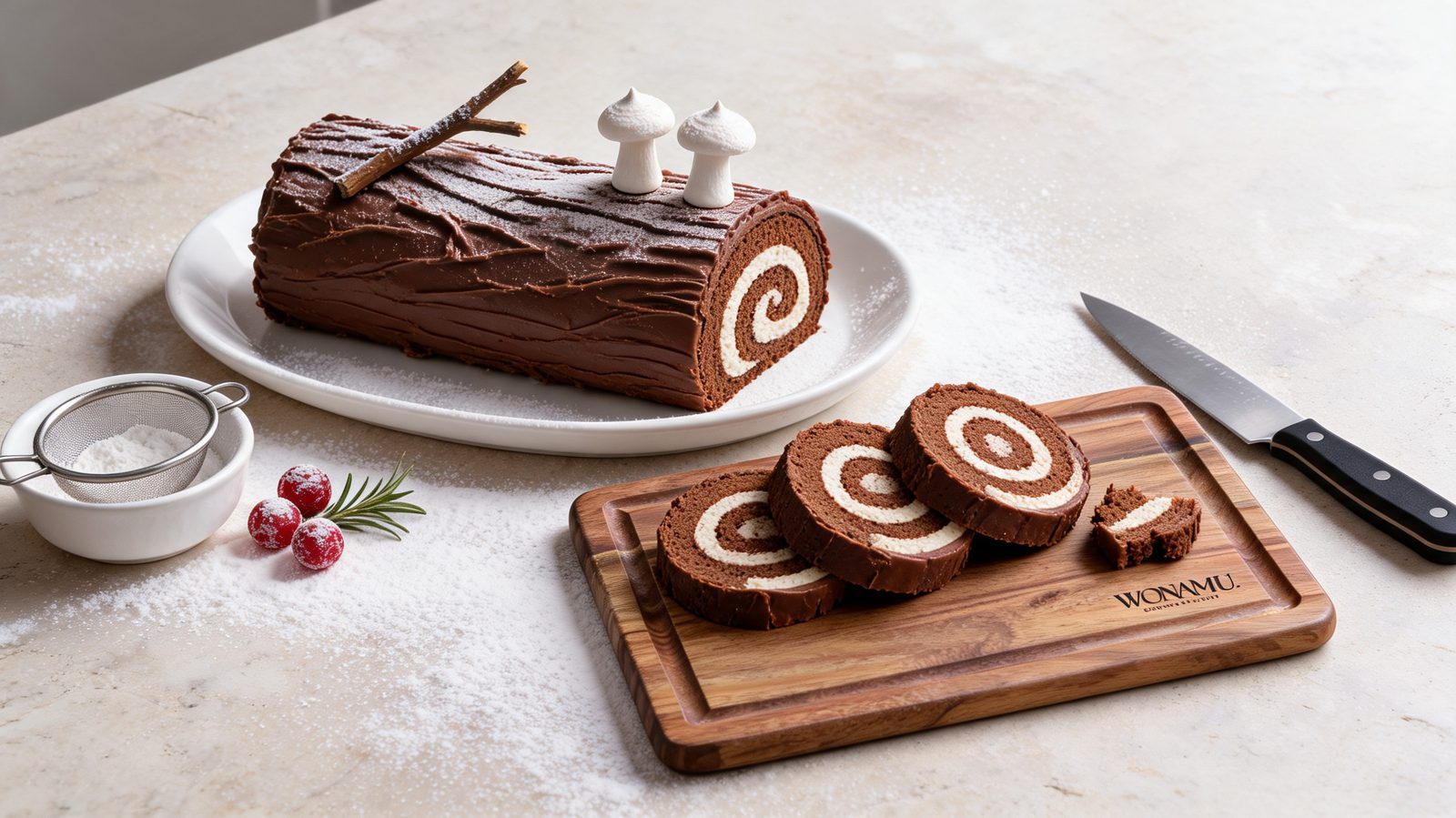
A yule log cake rolls without cracking when the sponge is rolled up while still warm from the oven, unfilled, and left to cool in that shape. Unroll it, spread a thin layer of filling, roll it back up with a tight first turn, and chill it before you frost. To slice it, trim the ends with a hot, dry knife to show the spiral, then cut slow, even slices, cleaning the blade between each one.
The cake looks complicated and is not. It is a thin sheet of sponge, a filling and a frosting, and almost every problem comes from two moments: the first roll and the first slice.
What a bûche de Noël is
Wikipedia describes the bûche de Noël, or Yule log, as a traditional Christmas cake, a form of sweet roulade, often served as a dessert especially in France, Belgium, Luxembourg, Switzerland, Lebanon, Vietnam and Quebec. It notes that the name originally referred to the Yule log itself, a log burned on a hearth as a winter tradition in regions of Europe, and passed to the dessert after that custom had fallen out of popular use.
The classic version, the article says, is a génoise baked in a shallow pan, rolled and iced, most often with a yellow sponge and chocolate buttercream. The decorations are part of the point: the ends cut off and set on top of the log or against its side like a broken branch, a bark texture dragged into the icing with a fork, powdered sugar for snow, and mushrooms made of meringue or marzipan.
Choose a sponge that bends
The sponge is what cracks, so start with one that wants to roll. King Arthur Baking recommends a chiffon-style cake for a bûche, because it tends to have a lot of oil and be more moist, so it is less likely to crack when you roll it.
Use the exact pan size the recipe calls for, as King Arthur’s guide insists; a smaller pan gives a thicker sheet than the recipe intended. King Arthur’s chocolate bûche recipe bakes its sponge in a 13 by 18 inch half-sheet pan at 350°F for 10 to 12 minutes, until it springs back when lightly touched.
Do not overbake. Take the cake out the moment it springs back; the recipe’s cue matters more than the clock.
Roll it warm, before it is filled
This is the step that prevents cracks. King Arthur Baking’s guide says to roll the cake up, unfilled, while it is still warm from the oven and at its most pliable.
- Prepare a landing surface. Lay out a clean tea towel dusted with confectioners’ sugar, or a sheet of parchment. A warm cake turned out onto a bare counter sticks.
- Turn the cake out a minute or two after it leaves the oven, and peel off the baking parchment.
- Roll it up in the towel from one end, loosely. King Arthur’s easy bûche de Noël rolls from a short end, which gives a shorter, thicker log.
- Let it cool completely in the roll. The sponge sets in a curve and will remember it.
Not every sponge is rolled this way. If your recipe gives a different method for rolling, follow it.
Fill thin, roll tight, then loose
Unroll the cooled cake gently. It will keep a curl, which is what you want.
Spread the filling in an even layer, stopping about an inch short of the far edge so it does not squeeze out. King Arthur’s guide gives the measure: the filling should be slightly less deep than the cake is tall. Whipped cream needs a stabilizer, such as confectioners’ sugar, to hold its shape inside the roll.
Then roll it back up. The same guide is specific: make the very first curl, the center of the spiral, tight, and after that roll loosely and let the weight of the cake guide itself. Too much filling, pressed by a tight roll, squeezes out of the sides and strains the sponge.
Wrap the log and chill it. King Arthur’s chocolate bûche chills the rolled log for at least 30 minutes, and up to 8 hours well wrapped. A cold log frosts cleanly and slices cleanly.
Trim the ends and make the branches
This is where the board comes in. A full log rolled from a half-sheet sponge is longer than a 12-inch board, so the whole cake goes on a long platter, and the trimming and slicing happen on the board beside it.
Following King Arthur’s chocolate bûche, use a hot, dry knife to trim a thin slice off both ends of the log to reveal a clean spiral. Then cut two pieces about 3 inches long from the log, slicing on a sharp diagonal. These are the branches. Set one against the side of the log and one on top, fixed in place with a little frosting.
The WONAMU. acacia cutting board is 12 × 9 inches, a good size for the trimmed ends and the branch pieces, and its perimeter juice groove keeps crumbs and smears of cream from reaching the counter.
Frost and decorate
Spread the frosting over the log and the branches in a thin layer, then comb through it with a fork to make it look like bark. King Arthur’s guide notes that a thinner layer gives neater, more distinct lines. Dust with powdered sugar for snow, and add meringue mushrooms or a few sugared cranberries if you like.
Slice it cleanly
Slicing is the second place a yule log comes apart. The fix is heat and patience.
- Chill before slicing. A cold log holds its spiral.
- Warm the knife. King Arthur’s recipe has you let a sharp chef’s knife rest in a container of hot water, then dry it and slice slowly.
- Cut straight down, slowly. Let the blade melt through the frosting before it reaches the sponge. Do not saw.
- Wipe, rewarm and dry the blade between slices. King Arthur’s guide says the knife should be cleaned between each cut for a clean slice.
- Move each slice with the flat of the knife onto the board or a plate, cut side up, so the spiral shows.
Slices about an inch thick hold together and show the spiral. For other cakes and pies on the holiday table, how to cut pie into even slices uses the same hot-water-and-towel routine for the knife.
Keep it cold
Whipped cream, buttercream and ganache fillings are dairy, and dairy is perishable. The CDC advises never leaving perishable food out for more than 2 hours, or 1 hour above 90°F, and keeping the refrigerator at 40°F or below. Bring the log out for the table, slice what will be eaten, and return the rest to the refrigerator. For planning where dessert fits in the evening, see how to host Christmas dinner for the first time.
The short version
Bake a moist, oil-based sponge in the pan size the recipe names, and roll it up unfilled in a sugared towel while it is still warm. Let it cool rolled.
Fill it thinner than the cake is tall, roll the first turn tight and the rest loose, and chill it. Trim the ends with a hot, dry knife, cut the branches on a diagonal, and frost thin.
Slice it cold with a warm, dry knife, cleaning the blade every time, and put leftovers back in the refrigerator within two hours.
❋
WONAMU. makes an acacia cutting board designed for daily prep, 12 × 9 inches, acacia, with a perimeter juice groove. Available on Amazon.
Designed by nature.

