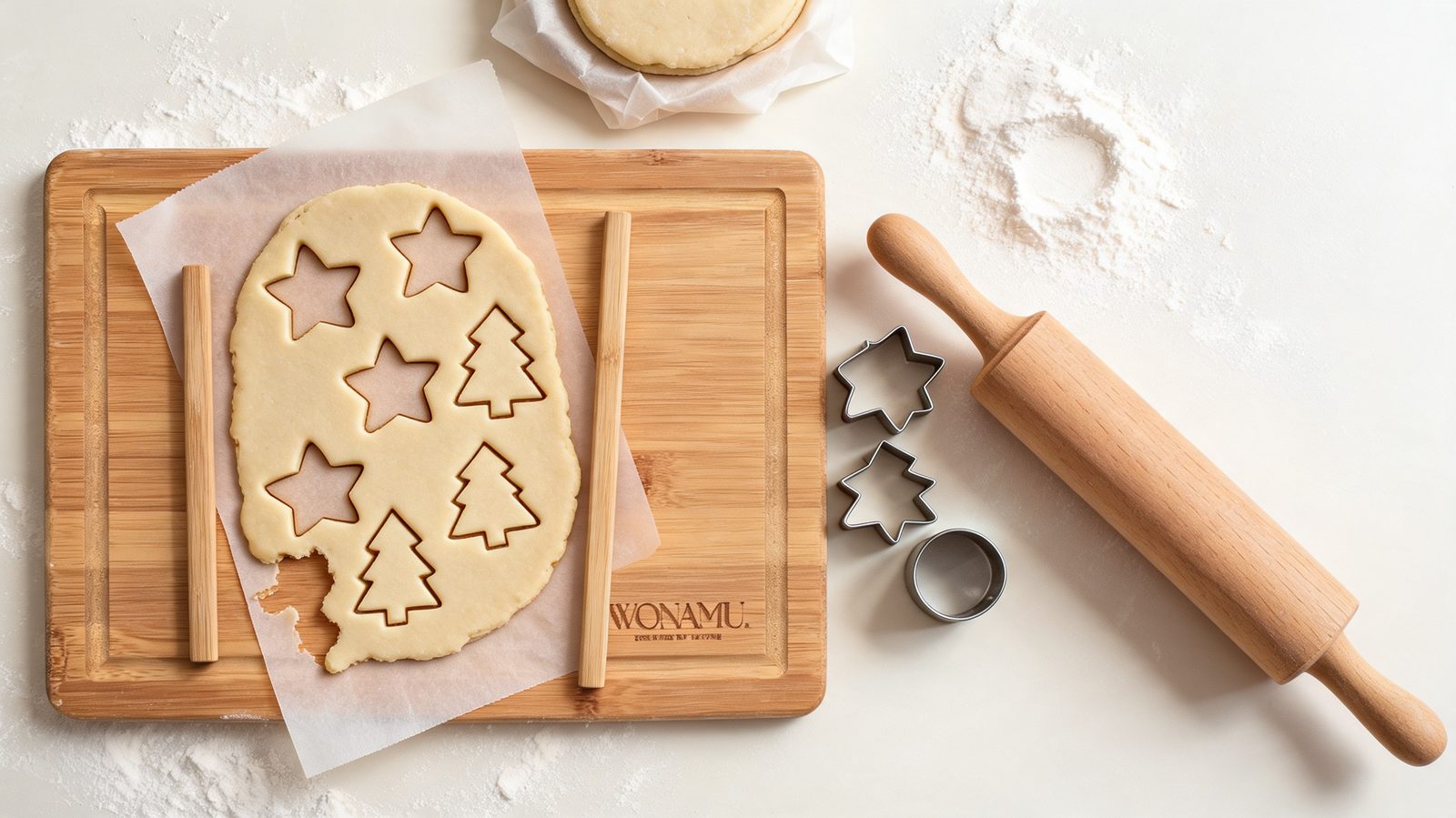
To roll cut-out sugar cookies to an even thickness, chill the dough, roll it between two sheets of parchment with a guide on each side of the rolling pin, and stop when the pin rides on the guides. For most cut-out cookies that thickness is about 1/4 inch. Then chill or freeze the rolled sheet before you cut, so the shapes come out clean and stay the thickness you rolled them.
Even thickness is the whole game with cut-out cookies. A sheet that is 1/4 inch on one side and 1/8 inch on the other gives you cookies that brown at the thin edge while the thick edge is still pale, on the same tray, in the same minutes. Decorating makes it worse: icing flows off a sloped cookie and pools at the low side.
Why rolling by eye drifts
A rolling pin pushed by hand presses harder wherever you lean. Lean a little more at the end of each stroke and the far side of the sheet thins while the near side stays thick. The edges are the other weak spot, because the pin rolls off them on every pass.
There are two ways to fix this: give the pin something to ride on, or check the thickness as you go. The first is easier and more reliable.
Tools that set the thickness for you
- Rolling pin rings. Rubber or silicone rings slip onto both ends of a straight rolling pin and lift it a fixed height off the surface. When the dough is down to that height, the pin stops pressing.
- Guide strips. Two strips of wood or metal of the same thickness, laid parallel on either side of the dough. The pin rolls across both strips; the dough between them can only get as thin as the strips are thick. A pair of 1/4-inch hardwood strips from a hardware store does the job.
- A ruler. Without guides, slide a clean ruler against the edge of the sheet in four or five places. It is slower, but it shows you where the dough is thick.
A straight pin without handles puts your hands directly over the dough, which makes the pressure easier to feel and to keep level.
The method, step by step
1. Chill the dough first. Divide the dough into two flat discs, wrap them and refrigerate. King Arthur Baking’s roll-out sugar cookie recipe calls for at least 2 hours, or overnight. Cold dough rolls without sticking and needs less flour.
2. Roll between parchment. Lay one disc on a sheet of parchment, cover it with a second sheet and roll through the top sheet. Parchment keeps the dough off the pin and the surface, so you need almost no extra flour, and none of it gets worked into the dough. It also lets you lift the whole sheet without stretching it.
3. Roll from the center out. Start each stroke in the middle and roll toward the edge, then turn the parchment a quarter turn and repeat. Turning the sheet rather than changing your stance keeps the pressure the same on every side. Stop when the pin rests on the guides all the way across.
4. Peel and smooth. Halfway through, peel the top parchment off and lay it back down. This releases creases that would otherwise press lines into the dough.
5. Chill the rolled sheet. King Arthur Baking’s method for cut-outs that hold their shape is to peel off the top parchment, slide the rolled dough on its bottom sheet onto a baking sheet and freeze it. Several sheets can be stacked on one pan. When you are ready to cut, let the dough stand at room temperature for about five minutes. The article notes that chilled dough cuts more cleanly, holds its shape, does not stick, and is less likely to spread in the oven.
Frozen, the sheet cannot be squashed thinner in one corner when you press a cutter into it, which is the other way cookies end up uneven.
Cut close, and lift the scraps, not the cookies
Dip the cutter in flour, press straight down, and do not twist; twisting drags the edge and pinches the dough thinner at one side. Cut the shapes as close together as you can.
Then pull the scraps away from around the shapes and leave the cookies where they are, a method King Arthur Baking recommends for gingerbread pieces so that the shapes do not distort. Slide the parchment, cookies and all, onto the baking sheet.
Gather the scraps into a flat disc, chill it, and roll again between the same guides, so the second round of cookies matches the first.
Bake by size
Put cookies of the same size and thickness on the same tray. A tray of large trees and tiny stars will overbake the stars before the trees are done, however evenly you rolled.
King Arthur Baking’s roll-out sugar cookie recipe bakes at 325°F for about 10 to 12 minutes, until the edges barely start to turn golden and the centers no longer look moist. Let the cookies cool completely before you decorate them. If you are using a different recipe, follow its oven setting and watch the first tray as a test.
Rolling on a cutting board
A clean, dry cutting board under the parchment gives you a flat, steady surface that moves to the refrigerator with the dough on it. The full method for rolling on wood, including how to keep the board from sliding, is in can you roll cookie dough on a wooden cutting board and why your cutting board slides.
Size the dough to the board. A WONAMU. bamboo cutting board is 12 × 9 inches, a comfortable size for a small portion of dough rolled to 1/4 inch, and it fits on a refrigerator shelf. It is a work surface for small batches, not a replacement for a full pastry board; for a large batch, roll several smaller sheets and stack them, parchment between, on a baking sheet in the freezer.
Raw dough is raw food
Taste the cookies, not the dough. The FDA advises never eating or tasting raw flour, dough or batter, because flour is a raw food and processing grain into flour does not kill harmful bacteria. Cooking is the only way to make it safe.
The same page advises washing hands, utensils, bowls, baking pans, cutting boards and countertops with warm, soapy water after handling raw flour or dough. Scrape the board with a dry bench scraper first, brush the loose flour into the trash, then wash, rinse and dry it on its edge. If you are baking for a swap, how to host a cookie exchange has the rest of the plan.
The short version
Chill the dough, then roll it between parchment with a guide on each side of the pin, from the center out, turning the sheet as you go. Stop at 1/4 inch, when the pin rides on the guides. Freeze or chill the rolled sheet, cut without twisting, pull the scraps away from the shapes, and bake cookies of one size together on one tray.
❋
WONAMU. makes a bamboo cutting board designed for daily prep, 12 × 9 inches, bamboo, with a perimeter juice groove. Available on Amazon.
Designed by nature.

