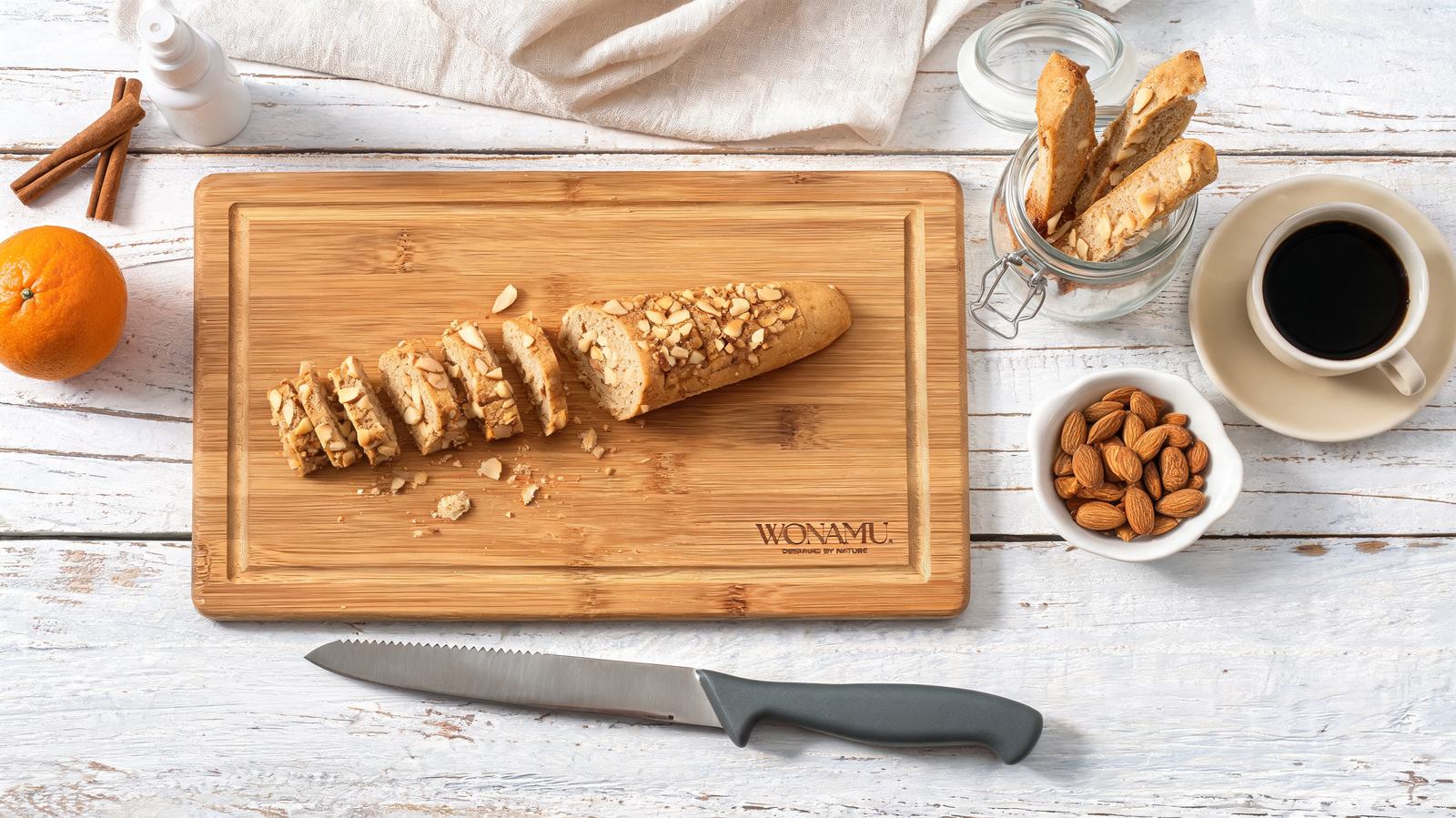
To slice biscotti without crumbling, let the log cool after its first bake, mist the crust lightly with water, wait about five minutes, and cut with a serrated knife using a back-and-forth sawing stroke instead of pressing down. Keep every cut straight up and down, 1/2 to 3/4 inch thick, then bake the slices again. Most crumbling happens in those few minutes between the two bakes, so that is where the care goes.
The second bake is forgiving. The slicing is not. A shattered log turns a tray of cookies into a bag of crumbs.
Why biscotti crumble at the knife
Biscotti are made to be cut halfway through baking. Wikipedia’s entry traces the name to the Medieval Latin biscoctus, “twice-cooked,” and gives their origin as Prato, in Tuscany; in Italy they are also called cantucci. A barely moist dough is baked once as a slab, cut into slices and baked again; the second baking decides how hard they become.
That leaves the cook slicing something with a crisp shell and a tender middle. Press down on it and the shell cracks before the blade reaches the soft center, and the crack runs through the slice. Whole nuts make it worse: the knife meets an almond, stops, and the extra pressure splits the cookie around it.
Three things prevent it: a slightly softened crust, a sawing stroke and nuts that are not too large.
Before the first bake
Chop the nuts. Almonds are traditional, and halves or rough chunks slice far more cleanly than whole nuts. How to chop nuts covers doing it on a board without sending pieces across the counter.
Shape low, even logs. Divide the dough and shape each piece into a log about 2 inches wide and 3/4 to 1 inch high, with straight sides and a flat top. A log of even height bakes evenly and slices evenly. Wet or lightly floured hands keep the sticky dough manageable.
A 12 × 9 board is a comfortable size for shaping one log at a time before moving it to the baking sheet. It is a small-batch surface, not a replacement for a pastry board or a clear counter.
Do not taste the dough. The FDA is plain about it: flour is a raw food, processing grain into flour does not kill harmful bacteria, and raw flour, dough and batter should never be eaten or tasted. Wash the board, utensils and your hands with warm, soapy water after shaping.
The pause between bakes
This is the step that decides the result. King Arthur’s vanilla biscotti recipe bakes the logs at 350°F for 20 to 30 minutes, until golden brown, then lets them cool for 25 to 30 minutes before slicing. Too hot, and the center is still soft and smears. Left too long, and the whole log hardens and shatters.
Then soften the crust. King Arthur has you lightly mist the baked logs with room-temperature water from a spray bottle, sides included, and wait five minutes. Its American-style recipe explains why: softening the crust a little makes slicing much easier.
A spray bottle used only for cooking is worth keeping in a drawer for this alone.
The cut
- Move the log to the board. Slide a wide spatula or two underneath and lift it whole onto a cutting board. A board gives the knife a flat, firm surface; the baking sheet’s rim gets in the way.
- Steady it. Rest the fingertips of your other hand lightly on top, curled back from the blade. Do not squeeze the sides.
- Choose the angle. Cut straight across for short, squat biscotti, or on a diagonal for the longer, classic shape. Either works.
- Saw, do not press. Draw the serrated knife back and forth through the log instead of pressing down, which is King Arthur’s advice for keeping crumbling to a minimum. Long, light strokes, with the teeth doing the work.
- Keep the blade vertical. Whatever angle you cut across the log, the blade should go straight down into the board. King Arthur’s American-style recipe warns that slices thicker on top than on the bottom topple over during the second bake.
- Go 1/2 to 3/4 inch. Thinner slices break; thicker ones stay soft in the middle.
When the knife meets a nut, keep sawing gently. Forcing it is what splits the slice. The two ends will be ragged no matter what; they are the baker’s share.
A bamboo board suits this job: the surface is firm enough to cut against, and it yields slightly under the blade, unlike glass or stone. The WONAMU. bamboo cutting board is 12 × 9 inches, long enough for one log at a time, and its perimeter juice groove holds the crumbs and nut fragments instead of letting them scatter onto the counter. For more on sawing with a bread knife on bamboo, see can you use a serrated bread knife on a bamboo board.
The second bake and after
Stand the slices upright on the baking sheet, a little apart, or lay them cut side down. King Arthur’s American-style recipe lowers the oven to 325°F and bakes them on edge for 25 to 30 minutes, until they feel very dry and are beginning to turn golden. Cool them on a rack.
Stored airtight at room temperature, King Arthur says, they stay good for weeks. That makes biscotti one of the most useful holiday bakes to make ahead, and one of the best for trading; how to host a cookie exchange has the logistics.
Wikipedia’s entry notes that biscotti are traditionally dunked in a drink, typically Vin Santo, a Tuscan dessert wine. Coffee or tea on a slow December morning does the same job.
Scrape the crumbs off the board with a dry bench scraper, then wash it with warm, soapy water, dry it with a towel and stand it on its edge.
The short version
Chop the nuts, shape low, even logs and bake them once. Cool the logs, mist the crust with water and wait five minutes. Lift each log onto a board and saw it with a serrated knife, never pressing, with the blade straight up and down, 1/2 to 3/4 inch thick. Bake the slices again until dry, cool, and store airtight.
❋
WONAMU. makes a bamboo cutting board designed for daily prep, 12 × 9 inches, bamboo, with a perimeter juice groove. Available on Amazon.
Designed by nature.

