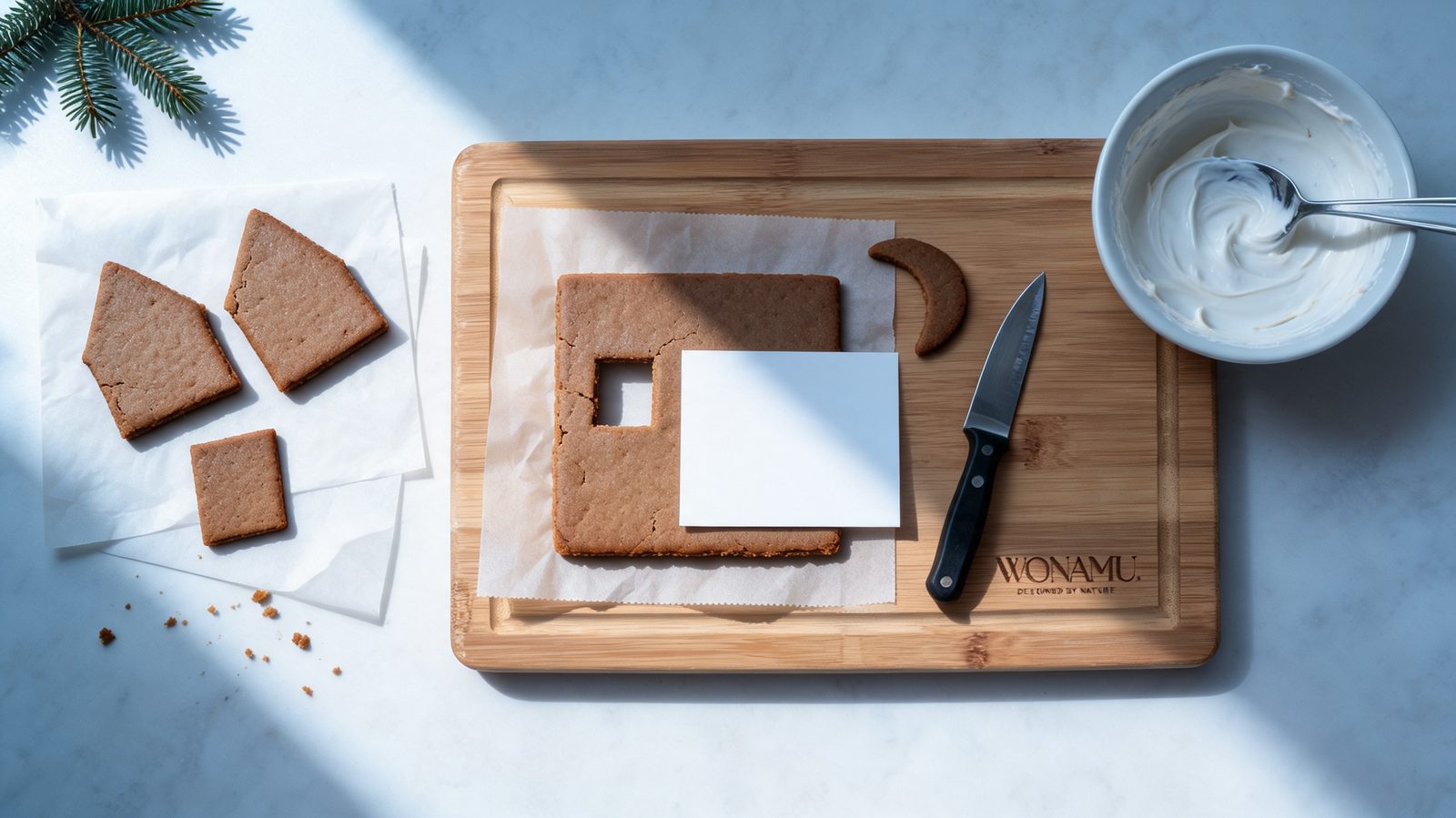
Clean gingerbread house panels come from cutting twice. Cut the raw dough around card templates directly on the parchment you will bake on, pull the scraps away instead of moving the pieces, and bake. Then, while the panels are still warm from the oven, lay the templates back on top and trim the edges again with a sharp knife.
Warm gingerbread cuts cleanly. Cold gingerbread chips and cracks.
When a house will not stand, look first at the walls. Dough can spread a little in the oven, corners round off, and two walls that matched as raw dough come out slightly different. The second cut, made while the panels are warm, is what makes them fit.
Make templates you can trust
Draw every piece on light cardstock, a cereal box is ideal, and cut it out with scissors and a ruler. King Arthur Baking’s gingerbread house guide suggests exactly this kind of cardstock template. Label each one: front, back, side, side, roof, roof.
Before you touch the dough, tape the templates together into a paper house. If the paper walls do not meet, the gingerbread walls will not either, and it is far easier to fix a template than a baked panel.
Choose a dough that holds
Gingerbread for houses and gingerbread for eating are not quite the same thing. King Arthur Baking suggests a softer roll-out cookie for a house that will be eaten soon, and a firmer construction dough for a house meant to stand on display. Its construction gingerbread recipe says that dough is “not really designed to be eaten,” though the recipe’s introduction calls it edible.
Thickness matters as much as the recipe. The house guide recommends rolling the dough at least 1/4 inch thick for strong walls, while the firmer construction gingerbread is rolled to 1/8 inch. Whichever you use, roll it to one even thickness across the sheet; a wall that is thick at one end will not stand straight.
First cut: raw dough on parchment
Roll the dough out on lightly floured parchment, the same sheet it will bake on, so the pieces never have to be lifted.
- Lay the templates on the dough about an inch apart, the spacing the King Arthur guide uses.
- Cut with the tip of a sharp paring knife held upright. A vertical blade gives a square edge; a slanted blade gives a bevel that will not sit flush against the next wall. Draw the knife along the template in one steady stroke per side.
- Cut windows and doors now. Openings are much easier in raw dough than in baked panels. Keep the door piece and bake it alongside the walls.
- Lift the scraps, not the pieces. Peel the dough away from around each template and leave the cut panels where they are. Moving a raw panel stretches it out of shape.
- Slide the parchment onto the baking sheet. Gather the scraps for another sheet.
Bake until firm, not puffy
The King Arthur guide bakes one pan at a time in the center of the oven at 325°F, a lower heat for a longer bake that gives a firmly set, evenly colored panel; its construction recipe uses 350°F for 10 to 12 minutes. Whatever the recipe, bake a small test piece first, because time depends on size and thickness.
Panels should feel firm, not puffy, when they come out, and be completely stiff once cool. The guide warns that underbaked pieces can warp and bring the house down; if they are still soft after cooling, return them to the oven to dry further.
Second cut: trim while warm
This is the step that matters most. As soon as the pan comes out, slide the parchment, panels and all, onto a large cutting board, or cut the parchment between the pieces and move each panel on its own square. Lay each template back on its panel and trim away whatever has spread past the edge, working fast while the gingerbread is still warm and yielding. King Arthur Baking gives the reason: some doughs rise and spread in the oven, so the baked pieces must be checked against the pattern.
Use a long, sharp knife, keep the blade upright so the edge stays square, and let the template guide it. Trim the bottom edge of every wall with particular care. That is the edge the house stands on, and a straight one does more for a steady house than any amount of icing.
A sharp edge makes this work. A dull knife drags and tears warm gingerbread; how to sharpen a knife at home covers the routine.
The board is the natural place for this step. A WONAMU. bamboo cutting board is 12 × 9 inches, a size for trimming the panels of a small house one at a time, each on its own square of parchment, and its perimeter juice groove keeps crumbs and trimmings from sliding off onto the counter. Panels too large for the board, or a full sheet of them, can be trimmed on the parchment on the sheet pan itself.
Let all the pieces cool completely, flat, before you build.
If a cooled panel is still slightly off
Small errors can still be corrected cold. Rub the edge gently against a fine grater, held flat, to take off a sliver at a time, and check against the template after each pass. Do not try to cut a cold panel with a knife; it is more likely to snap than to trim.
Royal icing is the glue
Royal icing sets hard and holds the walls together. King Arthur Baking’s royal icing recipe uses meringue powder, with a variation made from a pasteurized egg white. Raw egg whites from ordinary shell eggs do not belong in an icing that is never cooked: for recipes with eggs that are raw or undercooked when served, the FDA advises shell eggs treated to destroy Salmonella, by pasteurization or another approved method, or pasteurized egg products.
For building, beat the icing until it is stiff and glossy and holds a tall peak, and keep the bowl tightly covered between uses, because it hardens as it dries. Pipe a thick line along the base and up the corner where two walls meet, hold them, and support them until they stand on their own. Let the walls set before adding the roof. With royal icing, the King Arthur guide says the walls and then the roof each need only a few minutes of support, but the icing should set fully, which can take a few hours or overnight, before you decorate.
The short version
Make cardstock templates and test them as a paper house first. Roll the dough to one even thickness on parchment, cut with an upright knife, pull the scraps away from the panels, and bake until firm.
Then trim each panel against its template on a cutting board while it is still warm. Glue the house with stiff royal icing made from meringue powder or pasteurized egg white, and give it time to set. For more holiday dough work, see can you roll cookie dough on a wooden cutting board.
❋
WONAMU. makes a bamboo cutting board designed for daily prep, 12 × 9 inches, bamboo, with a perimeter juice groove. Available on Amazon.
Designed by nature.

