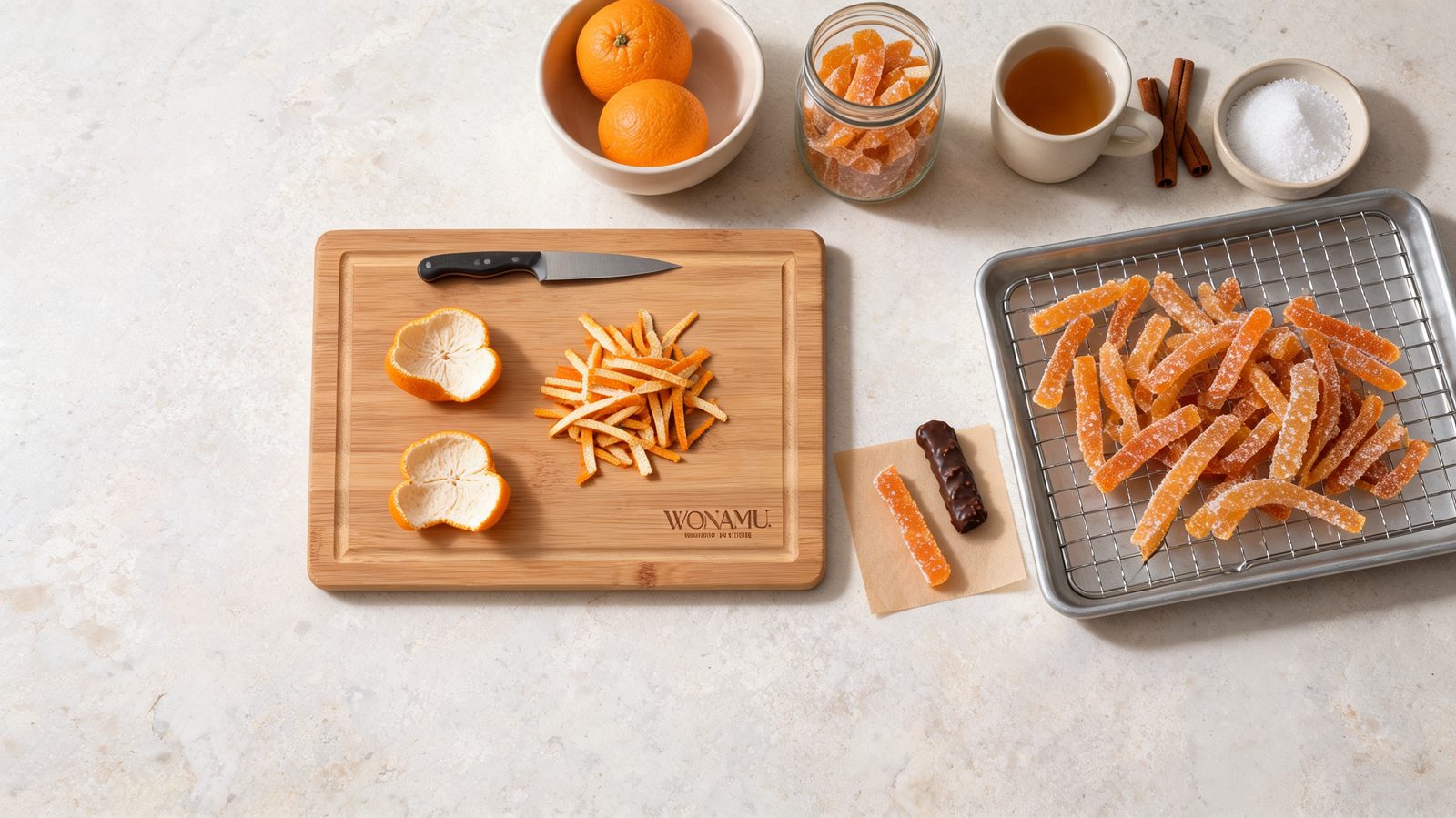
To make candied orange peel, peel thick-skinned oranges in quarters, cut the peel into 1/4-inch strips, and boil the strips in fresh water three times to soften them and draw out the bitterness of the pith. Then simmer them gently in a heavy sugar syrup for about an hour, until translucent, dry them on a rack until tacky, and roll them in sugar. Most of the work is the knife work at the start, and the even strips it produces are what make the finished peel look like something from a good bakery.
It takes an afternoon, mostly unattended, and the oranges themselves are not wasted.
What you need
The recipe here follows a candied citrus peel recipe handout from University of California Agriculture and Natural Resources (UC ANR). It is written for any thick-skinned citrus and makes about 2 pints:
- Peel from 6 thick-skinned oranges, pith included
- 1 cup water, plus more for blanching
- 5 cups granulated sugar: 4 for the syrup, 1 for coating
- 1 vanilla bean, optional
You will also need a large nonreactive saucepan (stainless steel or enameled), a colander, tongs, a wire rack set over a baking sheet, a sharp paring knife or chef’s knife, and a cutting board.
Thick-skinned oranges give fat, tender strips. Thin-skinned juice oranges give mostly zest and very little body.
Wash and peel the oranges
Wash the oranges before you cut into them, even though the peel is what you are after. The FDA advises gently rubbing produce under plain running water, with no need for soap or produce wash, and rinsing it before peeling so dirt and bacteria are not carried from the knife onto the fruit. Dry them with a clean towel.
Then take the peel off in large pieces:
- Cut a thin slice off the top and bottom of the orange.
- With the tip of a paring knife, score the peel from top to bottom in four lines, cutting through the peel and pith but not deep into the fruit.
- Work your thumb under the peel at the top and pull each quarter away.
Save the peeled oranges. They are ready to eat as they are, or to cut into clean segments; how to supreme an orange shows how.
Cut even strips
This is where the board earns its place. Even strips cook evenly, so a whole batch turns translucent at the same time instead of leaving some chewy and some falling apart.
Lay each quarter flat on the board, pith side up. If it curls, press it flat with your palm or make a short cut at each end so it lies down. Trim off any ragged edges and the tough tip where the stem was.
Then slice straight across with a sharp knife into strips 1/4 inch wide, the width the UC recipe calls for. Long, single strokes give cleaner edges than sawing. A board that does not slide matters here; a damp towel underneath keeps it still.
Orange peel is oily and a little juicy, and the strips multiply fast. The WONAMU. bamboo cutting board is 12 × 9 inches, room for two or three quarters at a time and a growing pile of strips, and its perimeter juice groove holds the drips. For more on knife cuts for citrus, see how to cut citrus garnishes.
Blanch three times
Put the strips in the saucepan, cover them with cold water and bring it to a boil, stirring so every piece heats through. Drain in a colander, then repeat twice more with fresh cold water each time.
The UC recipe gives the reason: three rounds remove the bitter flavor from the pith and soften the peel. After the third, leave the strips to drain while you make the syrup.
Simmer in syrup
Bring 1 cup of water to a boil and add 4 cups of the sugar gradually, stirring until it dissolves. Add the drained peel and the vanilla bean, if using. Bring it back to a boil, then lower the heat to a gentle simmer.
Cook until the peel is translucent and tender, which the UC recipe puts at about 1 hour. Keep the heat low and swirl the pan rather than stirring hard, so the strips stay whole. Watch the syrup toward the end; it thickens as the water cooks off.
Dry and coat
Lift the strips out with tongs and lay them on the wire rack over a baking sheet, in a single layer, not touching. Leave them to drain and dry for 4 to 5 hours, the time the UC recipe gives, until they are quite dry but still tacky, then roll them in the remaining 1 cup of sugar.
Spread the coated strips back on the rack for another hour or so before packing them away.
For a gift or a dessert board, dip one end of each strip in melted dark chocolate and set it on parchment. Chopping the chocolate first helps it melt evenly; how to chop chocolate covers it.
The syrup left in the pan has a strong orange flavor. Strain it into a clean jar and refrigerate it for sweetening tea or drizzling over cake.
Storing and using candied peel
Stored in an airtight container, the peel keeps for up to a month, according to the UC recipe. A plain glass jar, filled and tied with string, makes a good small gift.
Candied peel is a standard baking ingredient; Wikipedia’s entry on candied fruit notes that candied peels are eaten as snacks and used in fruitcakes. To chop it for a recipe, toss the strips with a spoonful of sugar first and wipe the knife now and then so the pieces do not cling together on the board.
Sugar and orange oil leave the board sticky. Rinse it with hot water, wash it with dish soap, towel it dry and stand it on its edge.
The short version
Wash the oranges, peel them in quarters and cut the peel into even 1/4-inch strips on a steady board. Boil the strips in fresh water three times, then simmer them in 1 cup of water and 4 cups of sugar for about an hour, until translucent. Dry them on a rack until tacky, roll them in sugar, and store them airtight for up to a month.
❋
WONAMU. makes a bamboo cutting board designed for daily prep, 12 × 9 inches, bamboo, with a perimeter juice groove. Available on Amazon.
Designed by nature.

