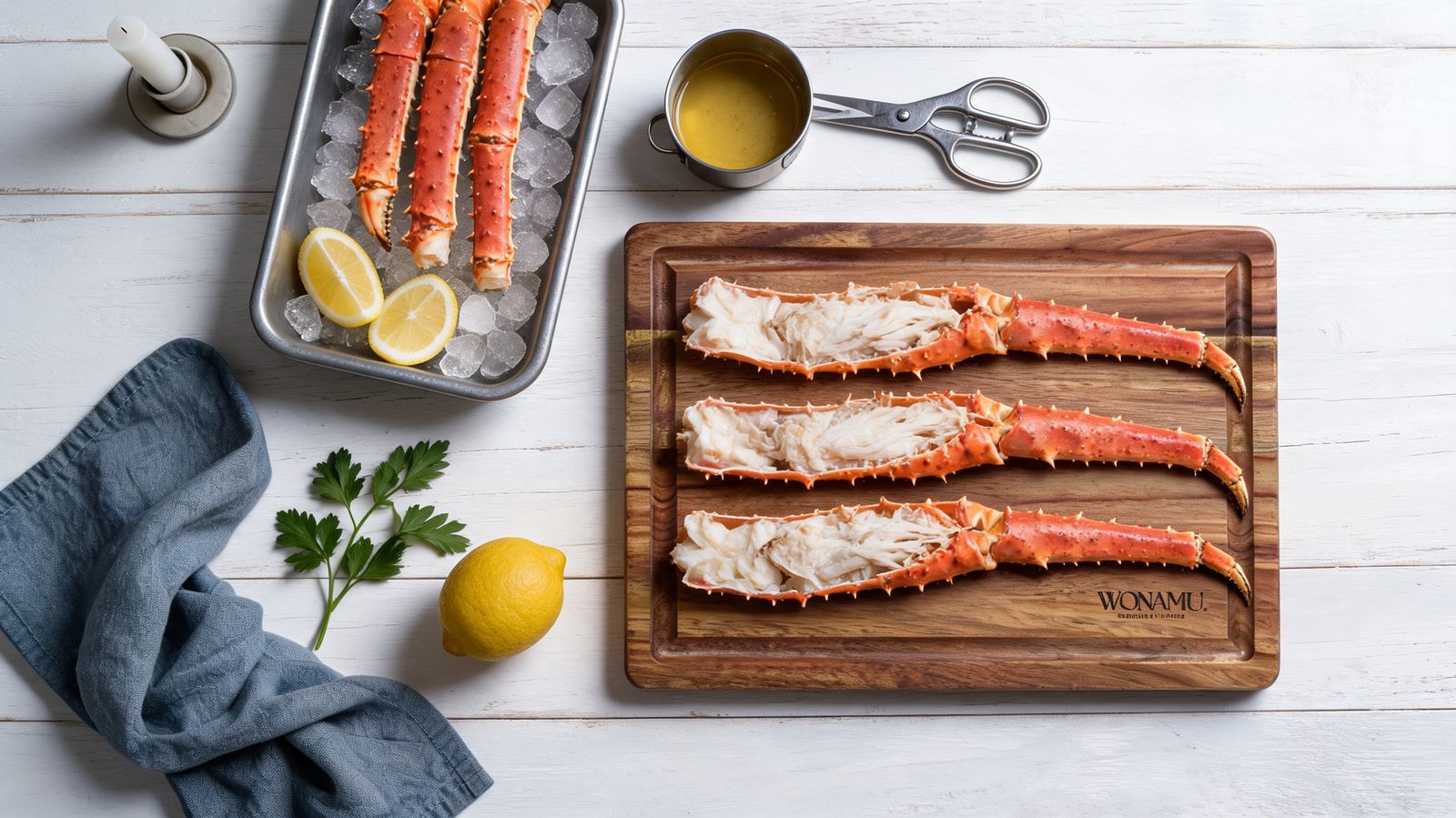
To crack and serve crab legs, thaw them in the refrigerator overnight, steam them until hot all the way through, and then open them on a board before they reach the table. Cut king crab legs lengthwise along the shell with kitchen shears so the meat lifts out in one piece; bend snow crab legs at each joint until the shell snaps and the meat slides free. Serve them with drawn butter, lemon wedges and an empty bowl for the shells.
Most of the mess of a crab dinner comes from guests fighting whole legs at the table. Ten minutes of shear work in the kitchen turns it into an easy, unhurried meal.
Know what you are buying
Most king and snow crab legs are already cooked by the time they reach a home kitchen. Alton Brown’s recipe page for steamed Alaskan king crab legs notes that most snow and king crab are cooked, dismantled and flash frozen at the processing plant, which is usually aboard ship. At home, the job is to warm them, not to cook them.
That changes the technique. Crab that is already cooked needs gentle heat for a short time, enough to warm it through and no more.
When buying frozen legs, the FDA advises skipping packages that are open, torn or crushed on the edges, packages with frost or ice crystals, and anything that is not frozen hard.
How much to buy: plan on 1 to 1½ pounds of legs per person for a crab-centered main course, or about half a pound per person as one course in a larger seafood dinner.
Thaw, then heat
Thaw them overnight. Move the bags to the refrigerator the night before, set on a sheet pan to catch drips. The FDA recommends thawing frozen seafood gradually in the refrigerator overnight. Thawed legs heat evenly and are easier to cut.
Steam them. Bring an inch of water to a boil in a large pot with a steamer basket or a rack. Lay the legs in the basket, cover, and steam until hot all the way through: about 5 minutes for thawed snow crab clusters, 6 to 8 minutes for thick king crab legs. Bend a long section to fit if you need to, or cut it at a joint.
Drain them. Let the legs sit in the basket for a minute so the water runs off the shells before they go onto the board.
Setting up the board
Cooked crab is ready-to-eat food, so it goes on a clean board, never one that has just held raw fish or raw meat. The FDA advises washing cutting boards with soap and hot water between preparing raw foods and preparing cooked or ready-to-eat foods.
A heavier board is welcome here. Shears and a heavy knife put sideways pressure on the board, and the shells shed warm water as they are opened.
A WONAMU. acacia cutting board is acacia, a true hardwood that is denser and heavier than bamboo, so it stays put under the shears, and its perimeter juice groove holds the water that drains from the shells. The groove is explained in what is a juice groove.
Put a damp towel under the board if your counter is slick, and keep a sheet pan beside it for the opened legs.
Cracking king crab legs
King crab shells are thick and spiny, and the meat inside each section comes out whole if the shell is opened along its length.
- Separate the sections. Find the joints and cut through them with the shears, or bend each joint back until it gives. You will have long straight sections and the shorter pieces near the body.
- Find the smooth side. Turn each section so its smoother, paler side faces up. It is the easier side to cut along.
- Cut lengthwise. Slide one blade of the shears into the open end of a section and cut along the smooth side, all the way to the other end. Make a second cut parallel to the first if the shell is wide.
- Open it like a book. Pull the shell apart with your thumbs. The meat can stay in the shell for serving, half exposed, or be lifted out whole.
Leave the claws for a crab cracker or the back of a heavy knife: one firm tap on the shell, not the meat, then pull the pieces away.
Cracking snow crab legs
Snow crab shells are thinner and the legs are slimmer, so hands do most of the work.
- Snap at the joints. Hold a leg on either side of a joint and bend it backward until the shell cracks. Pull gently, and the meat from one segment often slides out attached to the other.
- Trim the long sections. For a neater platter, cut along one side of each long section with the shears, the same way as king crab.
- Leave the clusters whole for guests who like to work. Snow crab is easy enough to finish at the table once the first cuts are made.
Serving
Drawn butter. Melt a stick of butter over low heat, let it sit for a few minutes, and skim the foam from the top. Pour off the clear yellow butter and leave the milky layer behind in the pan. Serve it warm in small dishes.
Lemon. Wedges, seeds removed; how to cut a lemon for juice shows the cut.
The rest of the table. Small forks or seafood picks, a large empty bowl for shells, a stack of napkins and a bowl of warm water with lemon slices for fingers.
You can also serve the thawed legs chilled on a tray of crushed ice with cocktail sauce, since they are already cooked. On a buffet, keep cold crab on ice and bring it out in rounds. The FDA’s rule is that seafood should not sit out of the refrigerator for more than 2 hours, or 1 hour when the temperature is above 90°F. How to set up a holiday buffet covers where a seafood tray belongs on the line.
Leftovers and cleanup
Pick any leftover meat out of the shells and refrigerate it within 2 hours, in a covered container, at 40°F or below. If you reheat it, bring it to 165°F, the FDA’s safe minimum temperature for leftovers; the meat is as good cold, in a salad.
Wash the board with soap and hot water, rinse it, towel it dry and stand it on edge. If the shells leave a smell behind, how to get garlic, onion and fish smells out of a board has the fix.
The short version
Most king and snow crab legs are sold cooked and frozen, so the job is to thaw them overnight in the refrigerator and steam them until hot. Open king crab sections along the smooth side with shears; snap snow crab at the joints.
Do the cracking on a clean, steady board, serve with drawn butter and lemon, and keep cold crab on ice for no more than 2 hours.
❋
WONAMU. makes an acacia cutting board designed for daily prep, 12 × 9 inches, acacia, with a perimeter juice groove. Available on Amazon.
Designed by nature.

