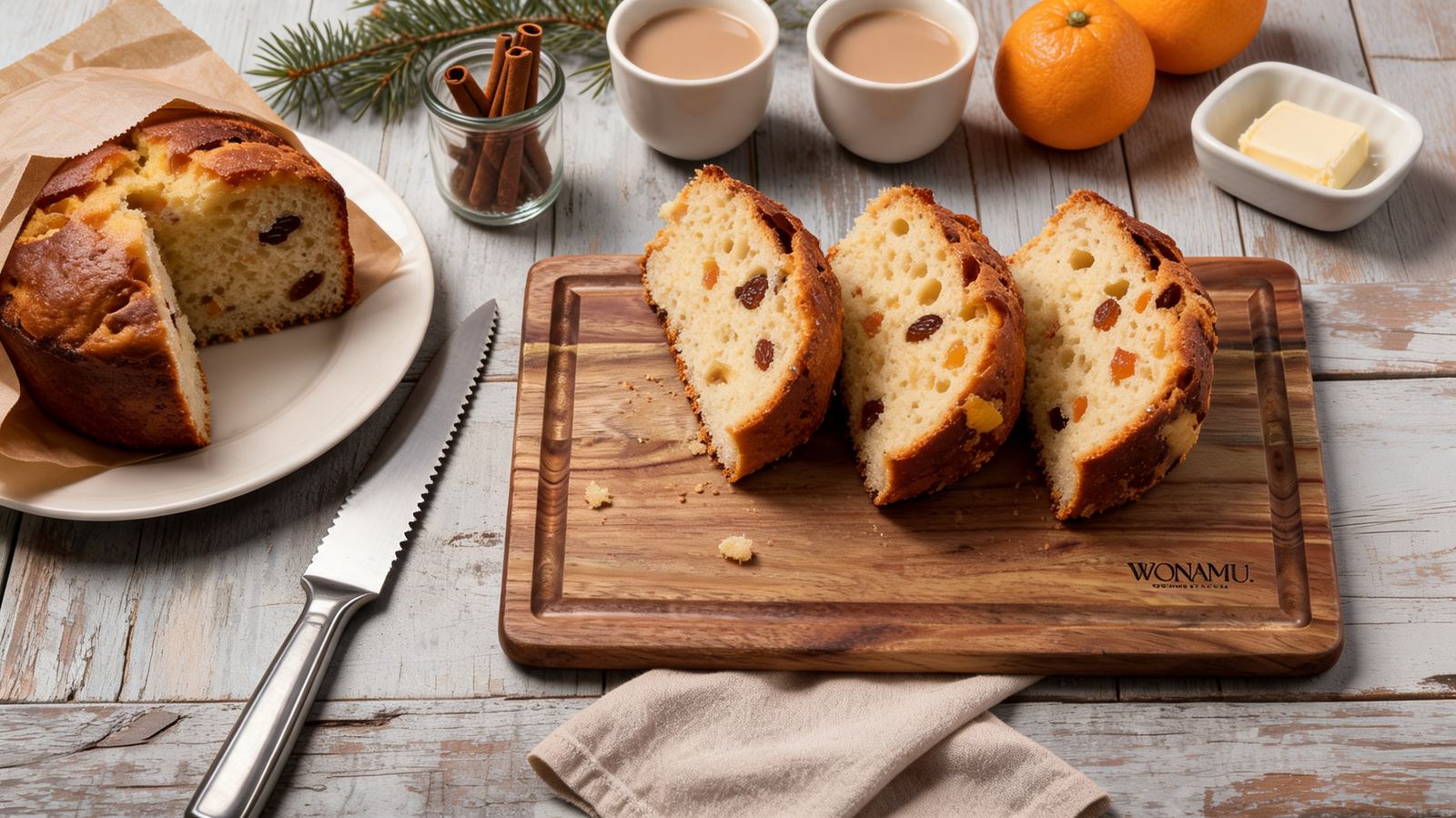
To slice panettone, use a long serrated knife and cut it the way it is traditionally served: in tall wedges, from the top of the dome straight down to the base, with light sawing strokes that never press the bread flat. For toast or French toast, lay it on its side and cut it into rounds instead. The crumb is soft and stretchy, so the whole job comes down to letting the knife saw while your other hand barely touches the loaf.
A crushed panettone is not ruined, but it is a shame. The airy, feathery crumb is the reason to buy one.
Why panettone needs a gentle knife
Panettone is a sweet bread loaf associated with Milan, according to Wikipedia’s entry, and it is usually prepared for Christmas and New Year. It has a tall cupola that rises from a cylindrical base, with raisins and pieces of candied orange and citron through it. The same entry notes that proofing the dough alone takes several days, and that the baked loaf is hung upside down to cool.
All that rising gives a crumb full of long, open strands. Press down with a knife and the strands fold flat, so the slice comes out dense and the cut face looks squashed. A serrated blade sawing lightly cuts those strands instead of compressing them.
The origin story comes in more than one version. Wikipedia tells it as legend: in the best-known tale, a nobleman falls for the daughter of a poor baker named Tony, and the bread becomes “pan di Tonio.” In another telling the roles are reversed: a baker named Tony bakes it to win the approval of a rich noble whose daughter he hopes to marry. Nobody needs the legend to cut a good slice, but it makes conversation at the table.
What to set out
- A serrated bread knife longer than the panettone is wide. Short knives force you to cut from both sides, and the two cuts never meet cleanly.
- A large board or a flat platter for the whole loaf. A panettone is tall and round, and halving it needs room for the knife and your steadying hand, so make the first cuts on a large bread board or platter. Lay a damp towel under a board so it cannot slide.
- A smaller board for the wedges. Each wedge goes onto it as it comes off, ready for the table.
- Scissors for the paper collar.
- A cake server or wide spatula for moving wedges.
How to saw with a bread knife so the teeth cut the bread and not the board is covered in can you use a serrated bread knife on a bamboo board; the same method applies to any board.
Tall wedges, the traditional way
Wikipedia’s entry describes panettone served in wedge shapes, cut vertically. This is the best cut for a table, because every wedge has some dome, some crumb and some base.
- Free the paper. Snip the paper collar from the top edge down to the base in two or three places and peel it away, or leave the lower part on for now if you are cutting only a few wedges. The paper holds the shape of the rest.
- Rest a flat hand on the dome. Do not grip it. A flat palm steadies the loaf without squeezing it.
- Cut in half from the top. Start at the center of the dome with the tip of the knife and saw straight down with long, light strokes until the blade reaches the board. Let the teeth do the work.
- Cut each half into wedges. Lay a half cut side down, so it cannot roll, and cut it into three or four wedges from the center outward, again sawing from the top down.
- Lay wedges on their sides. Standing wedges sag and dry out. Laid down, they keep their shape and show their crumb.
For a smaller household, cut one wedge at a time from the whole loaf instead of halving it. The uncut part stays moist longer.
Rounds for toast and French toast
For breakfast, rounds are more useful than wedges.
Lay the panettone on its side on the large board or platter. Saw off the dome first as a cap, then cut the body into rounds about 3/4 inch thick, working from the top toward the base. Each round can be toasted whole or cut into quarters.
Thick rounds also make French toast. Soak them only briefly, since the crumb drinks up custard fast, and cook egg dishes through: the FDA lists 160°F as the safe minimum internal temperature for egg dishes.
Serving it
Panettone is meant to be eaten slowly, with something warm. Wikipedia’s entry says it is accompanied by sweet hot drinks or a sweet wine such as Asti or Moscato d’Asti, and notes that in Milan Vin Santo or a sweet white wine is often drunk with it. At home, coffee or hot chocolate on Christmas morning is enough.
Wedges laid on a WONAMU. acacia cutting board go straight from the counter to the table. The board is 12 × 9 inches, a good size for a few wedges beside a dish of butter, and its perimeter juice groove holds the crumbs and stray bits of candied fruit that sawing always leaves. For a fuller spread, panettone fits well alongside the ideas in the Christmas morning breakfast board.
Keeping the rest
Press the cut faces of the remaining loaf together and slide it back into its bag, or wrap it closely. A panettone dries from the cut face inward, so the less cut surface is exposed, the longer it stays soft.
A slightly stale panettone is not waste. Cut it into rounds or cubes for French toast or bread pudding; a day-old crumb holds its shape in the custard. More ways to use holiday odds and ends are in what to do with Christmas leftovers.
Brush the crumbs off the board, wash it with warm water and dish soap, dry it with a towel and stand it on its edge. Candied fruit and butter left on the surface overnight turn sticky.
The short version
Use a long serrated knife, cut the whole loaf on a large board or platter, and rest a flat hand on the dome without squeezing. Cut tall wedges from the top down, sawing lightly, and lay them on their sides on a smaller board. For toast, lay the panettone on its side and cut rounds about 3/4 inch thick. Keep the cut faces covered, and turn any stale pieces into French toast.
❋
WONAMU. makes an acacia cutting board designed for daily prep, 12 × 9 inches, acacia, with a perimeter juice groove. Available on Amazon.
Designed by nature.

