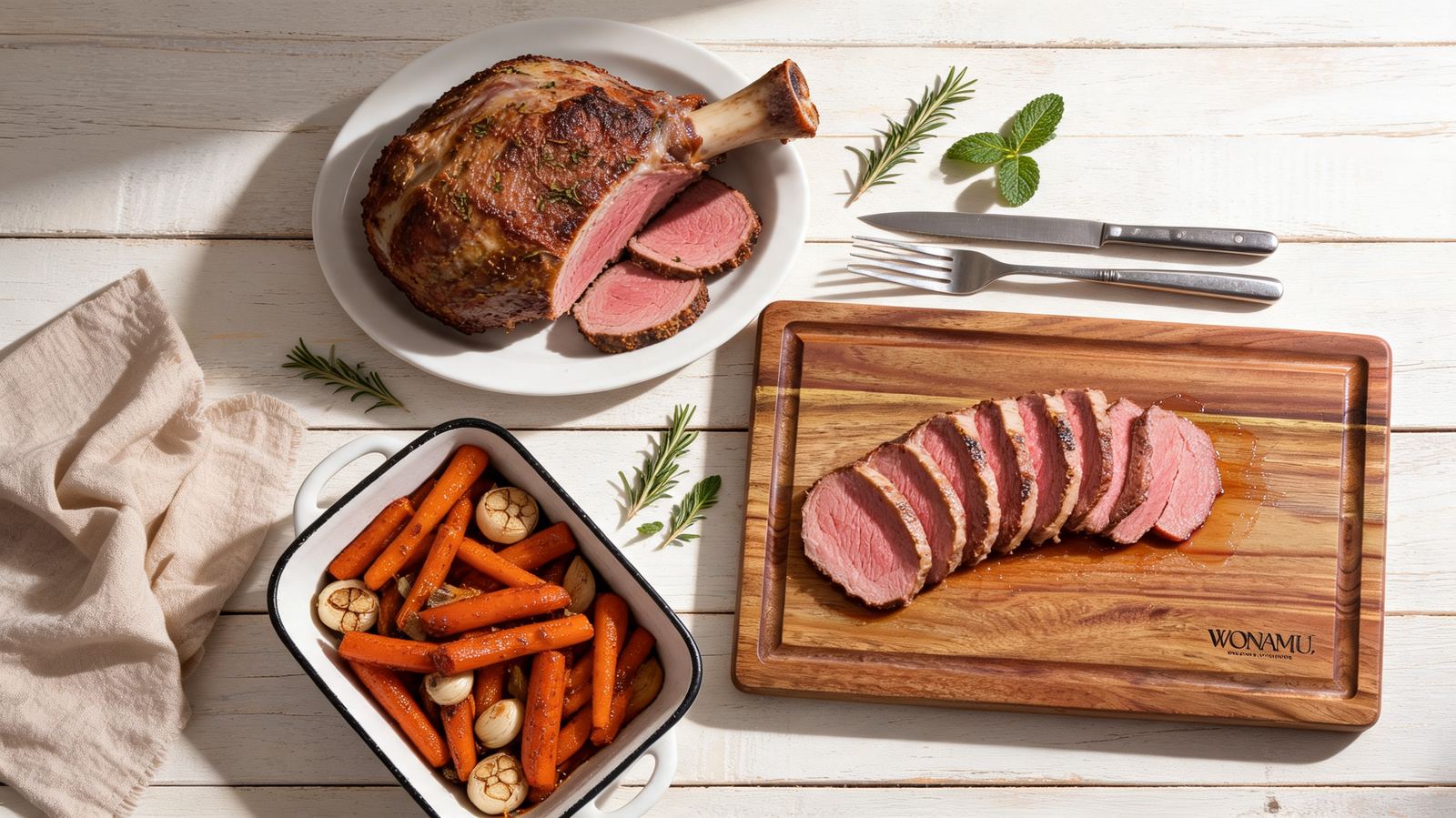
To carve a bone-in leg of lamb, let it rest, cut two or three slices from one side so the leg sits flat, turn it onto that flat base, then slice straight down to the bone across the grain. Finish by running the knife along the bone underneath the cuts to release every slice at once. A boneless leg is simpler still: remove the string or netting and slice it across the grain like any roast.
A leg of lamb looks awkward because the bone runs through it at an angle and the meat is thicker at one end than the other. The method above handles both problems. It turns an irregular roast into a stable block, and it lets the bone guide the knife instead of getting in its way.
Rest, check, set up
Cook to a safe temperature. Whole cuts of lamb are safe at 145°F followed by a 3-minute rest, the minimum the CDC gives for whole cuts of beef, veal, lamb and pork. Check with a thermometer in the thickest part of the leg, not touching the bone.
Let it rest. Move the leg to a large platter or carving board, tent it loosely with foil and leave it for 15 to 20 minutes. A rested roast is firmer and easier to hold, and slices hold their shape instead of tearing. It also gives you time to make a pan sauce from the drippings.
Set up the station. A long carving knife or a sharp chef’s knife, a carving fork, a clean kitchen towel, and a warm serving platter. A whole bone-in leg is too big and too uneven for an everyday cutting board, so carve it where it rested, with a damp towel underneath so nothing slides. A smaller board beside it takes the slices.
A carving knife needs a keen edge to cut through the browned crust without pressing down on the meat. If yours has gone dull, start with how to sharpen a knife at home.
Find the bone and the grain
Before you cut, look at the leg. The narrow end, where the bone sticks out, is the shank. The wide, meaty end is where the leg joined the hip. The main bone runs between them, closer to one side of the meat than the other.
Then look at the grain. On any cut surface the muscle fibers show as fine parallel lines, and every slice should cross those lines rather than follow them. Short fibers make a tender slice; long ones make a chewy slice, however well the lamb was cooked. Check the first cut face and adjust the angle of the knife if you need to.
Step 1: Make a flat base
Lay the leg on its side with the shank bone pointing away from you and the meatiest side facing up. Hold the shank end with a towel or steady it with the fork.
Cut two or three slices lengthwise from the side nearest you, the thinner side, until you have a flat surface about two to three inches across. Set these first slices aside on the cutting board; they are good to eat.
Now turn the leg over onto that flat surface. It sits steady on the platter and will not roll while you carve.
Step 2: Slice down to the bone
Starting near the shank end, cut straight down through the meat until the knife meets the bone. Make the next cut about a quarter inch further along, again down to the bone. Keep going along the length of the leg, making parallel slices across the grain, each one standing upright and still attached at the bottom.
Keep the slices thin and even. A quarter inch is right for most people; go thicker if you like a substantial slice with plenty of crust.
Step 3: Release the slices
Go back to the shank end. Turn the knife so the blade lies flat, parallel to the bone, and cut underneath all the slices, along the top of the bone, in one long stroke. The slices come free together.
Lift them off with the flat of the knife and lay them on the board. A WONAMU. acacia cutting board is sized for this: at 12 × 9 inches it holds a full row of slices in a single overlapping layer, and its perimeter juice groove catches the pink juice that runs from them, which you can spoon back over the meat or into the sauce.
Turn the leg over and carve the other side the same way, down to the bone and then along it. Finish by cutting away any meat left around the bone and the shank in rough pieces. Those pieces are the cook’s portion or tomorrow’s sandwich.
Boneless leg and butterflied leg
Boneless leg. If it is rolled and tied with string or held in an elastic net, snip the string or cut away the net completely after resting, and check for any loose loop before you start. Then slice across the roll, a quarter to half an inch thick. Because the meat has been rolled, the grain runs in more than one direction; if a slice looks stringy, turn the roast and try a different angle.
Butterflied leg. A leg that has been boned and opened flat for the grill or a hot oven has thick and thin sections. Cut it into those natural sections on the board first, then slice each section across its own grain. Thinner pieces will be more cooked, so give guests a choice.
Serving
Fan the slices down the center of the warm platter, overlapping, with the crusty end slices at the edges for those who want them. Spoon the juice from the board over the top. Mint, rosemary, garlic and a spoonful of the pan sauce are all good partners for lamb.
At a holiday table, carving in the kitchen and bringing out a full platter is less stressful than carving in front of everyone, and the meat stays warmer. For timing the rest of the meal around the roast, see how to host Christmas dinner for the first time. If you are serving a rack instead, the carving is quite different, and it is covered in how to cut a rack of lamb.
Leftovers and cleanup
Refrigerate leftover lamb within two hours of serving, the CDC’s limit for perishable food at room temperature. Store it in shallow containers; Nebraska Extension’s leftover guidance is to use it within three to four days. Cold sliced lamb is good in pita with yogurt and cucumber; the bone makes a rich soup.
Wash the board and knife in hot water with dish soap as soon as the platter is out, then towel the board dry and stand it on edge. Lamb fat turns waxy and firm as it cools, and how to clean grease off a cutting board after carving covers how to lift it.
The short version
Cook to 145°F followed by a 3-minute rest, then rest it 15 to 20 minutes under loose foil. Carve where it rested, with a smaller board for the slices.
Cut a flat base from the thin side, turn the leg onto it, slice straight down to the bone across the grain, then run the knife along the bone to free the slices. Turn it over and repeat. For a boneless leg, remove the string and slice across the roll.
❋
The WONAMU. acacia cutting board — 12 × 9 inches, acacia, with a perimeter juice groove and a cotton care cloth in the box — is available on Amazon.
Designed by nature.

