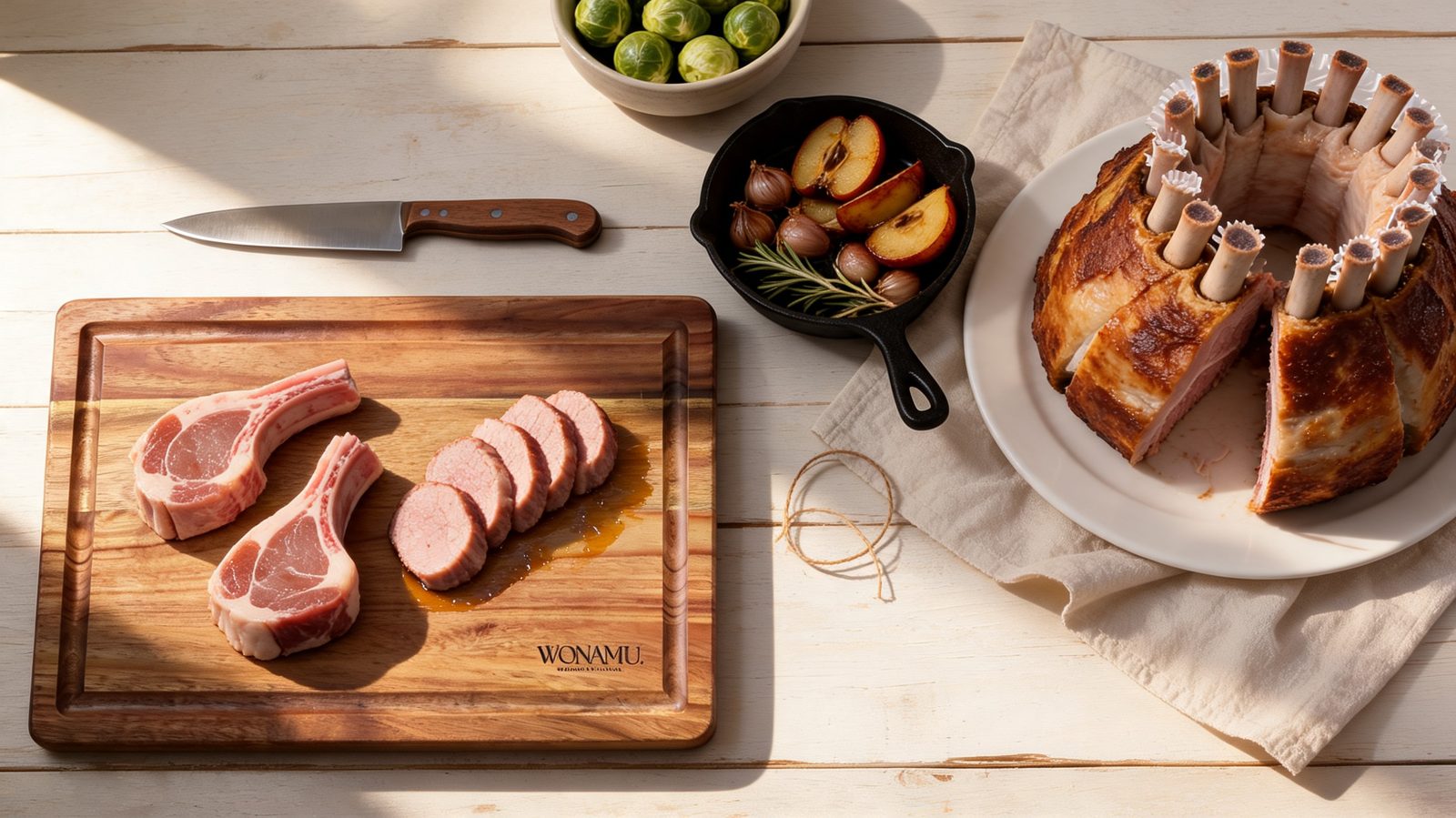
To carve a crown roast of pork, rest it for 15 to 20 minutes, move any stuffing out of the center, cut and pull away the kitchen twine, then slice straight down between the bones so each cut gives one rib with its piece of loin. It is one of the easiest roasts to carve, because the bones show you exactly where every cut goes.
A crown roast looks like an occasion, and that is most of its appeal at Christmas. Underneath the presentation it is a pork loin on the bone, bent into a ring. Once you see it that way, the carving stops being intimidating.
What you are carving
America’s Test Kitchen describes a crown roast as two bone-in pork loin roasts tied together in a round. The meaty loin forms the ring, and the rib bones stand up around the top like the points of a crown. The bones are usually frenched, meaning the meat and fat have been trimmed from their ends so they stand clean.
It is rarely sitting in the case at a supermarket. What’s Cooking America advises ordering it ahead from a local butcher shop or gourmet market and asking the butcher to form the crown. The same guide plans on about one rib per person, which makes the count easy: a roast with twelve ribs serves about twelve.
Those little paper frills on the bone tips are for show and for holding a chop with your fingers. Put them on after roasting, not before.
Roast, check, rest
Cook to a safe temperature. Whole cuts of pork are safe at 145°F followed by a 3-minute rest, the minimum the CDC gives. Check the thickest part of the loin, away from the bone, in more than one spot around the ring. The inner side of the crown can lag behind the outside.
Think twice about stuffing the center. A crown filled with stuffing is the classic picture, but America’s Test Kitchen found stuffing “a major impediment to even cooking,” and its recipe notes that a crown roast tends to come out undercooked around the inner circle. The simple fix is to roast the crown empty and bake the stuffing in a separate dish, then spoon some into the center for serving. If you do stuff it, the stuffing itself must reach 165°F, the CDC’s figure for casseroles.
Let it rest. Tent the roast loosely with foil and leave it for 15 to 20 minutes. What’s Cooking America notes that the meat temperature will rise 5 to 10 degrees after the roast leaves the oven. Take it out only once every part of the loin reads 145°F; the rise comes on top of that, never in place of it. The rest also gives you time to finish the gravy.
Set up before you cut
You need a long, sharp carving knife or chef’s knife, kitchen scissors for the twine, a carving fork or a clean towel to steady the roast, and a warm platter. Lay a damp towel under anything you cut on so it cannot slide.
The whole crown is too big for an everyday board. Rest and carve it on the platter it will be served from, or on a large carving board. Keep a second, smaller board nearby for the chops as they come off.
If the knife has not been sharpened in a while, do it first. A dull blade catches on the fat cap and tears the crust. The method is in how to sharpen a knife at home.
Step 1: Empty the center and remove the twine
If there is stuffing in the middle, scoop it into a warm serving bowl. Then find the loops of twine around the ring and snip each one with scissors. Pull them free. Without the twine the ring relaxes slightly, which is what you want: it gives the knife room between the bones.
Leave the frills off until the chops are cut, or slide them onto the bone tips now if you are carving at the table.
Step 2: Cut between the bones
Steady the roast with the fork or your toweled hand on the far side. Find the gap between two ribs from the top, where the bones are bare, and set the knife in it.
Cut straight down through the loin in one long stroke, keeping the blade parallel to the bones. If the knife meets bone, lift it out and shift it a little toward the center of the gap. Each cut releases one chop: a bone with a thick wedge of loin attached.
Work your way around the ring, one bone at a time. If guests have smaller appetites, cut every bone; if the chops are thin, cut every second bone for double chops. The same between-the-bones method is shown step by step in how to cut a rack of lamb.
Step 3: Slice for anyone who wants it off the bone
Some guests, younger ones especially, would rather not wrestle with a chop. For them, lay a chop flat on the cutting board, cut along the bone to free the eye of the loin, and slice it across the grain into rounds about half an inch thick.
This is where a WONAMU. acacia cutting board earns its place next to the platter. At 12 × 9 inches it will not hold the crown, but it holds several chops and their sliced loin with room to work, and its perimeter juice groove keeps the juice from the slices off the tablecloth. Spoon that juice back over the meat before serving.
Serving the crown
For the most dramatic presentation, carve in the kitchen, then stand the chops back up in a loose ring on the warm platter, bones up, frills on, stuffing heaped in the center. It looks almost the way it came out of the oven, and every portion is already cut.
For a buffet, lay the chops in an overlapping row with the sliced loin at one end, so people can take a whole chop or a few slices. More on keeping a serving table moving is in how to set up a holiday buffet.
Apples, roasted shallots, a pan sauce from the drippings and a sharp green vegetable all suit pork. A mustard sauce is a good partner too.
After dinner
Refrigerate leftovers within two hours, the CDC’s limit for perishable food left out, in shallow containers. Nebraska Extension’s leftover guidance is to use them within three to four days and reheat them to 165°F. Cold sliced pork loin makes a good sandwich the next day with mustard and pickles.
Wash the boards while they are still warm, in hot water with dish soap, then towel them dry and stand them on edge. Pork fat sets as it cools, and the method for lifting it is in how to clean grease off a cutting board after carving.
The short version
Order the crown ahead, cook it to 145°F followed by a 3-minute rest, then rest it 15 to 20 minutes under loose foil. Bake the stuffing separately if you can.
Scoop out the center, snip the twine, and cut straight down between the bones, one rib per chop. Slice the loin off the bone on the board for anyone who wants it boneless. Stand the chops back in a ring to serve.
❋
The WONAMU. acacia cutting board — 12 × 9 inches, acacia, with a perimeter juice groove and a cotton care cloth in the box — is available on Amazon.
Designed by nature.

