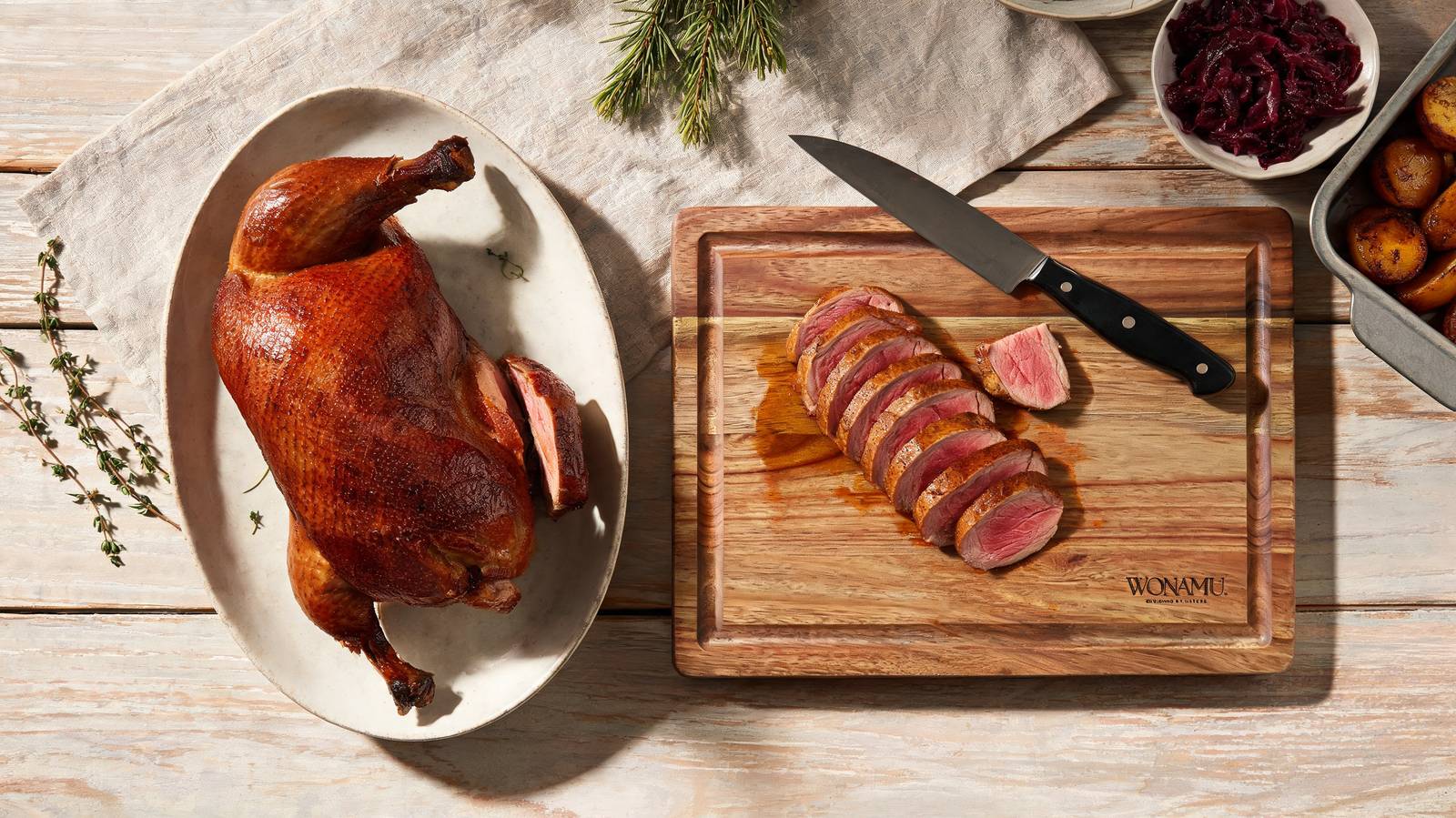
To carve a roast goose or duck, let it rest, take the legs off at the hip joint, then lift each breast off the bone in one piece and slice it on the bias with the skin facing up. Do not try to shave thin slices from the whole bird at the table. The breast comes away cleanly only when you follow the bone, and the skin stays on only when you slice it skin side up.
The method is the same for both birds. A goose is larger and heavier, a duck is quicker to carve, and each rewards a sharp knife and a little patience with a crisp skin you do not want to tear.
Before the knife: temperature, rest and setup
Check the temperature first. Poultry is safe at 165°F, the minimum the CDC gives for all poultry, so check the thickest part of the thigh and the breast before the bird leaves the oven. Duck and goose are no exception to that number.
Let it rest. Move the bird to a large platter or rimmed sheet pan and leave it, uncovered so the skin stays crisp, for 15 to 20 minutes. A rested bird is firmer, easier to hold, and the meat slices more neatly.
Deal with the fat. Both birds give off a lot of fat in the oven. Wikipedia’s entry on goose as food notes that roasting a goose renders “a great deal of excellent-quality fat.” Pour it off the roasting pan into a heatproof jar before you start carving, so it is out of the way and saved for roasting potatoes later in the week.
Set up the station. A sharp boning knife or a slim chef’s knife, a pair of poultry shears, a damp towel under each board so nothing slides, a warm serving platter and a clean kitchen towel for your hands. The whole bird stays on its platter or sheet pan. A separate cutting board stays clear for the pieces as they come off.
A dull knife drags through duck skin and tears it. If yours has not been sharpened since last winter, start with how to sharpen a knife at home.
Step 1: Take off the legs
Set the bird breast side up with the legs toward you. Pull one leg gently away from the body and cut through the skin between the thigh and the breast. Keep easing the leg outward and down until the hip joint pops, then cut through the joint and free the leg with the skin that covers it.
Feel for the joint with the tip of the knife instead of forcing it; the blade should find the gap with little pressure. Repeat on the other side.
On a duck, the leg is usually served whole, one per guest. On a goose, separate the drumstick from the thigh at the joint, which bends to show you exactly where to cut.
Step 2: Lift each breast off whole
Find the breastbone, the ridge running down the center of the bird. Cut straight down along one side of it, keeping the blade pressed close to the bone.
Then work outward with short, shallow strokes, following the curve of the ribcage and peeling the meat back with your free hand as it loosens. The breast comes away in one long piece, skin still on. Repeat on the other side.
This is the step that makes the carving neat. A cut that follows the bone leaves very little meat behind on the frame.
The wings carry little meat. Cut them off at the shoulder joint and save them with the frame for stock.
Step 3: Slice the breast on the bias
Move the breasts to the cutting board, skin side up. Slice across the breast at a slight angle into pieces about a quarter to half an inch thick, using long, single strokes so the knife cuts through the skin instead of sawing at it.
Keep the skin up the whole time. Turning the breast over and cutting through the meat first pushes the skin off the slices.
A WONAMU. acacia cutting board works well for this stage. At 12 × 9 inches it is too small for the whole bird, but it is the right size for two breasts at a time, and its perimeter juice groove keeps what runs from the slices on the board rather than on the counter. Why that groove matters is explained in what is a juice groove.
Quartering a duck instead
For a duck, there is a faster way that suits a table of four. Once the legs are off, use poultry shears to cut along both sides of the backbone and remove it. Then cut straight down through the breastbone to split the breast in two, still on the bone.
You now have four portions: two legs and two breast halves. Serve them as they are, or lift the breast meat off its bone on the board and slice it there. Quartering keeps the skin intact.
Serving
Fan the breast slices down the center of the warm platter, skin side up. Put the legs, or the thighs and drumsticks of a goose, at either end. Spoon over a little of the pan juice, skimmed of fat, or serve it in a jug on the side.
Something sharp on the side cuts through the richness: red cabbage, apples, or a fruit sauce. Wikipedia’s entry on goose as food notes that in Germany roast goose is the traditional Christmas Day dish, “almost always served with red cabbage.” The same sides sit well beside duck.
Plan your numbers honestly. The same article notes that goose’s “low ratio of meat to bone and fat” makes it more expensive per serving than turkey, so a goose feeds fewer people than its size suggests. If you are cooking for a crowd, two ducks are often easier to carve and serve than one large goose.
For the rest of the meal, how to host Christmas dinner for the first time has a working timeline.
After dinner
Refrigerate leftover meat in shallow containers within two hours of serving, the CDC’s limit for perishable food at room temperature. Nebraska Extension’s leftover guidance is to use it within three to four days. Shredded duck or goose goes well in a hash, a salad with bitter leaves, or a pot of beans. More ideas are in what to do with Christmas leftovers.
The frame, wings and neck make a rich stock. Cover them with cold water, simmer gently for a few hours, strain, and chill; the fat sets on top and lifts off in one piece.
Wash the board while the bird is still warm. Duck and goose leave a lot of grease behind, and hot water with dish soap removes it best before it sets. The full method is in how to clean grease off a cutting board after carving. Dry the board with a towel and stand it on edge to finish drying.
The short version
Cook to 165°F, rest for 15 to 20 minutes uncovered, and pour off the fat. Legs off at the hip, breasts off whole along the bone, wings into the stock pot.
Slice the breast on the bias, skin up, a quarter to half an inch thick, with long single strokes. For a duck, quartering with shears is the fastest route to the table. Serve with something sharp, and wash the board while it is still warm.
❋
The WONAMU. acacia cutting board — 12 × 9 inches, acacia, with a perimeter juice groove and a cotton care cloth in the box — is available on Amazon.
Designed by nature.

