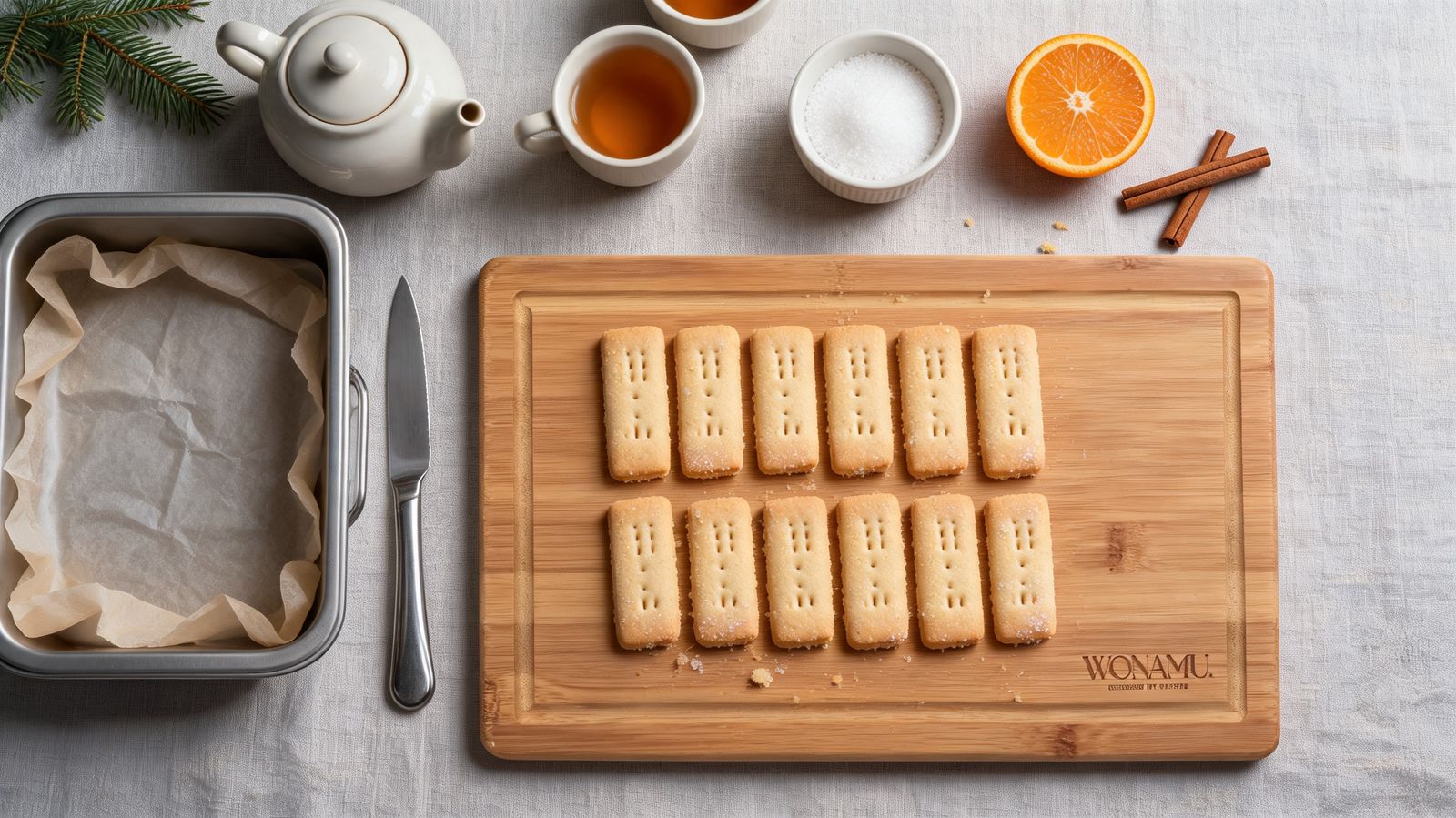
To cut shortbread into fingers, score the slab into fingers before it goes into the oven, cut along the same lines again the moment it comes out while it is still warm and soft, then let it cool completely in the pan before lifting it onto a board and separating the pieces. Cut it cold and it shatters; cut it only once, before baking, and the lines close up in the oven. Two cuts, one before and one straight after, give clean, even fingers.
For the sharpest edges of all, there is a second method: cut the fingers from a chilled slab of raw dough on a board and bake them apart. Both are below.
Why shortbread is hard to cut
Shortbread is all butter, sugar and flour, and very little else. Wikipedia’s entry explains the name: “short” is an old word for crumbly, as opposed to long or stretchy, and the high butter content keeps long gluten strands from forming. That is what makes it melt in the mouth, and also what makes it fragile.
Warm from the oven, shortbread is soft enough to cut cleanly. Once it cools, it sets firm and brittle, and a knife pressed through it cracks the edges or snaps a finger in half. The whole method is about cutting at the right moment.
Wikipedia lists three common shapes: one large round cut into wedges called petticoat tails, individual rounds, and fingers cut from a thick slab. Fingers are the easiest to make evenly and to pack in a tin.
The dough
Shortbread is usually given as a ratio, and Wikipedia’s entry gives it as one part sugar, two parts butter and three to four parts plain flour. By weight, that becomes:
- 8 ounces (2 sticks) unsalted butter, softened
- 4 ounces granulated sugar, a heaping 1/2 cup
- 12 ounces all-purpose flour, about 2 3/4 cups, plus a pinch of salt
Beat the butter and sugar until smooth and pale, then add the flour and salt and mix only until the dough holds together in clumps. A kitchen scale makes the ratio exact.
Do not taste the raw dough. The FDA says flour is a raw food, that processing grain into flour does not kill harmful bacteria, and that raw flour and dough should never be eaten or tasted.
Method one: bake in a pan, cut twice
- Line the pan. Use a 9-inch square pan with a parchment sling, two strips crossing with overhanging handles, the same setup described in how to cut brownies and bars into clean squares.
- Press the dough in evenly. Pat it into the corners and level the top with the flat bottom of a measuring cup. It should sit about 1/2 inch thick.
- Score the fingers. With a thin knife, mark two lines across the slab to make three 3-inch bands, then mark each band at 1-inch intervals. That gives 27 fingers, each about 3 × 1 inch. Cut about halfway into the dough.
- Prick each finger. Press the tines of a fork into each one, two or three times in a row. Wikipedia notes that shortbread is often patterned with the tines of a fork before baking, and the marks make each finger look finished.
- Chill for 20 minutes, then bake at 325°F for about 35 to 45 minutes, until the edges are pale gold and the center feels set.
- Cut again at once. As soon as the pan leaves the oven, run a thin, sharp knife down every scored line, all the way to the bottom. Sprinkle with a little sugar while warm if you like.
- Cool completely in the pan. Leave it at least an hour. Moving warm shortbread is how fingers break.
Then lift the slab out by the parchment handles and set it on a cutting board. The fingers will have fused slightly as they cooled. Press a thin knife straight down along each line, one short press at a time, rather than sawing, and they come apart along the cuts.
Method two: cut cold dough on a board
For the cleanest edges, shape and cut the dough before it bakes.
On a sheet of parchment laid over a cutting board, pat half the dough into a rectangle about 6 × 7 inches and 1/2 inch thick, squaring the edges with the side of a bench scraper. Slide the parchment onto a baking sheet and chill the dough for about 30 minutes, until firm, then slide it back onto the board.
Cut it there with a long, straight chef’s knife, pressed straight down in one motion: one cut along the middle to make two 3-inch bands, then cuts every inch across. That gives 14 fingers. Move them to a lined baking sheet about an inch apart, prick them with a fork, and bake at 325°F, checking from about 20 minutes, until the edges are pale gold. Repeat with the rest of the dough.
A 12 × 9 board suits this kind of small-batch work, a half batch at a time, the same way it suits rolled cookie dough; can you roll cookie dough on a wooden cutting board covers preparing the board. It is a surface for portions, not a replacement for a full pastry board. The WONAMU. bamboo cutting board is that size, and its perimeter juice groove keeps flour and stray crumbs on the board instead of the counter.
When you are done, follow the FDA’s advice for raw flour and dough: wash the board, utensils and your hands with warm, soapy water.
Serving and keeping
Stack fingers in a tin with parchment between the layers, or lay them in rows on a board with tea. Wikipedia notes that shortbread is widely associated with Christmas and Hogmanay in Scotland, where it originated, and a tin of fingers is an easy thing to bring to a holiday open house or a cookie swap. How to host a cookie exchange covers the trading.
Scrape the board with a dry bench scraper before washing it; butter and flour wiped wet turn into paste. Dry it with a towel and stand it on its edge.
The short version
Score the slab into 3 × 1 inch fingers before baking, prick each one with a fork, and bake. Cut along the lines again the moment it leaves the oven, cool it fully in the pan, then lift it onto a board and press the fingers apart. For the sharpest edges, cut chilled raw dough into fingers on a board and bake them separately.
❋
WONAMU. makes a bamboo cutting board designed for daily prep, 12 × 9 inches, bamboo, with a perimeter juice groove. Available on Amazon.
Designed by nature.

