Humidity affects a bamboo cutting board because bamboo, like wood, trades moisture with the air around it. In humid weather it takes some on and swells very slightly. In dry weather it gives some up and shrinks.
Slow, even changes do no harm. The trouble comes from fast or one-sided changes, and those are the ones a simple routine prevents.
Most care advice talks about winter, when heated air dries everything out. Humid summers matter as much, and so does the swing from one season to the next. A board that lives in the same kitchen all year goes through both.
Bamboo breathes with the room
Wood is hygroscopic: it absorbs or releases moisture until it reaches equilibrium with the air around it. That balance point, the equilibrium moisture content, depends on the relative humidity and the temperature of the room. When the humidity rises, the balance point rises with it. Below a certain moisture level, wood swells as it takes water on and shrinks as it loses it.
Bamboo is a grass, not a wood, but it behaves the same way. A 2007 study in the Journal of Tropical Forest Science measured a tropical bamboo, Gigantochloa scortechinii, across relative humidities from 12 to 93 percent and found that its moisture content follows the humidity, with measurable shrinking and swelling as it does.
None of this is a defect. It is what a natural material does. Your floors, cabinets and wooden spoons are doing it too, every day, as the weather changes.
What humid months change
In a humid kitchen, the board does not swell much. The bigger change is that it dries slowly.
After washing, a board dries more slowly in humid air than in dry air, and in a muggy kitchen it can stay damp for hours. A board that stays damp that long is the one that develops a musty smell, gray marks in the juice groove or, in the worst case, spots of mold. The EPA advises keeping indoor humidity below 60 percent, ideally between 30 and 50 percent, to keep mold in check.
Humid air also exposes weak habits. Drying a board flat on the counter, stacking it while damp or shutting it in a closed cabinet straight from the sink all trap moisture against one face. In dry weather the board might forgive that. In humid weather it will not.
What dry months change
Dry air pulls the other way. Heated winter air draws moisture out of the board, and a board that has not been oiled in a while starts to look pale, feel rough after washing and show fine lines at the ends.
The ends of a board give up moisture faster than its faces, because water moves more readily along the fibers than across them. That is why dry-season care focuses on oiling the ends as well as the faces. Dry winter air and your cutting board covers the cold-weather routine in detail.
The real risk is uneven change
A board that gains or loses moisture evenly, on both faces at once, stays flat. A board that changes on one side faster than the other can cup.
The common causes are the same in every season:
- Drying flat. The top face dries while the bottom stays wet against the counter.
- Heat on one side. A board stored beside the stove, above the dishwasher vent or near a radiator dries hard on the side facing the heat.
- Wet on one side. A board left leaning against a damp backsplash, or stored on a wet dish rack, takes on water from one face only.
- Big swings in a single day. A soak in the sink followed by an afternoon in front of a heating vent is the most extreme change a board can go through.
Bamboo is dimensionally stable when it is properly cared for. It can warp or crack with extreme or uneven moisture exposure, as any natural board can, and the routine below is built to prevent exactly that.
A routine for every season
Dry it standing, every time. Towel off both faces, then stand the board on its long edge so air reaches both sides. In humid weather, give it a full few hours before it goes away. How to dry a wooden cutting board explains why lying flat is the mistake.
Store it with air around it. An upright rack or an open shelf on an interior wall is better than a closed cabinet, especially in summer. Keep it away from the range, the dishwasher vent and heating registers.
Oil it on the board’s schedule, not the calendar’s. Oil does not seal a board, but it slows the exchange of moisture with the air and keeps the fibers supple. Sprinkle a few drops of water on the surface. If they bead, the board is fine. If they soak in and darken the bamboo, it is time to oil. In dry months that test may call for oil every couple of weeks. In humid months, less often. How to oil a bamboo cutting board walks through the steps.
Never soak it. No board should sit in water or go through the dishwasher, in any season.
Dry the juice groove. The groove holds liquid by design. After washing, run the towel through it so water does not sit there while the rest of the board dries.
A hygrometer tells you which season you are in
An inexpensive hygrometer on a kitchen shelf takes the guesswork out. When it reads high, give the board more drying time and more air. When it reads low, check it for oil more often. The board responds to the room, and the hygrometer tells you what the room is doing.
Signs the board is reacting
- It smells musty after washing. It is drying too slowly. Give it more air and more time, and see why a cutting board smells when wet.
- It looks pale or feels rough. It is dry. Oil it.
- It rocks on the counter. It has cupped. Dry it standing, oil both faces equally, and if it does not settle back, flatten the warped board.
- Dark spots appear. Treat them promptly; removing mold from a wooden cutting board covers what to do.
A board for every season
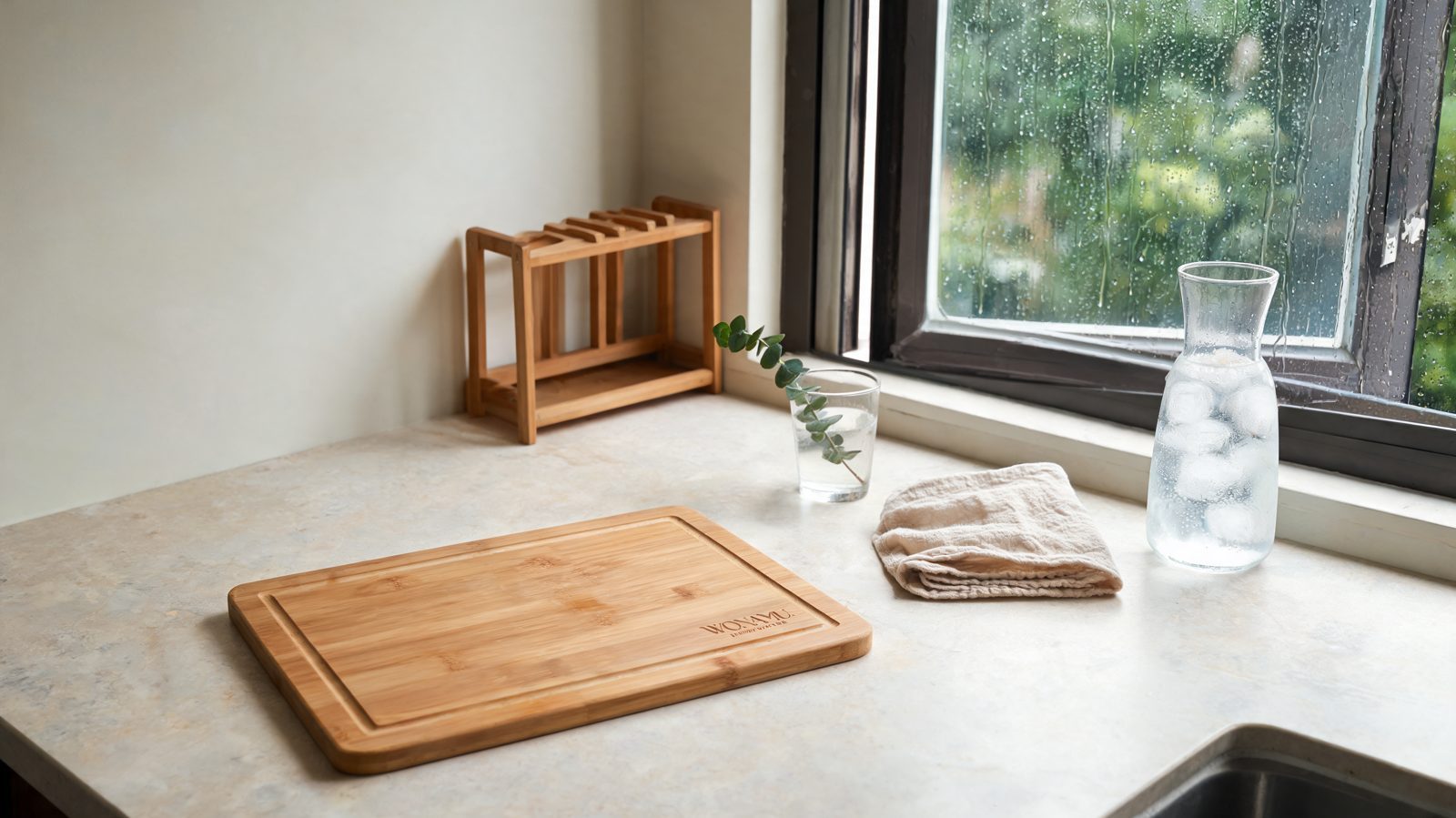
The WONAMU. bamboo cutting board is 12 by 9 inches with a perimeter juice groove, and it ships with a cotton care cloth for oiling and wiping down the board. That cloth suits the routine above: wipe the board and its groove dry after washing in July, oil it with the same cloth in January.
A bamboo board looked after this way moves with the seasons and comes back to flat every time.
The short version
Bamboo takes on moisture in humid air and gives it up in dry air, swelling and shrinking slightly as it does. Even changes are harmless; one-sided changes cause cupping.
In humid months, give the board more drying time, more air and an open place to stand. In dry months, oil it more often. In every season, dry it on edge, keep it away from heat and never soak it.
❋
WONAMU. makes a bamboo cutting board designed for daily prep, 12 × 9 inches, bamboo, with a perimeter juice groove. Available on Amazon.
Designed by nature.