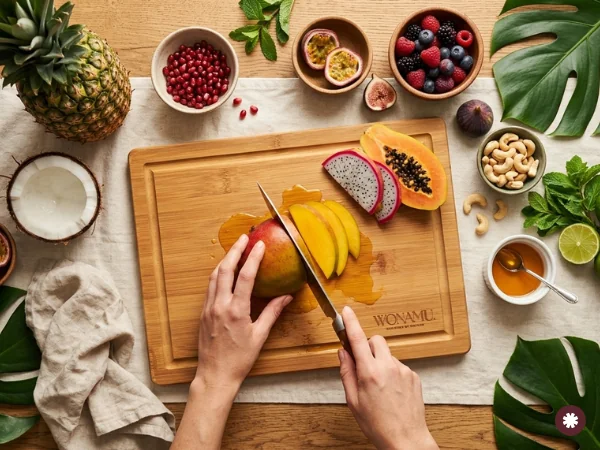
Yes, carnauba wax can go on a cutting board, as part of a board cream and over mineral oil, not on its own. It is a hard plant wax from a Brazilian palm, it is approved as a food ingredient in the US, and it adds a firmer, glossier layer than beeswax alone. What it cannot do is replace the oil underneath, and pure carnauba is too brittle to rub onto a board by itself.
So the useful question is not whether carnauba is safe. It is how to use it, and which carnauba to buy.
What carnauba wax is
Carnauba wax comes from the leaves of the carnauba palm, Copernicia prunifera, which is native to and grown only in northeastern Brazil. The leaves are collected and dried, then beaten to loosen the wax, which is refined and bleached. In its pure state it is usually sold as hard yellow-brown flakes.
Two properties set it apart. It is among the hardest natural waxes, and its melting point, 82 to 86°C, or about 180 to 187°F, is among the highest of natural waxes. Beeswax, by comparison, melts at 62 to 64°C, about 144 to 147°F.
Its glossy finish is why it turns up in car waxes, shoe polishes and polishes for musical instruments. The same gloss puts it on candy: carnauba is used in sweets, it carries the food-additive number E903, and it is used to coat chocolate dragées.
Is it food safe?
Food-grade carnauba is. The FDA lists carnauba wax as generally recognized as safe as a direct food ingredient, under 21 CFR 184.1978, with uses that include a surface-finishing agent and a release agent. The foods named include baked goods, chewing gum, confections and frostings, soft candy, and fresh fruits.
The catch is the word “food-grade.” Carnauba is sold for food and cosmetics, and it also goes into car waxes and shoe polishes, which are made for paint and leather, not for something you cut bread on. For a board, buy pure carnauba flakes sold for food or cosmetic use, or a board cream that lists it as an ingredient. Leave the car wax in the garage, even when carnauba is printed on the tin.
Why carnauba never goes on alone
Carnauba is too brittle to be used alone, and it is usually combined with other waxes, principally beeswax. Rubbed onto a board on its own, a hard flake does not spread into an even coat.
It also shares beeswax’s limit. Wax does not feed a board. It barely penetrates and sits on the surface as a water-repellent layer.
A board needs mineral oil first, soaked into the fibers to keep them from drying out. Wax over unoiled wood or bamboo is a crust over a dry board. Can you use beeswax on a cutting board explains the oil-then-wax order in full.
How to use it in a board cream
The usual approach is a soft cream of food-grade mineral oil and beeswax with a little carnauba added for hardness and sheen. Carnauba is the minor ingredient. Too much and the cream sets hard and becomes difficult to spread.
- Weigh out mineral oil and beeswax in your usual board-cream proportions, then swap a small part of the beeswax for carnauba flakes.
- Put everything in a heatproof glass jar and stand the jar in a pan of water held at a steady simmer.
- Stir until the carnauba flakes have fully melted. Because carnauba melts well above beeswax, this takes noticeably longer.
- Pour the liquid into a clean tin or shallow jar and let it set at room temperature.
Never melt wax over a direct flame. The water bath keeps the temperature controlled and the melt even.
If making it is not appealing, some commercial board creams include carnauba. Read the ingredients: mineral oil, beeswax and carnauba is a sound list, and anything fragranced or solvent-based is not.
Applying it
Start with a clean board that has been oiled within the last day or so and has had time to absorb. Rub a thumb-sized amount of cream across the whole face, along the grain, then the edges, the underside and the juice groove. Waxing both faces matters, because a board treated on one side takes on moisture unevenly.
Leave it for 20 minutes to an hour, then buff with a clean cloth until the surface feels dry and smooth. Carnauba is valued for its glossy finish, so the board can buff to a slightly brighter sheen than beeswax gives alone. Buff until it no longer feels tacky; a thick layer left on the surface marks under the knife.
Bamboo is dense and less porous than many traditional hardwoods, so a very light coat goes a long way. The WONAMU. bamboo cutting board is 12 by 9 inches with a perimeter juice groove, and it ships with a cotton care cloth that works for both the oil and the wax step. How to oil a bamboo cutting board covers the oil coat that goes first.
How often
Oil the board whenever it looks pale or feels dry, which for a board in daily use is usually every few weeks. Add a coat of cream every second or third oiling, or whenever water stops beading on the surface after a rinse.
A carnauba cream is a refinement, not a requirement. A board oiled on schedule does well without any wax.
If you like the way a waxed board sheds water and keeps its color between oilings, carnauba is a good addition to the blend. Board butter vs. mineral oil sets out when the extra step is worth it.
The short version
Carnauba wax is safe on a cutting board when it is food-grade and used in a cream over mineral oil. It is a hard palm wax from northeastern Brazil, generally recognized as safe in food by the FDA, and too brittle to use on its own. Blend a little of it into a mineral oil and beeswax cream, melt it in a water bath, and buff it thin over a board that has already been oiled.
Skip car waxes and polishes, even ones with carnauba on the label.
❋
WONAMU. makes a bamboo cutting board designed for daily prep, 12 × 9 inches, bamboo, with a perimeter juice groove. Available on Amazon.
Designed by nature.