A warped wooden cutting board can be flattened at home. Wet the concave side, the one that has pulled into a hollow, let it stand a quarter of an hour, then press the board flat under weight between two flat surfaces and leave it to dry for two or three days. When it comes out, oil both faces.
It works because warping is a moisture story. One face of the board took on water and the other did not, the wet side swelled, and the board cupped away from it. Reversing that, carefully, lets the fibers settle back flat. The same understanding is what keeps a board from warping again.
Why a board cups
Wood and bamboo move with moisture. When a board is washed and laid flat on the counter to dry, the top face loses water to the air while the underside stays damp against the counter. The top shrinks, the bottom does not, and the board bows upward at its edges. The next morning it rocks.
The same thing happens in reverse when one side sits in a puddle, when a board is left in a sink, or when it goes through a dishwasher. Can you put a wooden cutting board in the dishwasher describes what that cycle does. Heat and uneven wetting are the two causes; any wooden board left wet on one side will do it.
Which means the fix is to wet the other side.
The method
You will need two flat surfaces larger than the board, and weight. Two scrap boards, two baking sheets, or a countertop and a sheet pan all work. For weight, a stack of cast iron pans, a few heavy books in a bag, or clamps.
- Find the hollow side. Set the board on the counter. The face that touches the counter at its edges and lifts in the middle is the concave side. That is the dry side, and it is the one to wet.
- Wet it. Lay the board hollow side up and wipe the face with a wet cloth until the surface is evenly damp. Not dripping, not soaked. The aim is to let the dry fibers take up a little water and swell.
- Wait fifteen minutes. Give the board this pause before adding weight, because clamping a dry board the moment it is wet can crack it. Let the water get into the surface first.
- Sandwich and weight. Set the board on one flat surface, wet side down, put the other flat surface on top and pile the weight on, spread evenly. Or clamp the sandwich at all four corners, snug rather than crushing.
- Leave it two to three days. The board has to be fully dry before the weight comes off, or it will move again. A fan in the room speeds things up. Resist checking before day two.
- Oil it. When it comes out flat, wipe both faces with food-grade mineral oil, let it soak in overnight, buff off the excess. How to oil a bamboo cutting board sets out the method.
If the board is still slightly cupped on day three, repeat. A second round usually finishes it.
The gentler alternative
There is a case for doing less. Turn the cupped board over so the damp face is up and the dry hollow is down against the counter, and leave it. Over days or weeks the moisture evens out and the board settles. No water, no weights.
This is the right approach for a board that is only a little off, where a slight rock on the counter is the whole problem. It is slow, and it asks nothing of the wood. For a board that rocks enough to be unsafe under a knife, the weighted method is faster.
When it will not hold
Two honest notes. First, a board that cups side to side responds well; a board that has bowed along its length, end to end, can be harder to bring back. Second, a board flattened with water and weight can cup again if it goes back to the habits that warped it. The repair is real, but it is not a change in the wood’s nature.
So the flattening is half the job. The other half is the routine that follows.
Keeping it flat
Three habits prevent nearly every warp.
Dry it on its edge. After every wash, towel the board and stand it in the rack or against the backsplash with air on both faces. Both sides lose moisture at the same rate and nothing cups. How to dry a wooden cutting board covers the detail.
Wash both faces. Wetting only the cutting face is a smaller version of the dishwasher problem. Rinse the underside too, every time, so the board is evenly wet before it is evenly dried. How to wash a bamboo cutting board has the two-minute routine.
Oil it on a schedule. Oil fills the surface fibers so they take up less water in the first place. A board oiled once a month, and more often in winter when heating dries the air, moves far less than a bare one. Dry winter air and your cutting board explains the seasonal side.
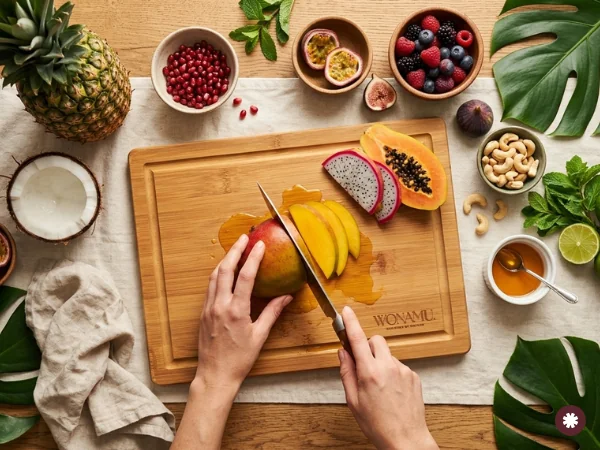
Bamboo is dimensionally stable when it is cared for this way. Its dense, low-porosity surface takes up less water than many hardwoods, and a bamboo board dried on its edge and oiled on its rhythm stays flat for years. The WONAMU. bamboo cutting board ships with a cotton care cloth for the oiling that keeps it so.
The short version
Wet the hollow side of a cupped board, wait fifteen minutes, press it flat between two flat surfaces under weight, and leave it to dry for two or three days. Oil both faces when it comes out. Then dry it on its edge after every wash, wash both sides, and oil it monthly so it never needs flattening again. ❋
WONAMU. makes a bamboo cutting board designed for daily prep, 12 × 9 inches, bamboo, with a perimeter juice groove. Available on Amazon.
Designed by nature.