When a recipe says small dice, it means cubes a quarter inch on each side. Medium dice is half an inch. Large dice is three quarters of an inch. In metric that is about 6, 12 and 20 millimeters.
These are the standard sizes in cooking references, and most well-written recipes follow them.
The sizes matter less as numbers than as a promise. A cube of a given size cooks in a predictable time. When every piece in the pan is the same size, everything is done at once, and nothing is raw in the middle while its neighbor turns to mush.
The three sizes, and one smaller
Small dice, 1/4 inch (about 6 mm). The workhorse for sauces, salsas, fillings and any dish that cooks in under twenty minutes. Onion, carrot and celery in small dice melt into a sauce without leaving chunks.
Medium dice, 1/2 inch (about 12 mm). Soups, hashes, sautéed vegetables, potato salad. Large enough to keep its shape through simmering and to be recognized on the spoon.
Large dice, 3/4 inch (about 20 mm). Roasting trays, stews, braises and anything that cooks for an hour. A large cube survives a long cook and still has texture at the end.
Below small dice sits the brunoise, an eighth of an inch, which is a garnish cut more than a cooking cut. It is covered with the julienne and chiffonade in the five basic knife cuts.
How to cut an even dice
Every dice is made the same way: square the vegetable, cut planks, cut the planks into sticks, then cut the sticks into cubes. The width of the planks sets the size of the dice.
Square it off. Trim a thin slice from one side of a carrot, potato or turnip so it sits flat and cannot roll. Trim the other three sides if you want true cubes; keep the trimmings for stock or a purée.
Cut planks. Lay the vegetable on its flat side and slice it lengthwise into planks the thickness of the dice you want: a quarter inch for small, half an inch for medium.
Cut sticks. Stack two or three planks and slice them lengthwise into sticks of the same width. At a quarter inch, these sticks are the cut called batonnet. At an eighth, they are julienne.
Cut cubes. Gather the sticks into a bundle and slice across them at the same spacing. The cubes fall away from the knife already finished.
The guiding hand holds the bundle in a claw, fingertips tucked behind the knuckles, and walks backward as the knife advances. Knife grips for beginners explains the pinch and the claw in detail.
Onions follow a different method
An onion is made of layers, so it is never cut into planks. Halve it through the root, peel it and lay each half flat.
Make vertical cuts toward the root without cutting through it, spaced at the dice size. Make one or two horizontal cuts parallel to the board. Then slice across, and the onion falls into cubes.
The root holds the layers together until the last stroke.
The spacing of those first vertical cuts is what decides small, medium or large. Because onion layers vary in thickness, an onion dice is never perfectly cubic, and no recipe expects it to be.
Reading the words in a recipe
Recipes often use looser language, and it helps to translate it.
Finely chopped or minced means smaller than small dice and not necessarily even. Garlic, herbs and shallots for a vinaigrette are minced. How to mince garlic covers the method.
Chopped usually means rough pieces about the size of a medium dice, where evenness is not the point. A soup that will be blended needs only chopped vegetables.
Diced without a size usually means medium. When a recipe takes the trouble to say small or large, it is telling you something about cooking time.
Cubed is used most for meat, bread and cheese, and often means larger than large dice: one inch for stew beef, three quarters for croutons.
Why the size changes the dish
A quarter-inch cube of carrot is cooked through in a few minutes of sautéing. A three-quarter-inch cube needs twenty minutes or more in the oven. Swap one for the other and the recipe stops working.
Size changes flavor as well as timing. Smaller pieces expose more surface, so they brown faster and release more of their flavor into the dish. That is why a soffritto or a mirepoix for a quick sauce is cut small, while the vegetables in a pot roast are cut large so they hold their own taste against the meat.
Mixed sizes in one pan are a common cause of uneven cooking at home. When onions and potatoes go into a hash together, cut the potatoes to the same dice as the onion, or start them first.
Setting up to dice
Dicing is repetitive, so the setup decides how pleasant it is. A sharp knife does most of the work; a dull one crushes the corners and leaves ragged cubes. A stable board that does not slide keeps every cut square. A bowl for finished cubes and a second for trimmings keeps the working area clear.
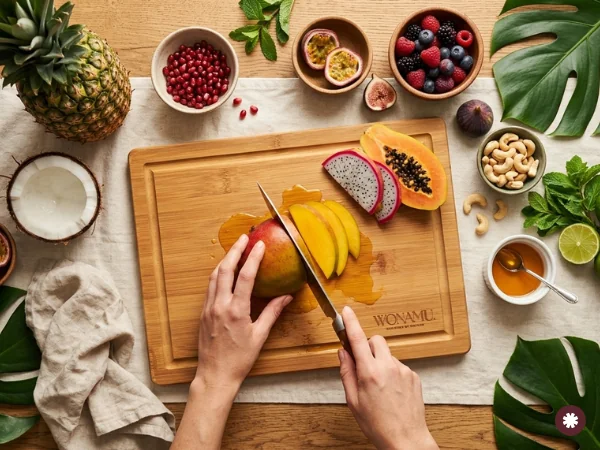
A WONAMU. bamboo cutting board at 12 × 9 inches holds one large onion or two carrots in planks with room left to push the finished dice to the far edge. Work in batches rather than crowding the board, and scrape the cubes away with the spine of the knife, never the edge.
The short version
Small dice is a quarter inch, medium is half, large is three quarters. Square the vegetable, cut planks at the dice size, cut sticks, then cut cubes. Onions get vertical cuts toward the root instead. Match the size to the cooking time, and keep everything in one pan the same size.
After a week of practice, the sizes become a feel in the hand rather than a measurement, and the recipe’s wording starts to read like instructions you already know.
❋
WONAMU. makes a bamboo cutting board designed for daily prep, 12 × 9 inches, bamboo, with a perimeter juice groove. Available on Amazon.
Designed by nature.