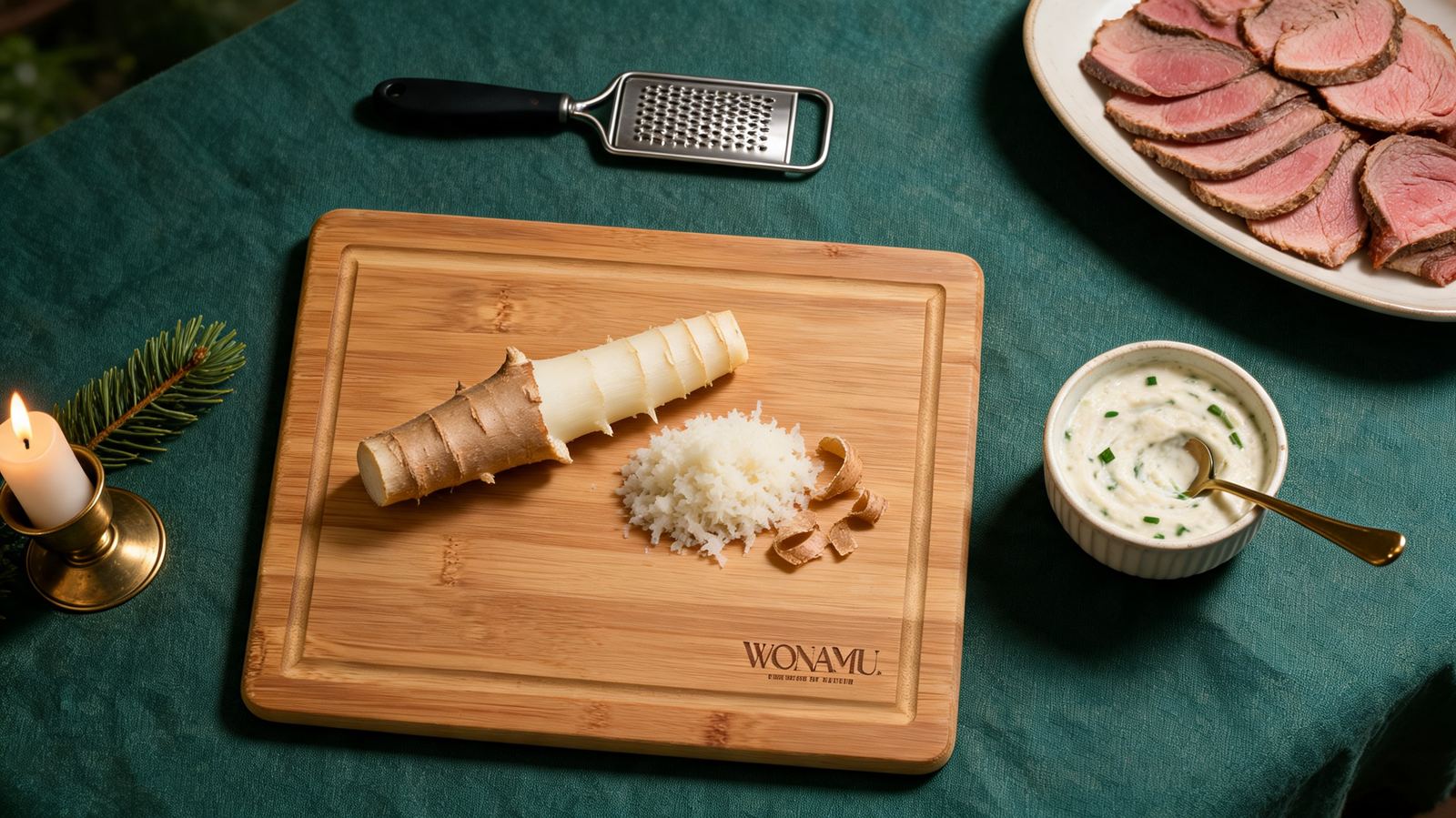
To grate fresh horseradish, scrub and peel the root, cut away any woody parts, and grate it on the fine teeth of a rasp grater or pulse it in a food processor. Mix in a little white vinegar and salt soon after grating to hold the heat, then fold it into sour cream for a horseradish cream to serve with prime rib. Work near an open window: freshly grated horseradish is strong enough to sting your eyes.
Jarred horseradish is convenient. A fresh root, grated an hour or two before dinner, is something else: brighter, sharper, and noticeably more alive on a slice of roast beef.
Why the heat appears only when you grate
Wikipedia notes that intact horseradish root has little aroma. The heat is created by the knife and the grater. According to Wikipedia, when the root is cut or grated, enzymes from inside the plant cells break down a compound called sinigrin into allyl isothiocyanate, or mustard oil, which irritates the mucous membranes of the sinuses and eyes.
That heat does not last. Wikipedia also notes that once exposed to air or heat, horseradish loses its pungency, darkens and develops a bitter flavor. America’s Test Kitchen tasted grated horseradish after two hours, four hours and overnight, and found it got milder the longer it sat.
The practical lesson: grate it close to serving time, keep it away from the stove, and give it vinegar.
Choosing and storing the root
Horseradish is a member of the Brassicaceae, the mustard and cabbage family. In the United States, Wikipedia notes, its most concentrated growth is in the region around Collinsville, Illinois. Look for it in the produce section of a supermarket.
Pick a root that feels firm and heavy, with no soft spots, shriveled ends or green sprouts. Wrap it loosely in a plastic bag and keep it in the refrigerator’s crisper drawer until the day you need it. One root goes a long way; an 8-inch piece makes plenty of sauce for a holiday roast.
Prep the root on the board
- Scrub it. The root grows in soil and arrives with some of it. Scrub under running water with a stiff brush and pat it dry.
- Trim the ends. Cut off the top crown and the thin, stringy tip.
- Peel it. A vegetable peeler works on a straight root; a paring knife is easier around knots and bends. Peel down to the creamy white flesh.
- Cut away woody parts. If the knife meets a tough, fibrous center, cut that core out.
- Decide the shape. For hand grating, keep one long piece, which gives you something to hold. For a food processor, cut the root into 1-inch chunks.
This is ordinary, wet knife work, and an everyday board handles it. A WONAMU. bamboo cutting board gives a 12 × 9 inch surface for peeling and chunking a root, and its perimeter juice groove keeps the moisture from the grated mound off the counter. The roast itself stays on its platter.
Grate it: three ways
Rasp grater. The finest, fluffiest result. Hold the grater over the board and run the root down its length in firm strokes. Stop before your fingertips get close to the teeth, and finish the last piece with a knife.
Box grater. Use the smallest holes. The texture is slightly coarser and wetter. Grating potatoes on a box grater follows the same grip and rhythm; how to grate potatoes for latkes covers it.
Food processor. The fastest route for more than one root. Pulse the chunks until finely chopped, add a couple of tablespoons of cold water, and pulse again to a fine, moist paste. When you open the lid, turn your face away. The fumes that come out are the reason to work by an open window.
Whichever way you choose, wash the grater straight away, before the fibers dry onto the teeth.
Fix the heat with vinegar
America’s Test Kitchen explains that the acetic acid in vinegar slows the enzyme, so the heat forms more gradually and lasts longer. Its recipe for prepared horseradish uses a peeled 8- to 10-inch root grated on a rasp-style grater, mixed with 6 tablespoons of water, 3 tablespoons of white vinegar and half a teaspoon of salt. According to the same article, the mixture holds its heat for up to two weeks in an airtight container in the refrigerator.
Stir the vinegar in once the grating is done. The result is your own prepared horseradish, ready to use straight or in a sauce.
Horseradish cream for prime rib
For six to eight people:
- 1 cup sour cream or crème fraîche
- 3 to 4 tablespoons prepared fresh horseradish, drained of excess liquid
- 1 teaspoon Dijon mustard
- 1 teaspoon lemon juice
- Salt and black pepper
- A tablespoon of finely sliced chives, optional
Stir everything together, taste, and add more horseradish a spoonful at a time. Make it an hour or two ahead so the flavors settle, cover it, and keep it cold until the roast is carved. Like any dairy sauce, it goes back into the refrigerator within two hours, the FDA’s limit for perishable food.
Serve it in a small bowl next to the jus, with a spoon. It also belongs on the cold roast beef sandwiches that follow the next day, a use covered with the rest of the dinner in what to do with Christmas leftovers.
The short version
Scrub, trim and peel the root, and cut out any woody core. Grate it fine on a rasp or pulse it in a food processor with a little water, by an open window. Stir in white vinegar and salt to hold the heat.
Fold three or four tablespoons into a cup of sour cream with mustard, lemon and salt. Make it an hour or two before dinner and keep it cold.
❋
The WONAMU. bamboo cutting board — 12 × 9 inches, bamboo, with a perimeter juice groove and a cotton care cloth in the box — is available on Amazon.
Designed by nature.