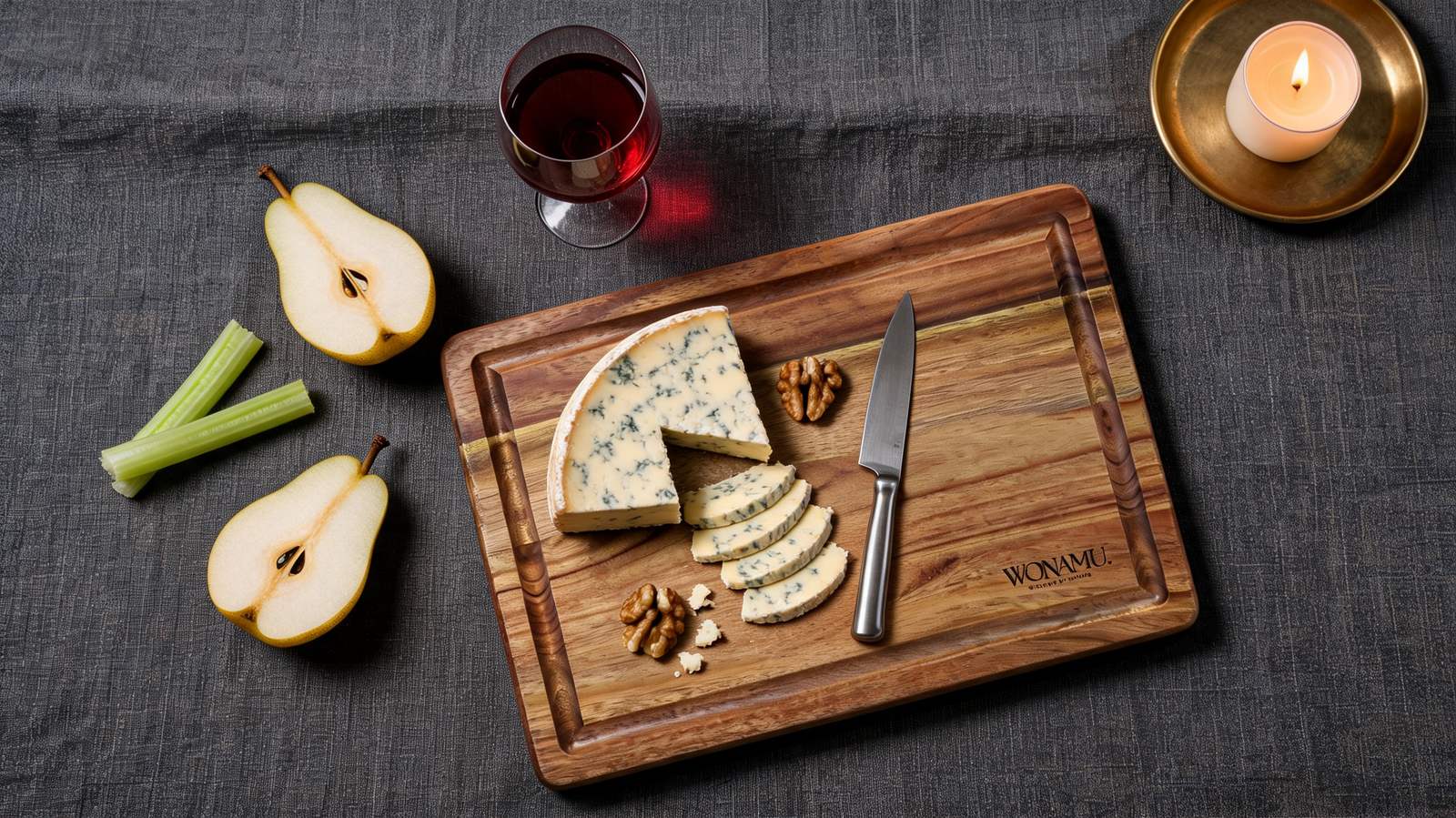
Cut a wedge of Stilton into long, thin slices running from the tip to the rind, parallel to one of the cut sides, with a cheese wire or a long, thin knife dipped in hot water and wiped dry between cuts. A whole round is cut differently: take a level disc off the top, cut that disc into wedges, and cover the cut face of the round straight away. What you never do is scoop it out from the middle.
Blue cheese is the one cheese on a holiday board that most people are unsure how to approach. A crumbly blue needs a slightly different hand from a cheddar or a brie, and the right cut keeps the veins clean and every piece the same mix of rind, paste and blue.
Know the cheese before you cut
Blue Stilton is a protected name. Under its protected designation of origin, only cheese made from pasteurised local milk in Derbyshire, Leicestershire and Nottinghamshire may be called Stilton, and it must have the traditional cylindrical shape. The blue veins develop after the crust is pierced with stainless steel needles, which lets air into the core.
That structure explains how it cuts. The paste is dense but crumbly, threaded with veins, and the crust is dry and rough. Press down hard with a thick knife and the cheese breaks apart instead of slicing.
Tools: a wire or a thin, hot blade
The cleanest cut through a crumbly blue is a cheese wire. The cheese-care guide Neal’s Yard Dairy publishes for its trade customers puts it plainly: because of its crumbly texture, Stilton should always be cut with a wire. A wire has no thickness to wedge the paste apart, so it passes through rather than splitting it.
At home, a long, thin-bladed knife does almost as well if you dip it in hot water and wipe it dry between cuts. The warm, clean blade glides instead of dragging blue across the white paste. Avoid thick chef’s knives and the stubby knives meant for prying hard cheese.
Cut it cold. Cold Stilton holds a clean edge, then it needs time at room temperature before anyone eats it (more on that below).
How to cut a wedge
A wedge of Stilton is a long triangle cut from the round, with crust on its curved back and two cut faces.
- Lay the wedge flat on the board, on one of its cut faces.
- Cut long, thin slices parallel to one of the cut sides, running from the narrow tip to the rind. Each slice gets a share of the center and of the paste near the crust.
- Keep the slices about 1/4 inch thick. Thinner slices crumble; thicker ones are hard to eat on a cracker.
- Leave the crust on the slices or trim it off, as you prefer. It is coarse and dry, and guests can cut around it.
If the slices break, do not fight it. Rough, broken pieces of blue look generous on a board, and the method for crumbles is in how to slice cheese for a board.
How to cut a whole or half round
A whole or half round is cut in layers, not from the center.
Cut straight across the round to take off a level disc about 2 inches (5 cm) thick. Keep the cut flat so the remaining cheese has an even top. Lay the disc on the board and cut it into wedges like a cake, then slice each wedge as above. Cover the exposed face of the round at once.
Scooping a hollow in the center of a Stilton, and pouring port into it, is a practice that is now discouraged. A level cut leaves one flat face to cover; a hollow leaves a large exposed surface that dries out and spoils faster.
Gorgonzola, Roquefort and other blues
Gorgonzola Dolce is the younger style, with a buttery, soft texture. It will not slice. Cut it into small wedges with a wire or a hot knife, or serve a piece whole with a small spoon or spreader beside it.
Gorgonzola Piccante is aged longer and is firmer and crumbly. Treat it like Stilton: thin slices or rough chunks.
Roquefort is made entirely from sheep’s milk and is creamy and slightly moist. Under its protected name, only cheese matured in the natural Combalou caves of Roquefort-sur-Soulzon may carry it. Cut it with a wire or a hot, wiped knife into small wedges, and expect a few crumbs.
Domestic and other blues, from creamy to crumbly, follow the same rule: the softer the paste, the more you need a wire or a hot blade; the firmer it is, the more it can be broken into chunks.
Serving blue cheese
Take Stilton out of the refrigerator about an hour before serving and leave it wrapped until the last few minutes, so the cut faces do not dry out. Cold blue tastes muted.
Give blue cheese its own corner of the board and its own knife, away from mild cheeses, so the flavor and the crumbs do not spread. Stilton is often eaten with pears or celery, and port is its traditional pairing. Walnuts and a little honey work too. The way to cut the fruit is in how to cut a pear for a cheese board.
A wooden board is a natural base for blue cheese. The WONAMU. acacia cutting board is 12 by 9 inches with a perimeter juice groove, room for a wedge of Stilton, its slices and a cut pear, and its warm, varied grain sits well with the cream-and-blue of the cheese.
Like any cheese, it should not sit out indefinitely. The FDA advises refrigerating perishable food within 2 hours, or within 1 hour when the temperature is above 90°F.
Storing what is left
Wrap cut Stilton in waxed, greaseproof or cheese paper pressed against the cut faces, then loosely in foil or in a lidded box. Cling film traps moisture and can make the cheese taste of plastic. Keep it away from other cheeses, because blue mold travels.
A cut wedge is best within about one to two weeks. If a cut face dries or darkens, pare off a thin layer and carry on. Stilton freezes better than many cheeses, but it comes out more crumbly, so frozen blue is best saved for cooking: a sauce, a soup, or crumbled over a salad. More uses for the end of a holiday cheese board are in what to do with Christmas leftovers.
The short version
Use a cheese wire or a long, thin knife dipped in hot water and wiped dry. Cut a wedge into thin slices from tip to rind, parallel to a cut side. Cut a round by taking off a level disc, then cutting the disc into wedges. Never scoop.
Serve it after an hour out of the refrigerator, on its own corner of the board, with pears and walnuts. Wrap leftovers in paper, then foil, away from other cheese.
❋
WONAMU. makes an acacia cutting board, 12 × 9 inches, acacia, with a perimeter juice groove. Available on Amazon.
Designed by nature.

