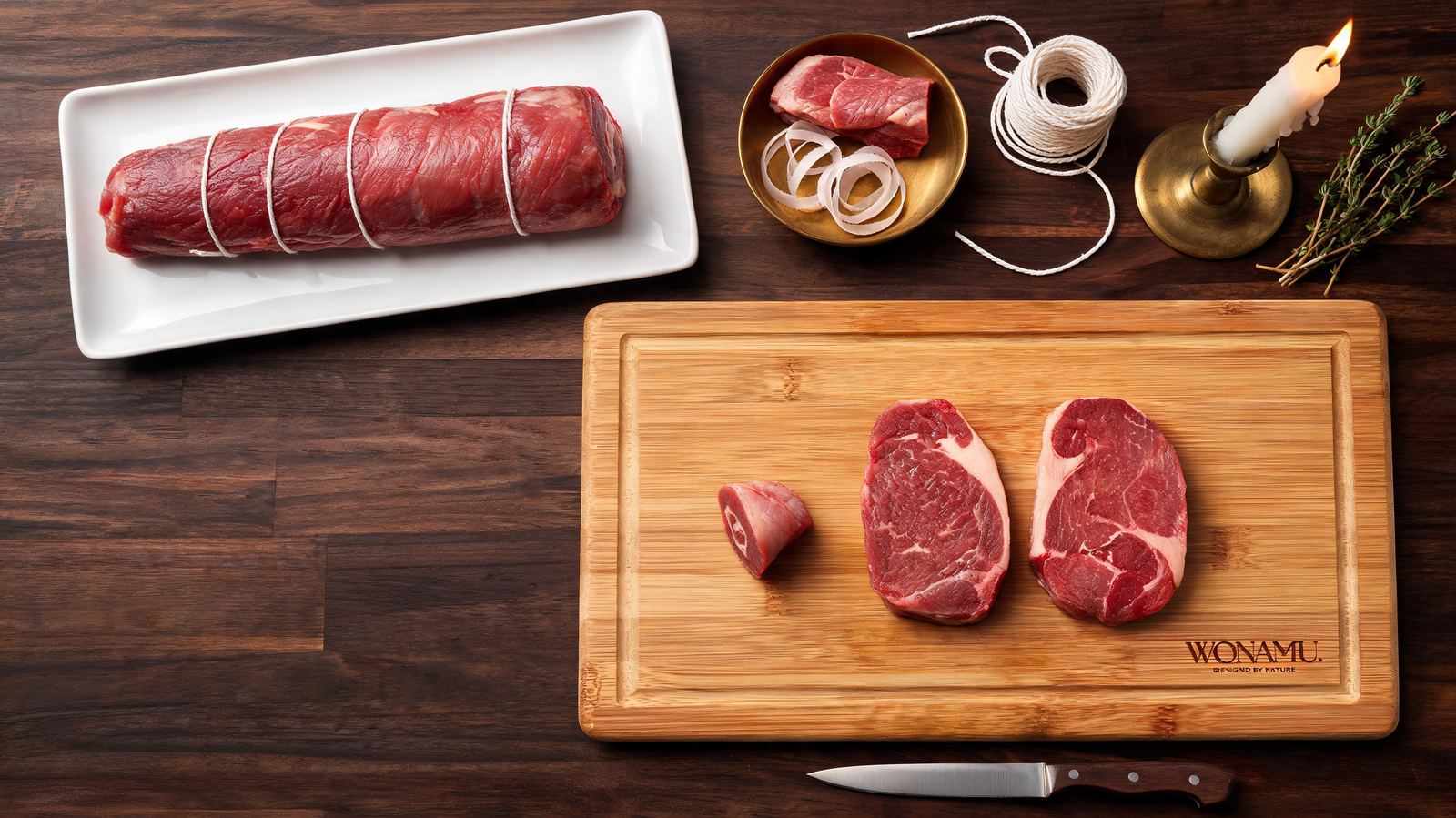
To trim a whole beef tenderloin, do three jobs in order: pull off the chain, the loose strip of meat and fat along one side; strip away the silverskin, the thin silvery membrane on top; then divide what is left into the thick butt end, the even center cut and the thin tail. Roast the center cut whole or cut it into steaks, fold or cut off the tail, and keep every scrap for another meal.
None of it needs special skill, only a sharp, thin knife and some patience. It is one of the most satisfying pieces of butchery a home cook can take on for a holiday dinner.
What you are buying
The tenderloin is a long muscle that sits under the ribs, beside the backbone. Wikipedia notes that it does very little work, which is why it is the tenderest part of the beef. It is thick at one end, the butt, and tapers to a thin, pointed tail at the other.
Whole tenderloins are sold in a few states of trim. Wikipedia lists them as unpeeled, with the fat and silverskin still on, and peeled, with the fat removed but the silverskin left in place. A peeled tenderloin with its side muscle still attached is labeled PSMO, for “peeled, side muscle on.” That side muscle is the chain. Check the label: an unpeeled one has a layer of fat to remove before anything else.
This is a bigger, longer cut than a pork tenderloin, with more to trim. The pork version is covered in how to cut pork tenderloin.
Set up for raw meat
A whole tenderloin is longer than an everyday 12 × 9 inch board. Trim it on a large cutting board kept for raw meat, or on a sheet pan if that is the largest flat surface you have. Wisconsin Extension recommends one cutting board for raw meat, poultry and seafood and another for vegetables, bread and other ready-to-eat foods.
- A boning knife or a thin, flexible slicing knife, freshly sharpened
- Paper towels to pat the meat dry and to grip the slippery bits
- Butcher’s twine
- A bowl for scraps you will cook and a second one for fat and membrane you will throw away
Pat the tenderloin dry before you start. Wet meat slides, and so does the knife.
Step 1: Pull off the chain
Lay the tenderloin with the chain facing you. It is a narrow, fatty strip of meat running most of the length of one side, attached only loosely.
Start at the thick end and pull the chain away with your fingers. It mostly separates along a natural seam of fat. Use the tip of the knife only where it clings. Work down the length of the tenderloin until it comes off in one long piece.
Do not throw the chain away. Trim the fat from it and you have good meat for a stir-fry, kebabs or a weeknight hash after the holiday.
Next, pull or cut off any large pockets of fat on the surface, especially around the thick end. Keep what is lean; discard the rest.
Step 2: Strip the silverskin
The silverskin is a thin, tough, shiny membrane covering part of the top of the tenderloin. It is chewy, so it comes off.
- Slide the tip of the knife under one end of the silverskin to free a short tab.
- Grip the tab with a paper towel.
- Angle the blade slightly upward, toward the silverskin and away from the meat.
- Pull the tab back gently and push the knife forward along the membrane in a long, smooth stroke.
- Repeat in strips until the top is clean.
The angle is the whole technique. Tip the blade down and it cuts into the meat; keep it angled up and it slides along the underside of the membrane, taking almost nothing with it.
Step 3: Divide it into three
Now look at the shape of what is left.
- The butt end is the thick, irregular end. Roast it on its own, or cut it into thick steaks.
- The center cut is the long middle section of even thickness. According to Wikipedia, it can yield filet mignon or tenderloin steaks, as well as Chateaubriand and Beef Wellington. This is the piece to roast whole for a Christmas table.
- The tail is the thin, tapering end. Wikipedia notes it can be used for tournedos, small rounds usually served in pairs.
Cut straight across where the thickness changes. There is no exact line; aim for a center cut that is the same thickness from end to end.
Step 4: Tie it or cut steaks
To roast the whole tenderloin, fold the thin tail under itself so the meat is even, then tie the roast with twine every inch and a half. Even thickness means even cooking, and the twine keeps the round shape in the oven.
To roast the center cut alone, tie it the same way and set the butt and tail aside for another meal.
For steaks, cut the center section into rounds about one and a half to two inches thick.
Once the meat is divided, the work changes scale. The tail, the trimmed chain and the steaks all fit a smaller board, and a WONAMU. bamboo cutting board, 12 × 9 inches with a perimeter juice groove, is the right size for cutting steaks and portioning the scraps.
Keep it for raw meat during the prep, then wash it before anything ready-to-eat touches it. Whether bamboo handles raw meat well is answered in can you cut raw meat on a bamboo cutting board.
Cooking and carving
The FDA’s safe minimum for beef roasts is 145°F with a three-minute rest. Check the center of the thickest part with a thermometer.
After the roast rests, cut the twine and slice it crosswise into rounds on a clean board, half an inch to an inch thick.
Cleanup
Raw beef juice is the reason the trimming board needs a real wash. The FDA advises washing cutting boards with hot, soapy water after each food. To sanitize, Wisconsin Extension gives 1 tablespoon of unscented liquid chlorine bleach per gallon of water, left to stand for several minutes, then a rinse with clear water. The full routine is in how to deep clean a cutting board after raw meat.
The short version
Pat the tenderloin dry. Pull off the chain along its seam and keep it. Strip the silverskin with the blade angled up. Divide the rest into butt end, center cut and tail.
Fold the tail under and tie the roast every inch and a half, or cut the center into steaks. Roast to at least 145°F, rest, and slice across the grain. Wash and sanitize every board that touched raw beef.
❋
The WONAMU. bamboo cutting board — 12 × 9 inches, bamboo, with a perimeter juice groove and a cotton care cloth in the box — is available on Amazon.
Designed by nature.

