A Feast of the Seven Fishes is manageable when it is planned backward from Christmas Eve. Choose seven dishes that share ingredients and cooking methods, start the salt cod soaking days ahead, buy the shellfish as late as you can, and do all the knife work in one session on the morning of the 24th, produce first and raw seafood last. Seven fishes do not have to mean seven separate projects.
The plan below assumes a single cook, one oven, a stove with four burners and a refrigerator that is already full. It works for six guests or twelve.
What the feast is, briefly
The Feast of the Seven Fishes is an Italian American celebration of Christmas Eve with dishes of fish and seafood, also known as la Vigilia. Wikipedia’s entry traces the seafood to the Roman Catholic observance of abstaining from meat on the eve of a feast day.
Why seven is another matter. The seven sacraments of the Catholic Church are one possible explanation, and Wikipedia’s entry adds that there is no general agreement on the number’s meaning.
A 2015 Denver Public Library history post that looked into the question concluded, “As near as we can tell, no one really knows.” The members of the library’s Italian Research Group did agree that baccalà, the salted cod, and calamari belong on the table, though the post notes that almost no one agrees on the other five. Treat the count as a frame for planning, not a test.
Choose seven that share the work
The mistake is choosing seven dishes that each need their own pan at the same moment. Group the menu by method instead, and keep each group small.
- Cold, made ahead: shrimp cocktail and a baccalà salad with lemon, olive oil, celery and parsley. Both are finished by early afternoon.
- Raw, done at the last minute: oysters on the half shell. The only work is shucking, and the method is in how to shuck oysters.
- Fried: calamari, and smelts if you want a second fry. One pot of oil serves both.
- Pasta: linguine with clams, cooked while the fry oil heats.
- Oven: a whole roasted fish or fillets, and lobster tails if you are splurging. They share a hot oven.
That is seven, with only two dishes cooked at the last minute and one pot of oil. If a dish does not fit a group, swap it for one that does.
For the shrimp, the deveining and poaching method in how to devein shrimp gets them cold and ready by lunchtime.
The timeline
Three days before (December 21): Start the baccalà. Dried salted cod needs to soak in cold water for one to three days, with the water changed two to three times a day, to rehydrate and lose its salt. Keep the container in the refrigerator and taste a flake before you cook it.
Two days before: Buy anything frozen, such as shrimp, squid or lobster tails, and move it to the refrigerator to thaw. The FDA recommends thawing frozen seafood gradually in the refrigerator overnight. Make the cocktail sauce and keep it covered in the refrigerator.
The day before: Buy the fresh fish and live shellfish. The FDA says seafood you will use within 2 days of purchase belongs in a clean refrigerator at 40°F or below. For clams and oysters, look for the tag on the sack, which carries the processor’s certification number. Throw away any with cracked or broken shells; live clams and oysters close when the shell is tapped. Store them in a bowl in the refrigerator under a damp towel.
Christmas Eve morning: The knife session (below). Then poach the shrimp, chill them, and poach and flake the baccalà for the salad.
Christmas Eve afternoon: Set up the frying station, put the pasta water on the back burner, and lay out platters. Ice the raw bar tray.
The evening: Shuck the oysters, fry the calamari, cook the clams and pasta, roast the fish. Everything else is already done.
The knife session, in order
One long session of knife work is faster than seven short ones, and the order matters more than the speed.
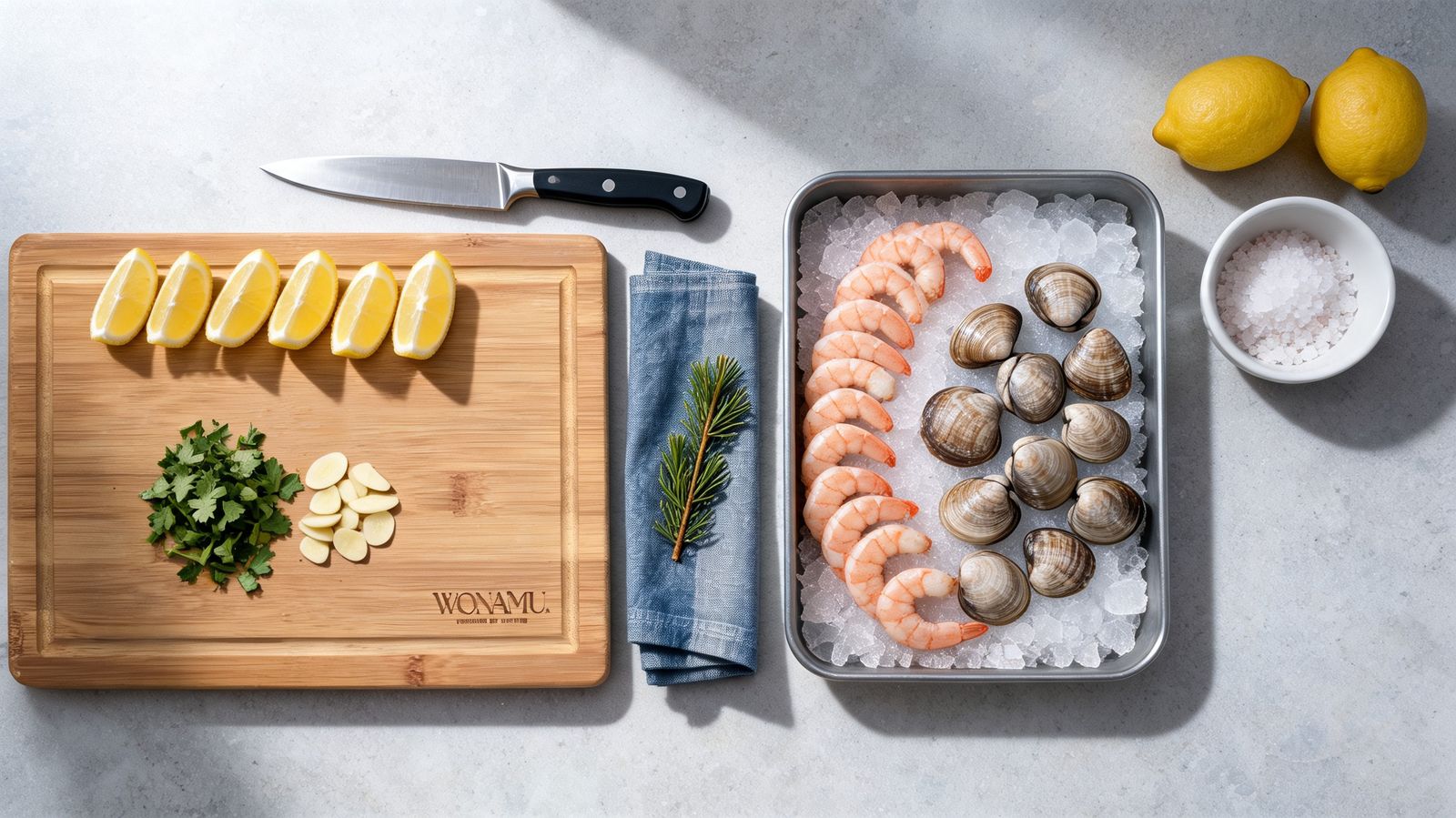
The FDA advises one cutting board for fresh produce and a separate one for raw meat, poultry and seafood. If you have two boards, use them that way. If you have one, cut everything that will be eaten without further cooking first, then the raw seafood, then wash the board.
- Lemons. Wedges for the oysters, the shrimp and the calamari, plus halves for the fish. Cut more than you think; every course uses them.
- Herbs and aromatics. Flat-leaf parsley for the baccalà salad, the pasta and the fish. Garlic for the clams, sliced thin. Celery and red onion for the salad.
- Raw seafood, last. Clean and slice the squid into rings, butterfly the lobster tails, score the fish. All of it goes back into the refrigerator on a covered tray as soon as it is cut.
A WONAMU. bamboo cutting board, 12 by 9 inches with a perimeter juice groove, is a comfortable size for the lemon and parsley work; the groove keeps citrus juice off the counter. Keep the raw seafood on its own board, or wash between the two.
After the seafood, wash the board, knife and counter with soap and hot water, as the FDA advises between raw seafood and ready-to-eat food. For added protection, sanitize the board with 1 tablespoon of unscented liquid chlorine bleach per gallon of water, let it stand for several minutes, rinse and dry it. Wash your hands for at least 20 seconds with soap and warm water. If the board holds on to a fishy smell afterward, how to get garlic, onion and fish smells out of a board has the fix.
Serving the evening
Serve in the order the food holds: cold dishes first, while the oil heats; fried food as soon as it leaves the pot, because it waits poorly; then the pasta; then the fish from the oven.
Keep the raw bar on ice and bring it out in rounds rather than all at once. Raw oysters are not for every guest: the FDA advises pregnant women, children, older adults and people with weakened immune systems to avoid raw oysters and other raw or undercooked shellfish, so the other six courses are theirs. The FDA’s rule is that seafood should not sit out of the refrigerator for more than 2 hours, or 1 hour when the temperature is above 90°F.
Cook the clams until their shells open and throw out any that stay closed. Fish is done at 145°F, or when the flesh is opaque and separates easily with a fork. Shrimp and lobster are done when the flesh is firm, pearly and opaque.
Leftovers
Refrigerate leftovers within 2 hours, in shallow containers, in a refrigerator at 40°F or below. Reheat them to 165°F, checked with a food thermometer. The baccalà salad and cold shrimp are best eaten cold the next day. More ideas for the day after are in what to do with Christmas leftovers.
The short version
Choose seven dishes in groups that share a method: cold, raw, fried, pasta and oven. Start the baccalà three days ahead, thaw frozen seafood in the refrigerator two days ahead, and buy live shellfish the day before.
On Christmas Eve morning, cut lemons and herbs first, raw seafood last, and wash the board in between. Serve cold to hot, keep the raw bar on ice, and keep seafood out of the refrigerator no longer than 2 hours.
❋
WONAMU. makes a bamboo cutting board designed for daily prep, 12 × 9 inches, bamboo, with a perimeter juice groove. Available on Amazon.
Designed by nature.