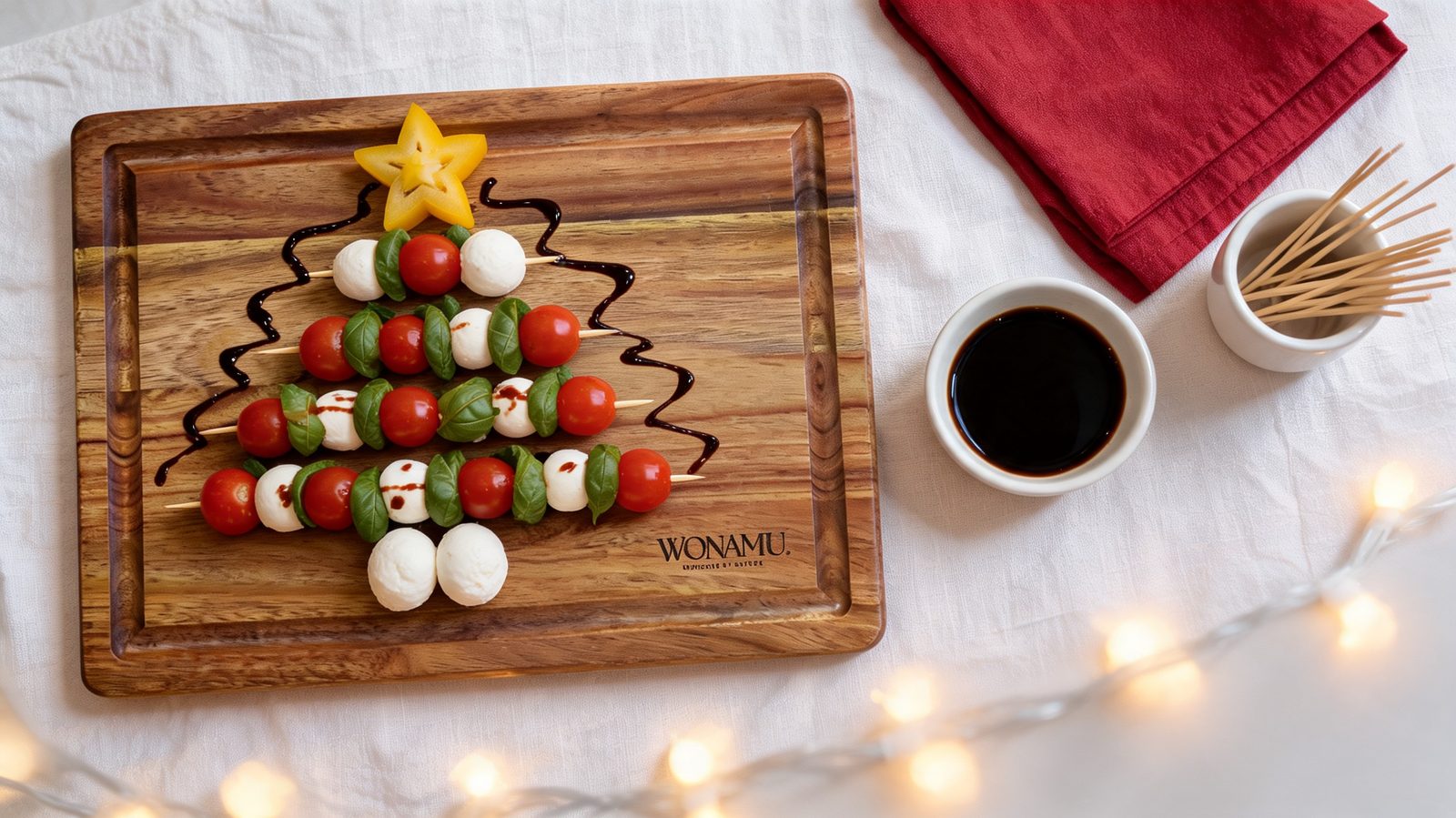
To make Christmas tree caprese skewers, thread a cherry tomato, a folded basil leaf and a cherry-size mozzarella ball onto short picks, then lay the skewers on a board in rows that widen from top to bottom: one, then two, then three, then four. Add a trunk of two mozzarella balls, cut a star from yellow bell pepper for the top, and drizzle balsamic glaze and olive oil right before the board goes out.
It is the same red, white and green as a caprese salad, built so guests can eat it standing up, and the tree shape turns a plain appetizer into the board people photograph before they eat. The skewers take about half an hour; the tree takes five minutes.
What to set out
For one tree of 10 skewers, plus a few spares for refilling the gaps:
- 1 pint cherry or grape tomatoes, red, and a few yellow ones if you can find them
- 8 ounces fresh mozzarella in small balls
- A large bunch of fresh basil with big, unblemished leaves
- 1 yellow bell pepper, for the star
- Balsamic glaze, good olive oil, flaky salt and black pepper
- About 15 sturdy wooden toothpicks or short cocktail picks, around 2 1/2 inches long
For a crowd, build two trees rather than one huge one. A board 12 by 9 inches holds one tree comfortably; a second tree waits in the refrigerator and replaces the first when it is half eaten.
Choosing the mozzarella
Fresh mozzarella comes in several sizes, and the names on the tub tell you which. Wikipedia’s article on bocconcini lists them: bocconcini are bite-size, ciliegine (“small cherries”) are cherry-size, perlene are the smallest, and ovolini are about the size of a hen’s egg. It also notes that these small balls are packaged in whey or water.
Ciliegine are the right size for skewers: about the size of a cherry tomato, so each skewer looks even. Bocconcini work if you halve them first. Perlene are too small to hold on a pick; save them for salads.
Drain the mozzarella and spread the balls on a double layer of paper towels in the refrigerator for 20 minutes. Dry cheese grips the pick; wet cheese slides down it and leaves a puddle on the board.
Prep on the board
Tomatoes. Rinse them and dry them well. Use them whole if they match the mozzarella in size. Larger ones can be halved through the stem end and threaded with the cut side facing the cheese. How to halve cherry tomatoes shows the lid trick for halving a whole pint at once.
Basil. Pick the medium leaves, about the length of your thumb. Wash and dry them gently; dry leaves fold neatly and stay on the pick. Fold each leaf in half, then in half again, so it sits on the pick as a small green square. Save the tiny top leaves for the tree’s garnish and chop a few large ones fine for scattering over the board at the end; how to chop fresh herbs covers cutting basil without bruising it.
The star. Cut the bell pepper in half from top to bottom, and remove the seeds and pale ribs. Lay one half skin side down and cut out the flattest part of the wall, a piece about 2 inches square. With the tip of a paring knife, cut a five-pointed star from it: mark the five points with small nicks, then join each point to the next with two straight cuts, angling in toward the center. A small star-shaped cookie cutter, pressed down hard, does the same job in one motion.
Thread the skewers
Thread each pick in the same order: tomato, folded basil, mozzarella. Push the tomato on first so it sits at the blunt end, near your fingers, and the mozzarella sits closest to the point. Keep every skewer identical. The tree reads as a pattern only if the pieces repeat.
For contrast, make two or three skewers with a yellow tomato in place of a red one. Scattered through the tree, they look like ornaments.
Build the tree
Clear the board and set it with a long side facing you. The tree’s tip points toward the far edge, and its base runs along the near one.
Lay the skewers flat and horizontal, end to end, in rows:
- Top row: one skewer, centered.
- Second row: two skewers end to end, centered below the first.
- Third row: three skewers.
- Fourth row: four skewers.
Leave a narrow gap, about a quarter inch, between rows so each one is easy to pick up. With picks about 2 1/2 inches long, the bottom row of four spans roughly 10 inches, which fits along the 12-inch side of the board with about an inch to spare at each end. From the star to the trunk the tree stands about 8 inches tall, inside the board’s 9-inch depth, as long as the gaps stay narrow.
Below the bottom row, set two mozzarella balls on a pick, standing a little apart from the tree, as the trunk. Lay the pepper star at the very top, just above the middle of the first skewer. Tuck the tiny basil leaves into the gaps between rows.
Dress and serve
Dress the tree only at the last minute. Drizzle balsamic glaze in a thin zigzag across the rows, add a few drops of olive oil, a pinch of flaky salt and some black pepper, then scatter the chopped basil. Put a small bowl of extra glaze and a cup for used picks beside the board.
Assemble the skewers up to 4 hours ahead and keep them covered in the refrigerator, laid flat in a single layer. Fresh mozzarella is a perishable dairy food. The CDC’s food safety guidance is to keep perishable food out for no more than 2 hours, and to keep the refrigerator at 40°F or below, which is one more reason to serve two small trees in turn rather than one large one all evening.
A board with a juice groove helps here. The WONAMU. acacia cutting board has a perimeter juice groove that catches the tomato juice and balsamic before it reaches the tablecloth, and its warm, varied grain sets off the red and green. When the tree is gone, wash the board in hot, soapy water the same evening and towel it dry.
If you want the classic sliced caprese instead, with rounds of mozzarella and tomato fanned on a platter, the knife work is in how to cut fresh mozzarella and tomatoes for caprese. For more on building a holiday board that holds up through a party, see the Christmas charcuterie board.
The short version
Drain and dry cherry-size mozzarella (ciliegine). Thread tomato, folded basil and mozzarella onto short picks, all the same way. Lay them on the board in rows of one, two, three and four, add a two-ball trunk and a star cut from yellow pepper, and finish with balsamic glaze, olive oil and flaky salt at the last minute.
Build two small trees, keep the second cold, and swap it in before the first has been out for 2 hours.
❋
WONAMU. makes an acacia cutting board designed for daily prep, 12 × 9 inches, acacia, with a perimeter juice groove. Available on Amazon.
Designed by nature.

