Christmas gifts for a beginner cook should do one thing: make the first hundred meals go better. A beginner does not need more equipment than an experienced cook. They need less of it, chosen well, so that every tool in the drawer has earned its place by the end of January.
That makes a new cook one of the easier people on the list. Almost anything good is an upgrade. The risk runs the other way, toward the fifteen-piece set and the gadget that promises to do the cooking for them.
Start with the three tools every recipe assumes
Open any recipe written for home cooks and it quietly assumes a sharp knife, a heavy pan and something sturdy to cut on. Most beginners are short on all three.
One good chef’s knife. Not a block of twelve. A single chef’s knife of around 8 inches handles nearly all the cutting a new cook does, from onions to chicken thighs. Keep it sharp and it goes where it is aimed instead of skidding off an onion skin. Pair it with a short lesson in the pinch grip and the claw and it becomes the most-used gift under the tree.
A heavy skillet. Cast iron or thick stainless steel, 10 or 12 inches across. A thin pan scorches in one spot and stays pale in another, and a beginner blames themselves for what is really the pan. A heavy one makes the first good sear feel achievable.
A rimmed sheet pan. The most forgiving piece of cookware in the kitchen. Chopped vegetables, a little oil, a hot oven, and dinner happens without much skill. Choose a heavy-gauge pan that stays flat in a hot oven.
Gifts that teach rather than equip
Tools help a beginner. Understanding helps more, and it is the part a store cannot sell in a box.
A cookbook that explains why. Look for one built around technique rather than a stack of recipes: how heat works, why salt goes in early, what browning does to flavor. A cook who understands one reason can make many dishes without a recipe.
A class, booked for two. A hands-on evening at a local cooking school, with you as the other student. A beginner learns faster beside someone making the same mistakes, and the evening is half the gift.
An afternoon in their kitchen. If you cook, the most useful gift may be three hours on a Saturday making one dish together, start to finish, with their own pans. Write down what you made as you go. That page becomes their first reliable recipe.
Gifts that build confidence
Confidence in a kitchen comes from two things: knowing when food is done, and being organized before the heat goes on.
An instant-read thermometer. It replaces the beginner’s worst habit, cutting into the chicken to check it, with a number. The FDA’s safe minimum internal temperatures are 165°F for poultry, 160°F for ground meat, and 145°F with a 3-minute rest for beef, pork, veal and lamb steaks, chops and roasts. The FDA also notes that color and texture are not reliable signs of doneness, and that a food thermometer is the only way to be sure. Tape those numbers inside a cabinet door and the gift is complete.
A set of small prep bowls. Nesting glass or steel bowls for chopped garlic, measured spices and diced onion. Cutting and measuring everything before the stove is on is the habit that turns a frantic first dinner into a calm one, and the bowls make the habit visible.
On giving a cutting board
Most beginners cut on whatever is nearby: a dinner plate, a thin plastic sheet that slides, the counter itself. A real board changes how cutting feels, and it sits under every other gift on this list.
What makes a board right for someone learning is plain. It is large enough that a chopped onion does not spill over the edge. It sits flat and stays put, especially with a damp towel underneath. It is light enough to carry to the sink, so it gets washed and dried instead of left soaking.
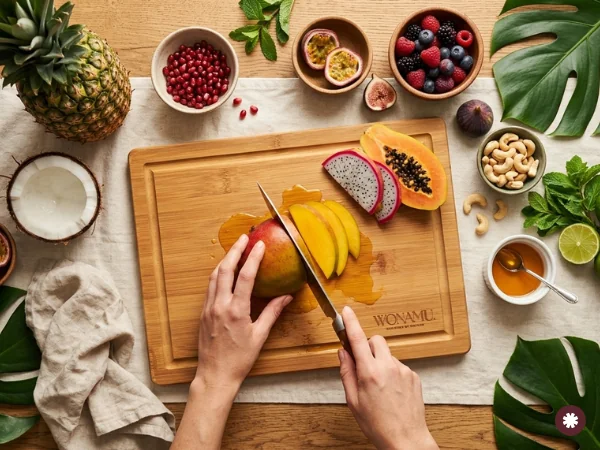
The WONAMU. bamboo cutting board is 12 × 9 × 0.5 inches, a size that leaves room for an onion and a pile of carrots on a standard counter. A perimeter juice groove catches what runs off a ripe tomato or a carved chicken before it reaches the counter.
Bamboo is lighter than acacia, which makes the trip from counter to sink a one-handed job. It arrives in gift-ready packaging with a cotton care cloth, so there is no extra wrapping to do.
For a new cook who will handle raw chicken, a second board is worth considering. The FDA recommends one cutting board for fresh produce and a separate one for raw meat, poultry and seafood. The WONAMU. acacia board, heavier and darker with warm, varied grain, makes the pair easy to tell apart at a glance.
Care is short enough to fit on an index card: wash by hand, dry standing on edge, oil when the surface looks pale. The full routine is in how to care for a bamboo cutting board.
What to skip
The knife block set. It fills the counter with blades a beginner will rarely reach for. The money is better spent on a single chef’s knife of real quality.
Unitaskers. The garlic press, the avocado slicer, the egg separator. Each solves a problem a knife and a board already solve.
The mandoline. Fast, and unforgiving of a cook who is still learning where their fingers belong. Give it once the knife work is steady.
A large appliance. A stand mixer for someone who does not yet bake is a heavy object on a small counter, and a beginner’s counter is usually small.
The short version
A beginner cook needs a few good tools, not many. Give a single chef’s knife, a heavy skillet, a sheet pan and a thermometer, and add something that teaches: a technique cookbook, a class or an afternoon cooking together. A real cutting board ties the set together, because every recipe starts on it.
For a beginner setting up a whole kitchen, the first apartment kitchen essentials list goes further; for gifts meant to last decades, see buy-it-for-life kitchen tools.
❋
WONAMU. makes a bamboo cutting board designed for daily prep — 12 × 9 inches, bamboo. Available on Amazon.
Designed by nature.