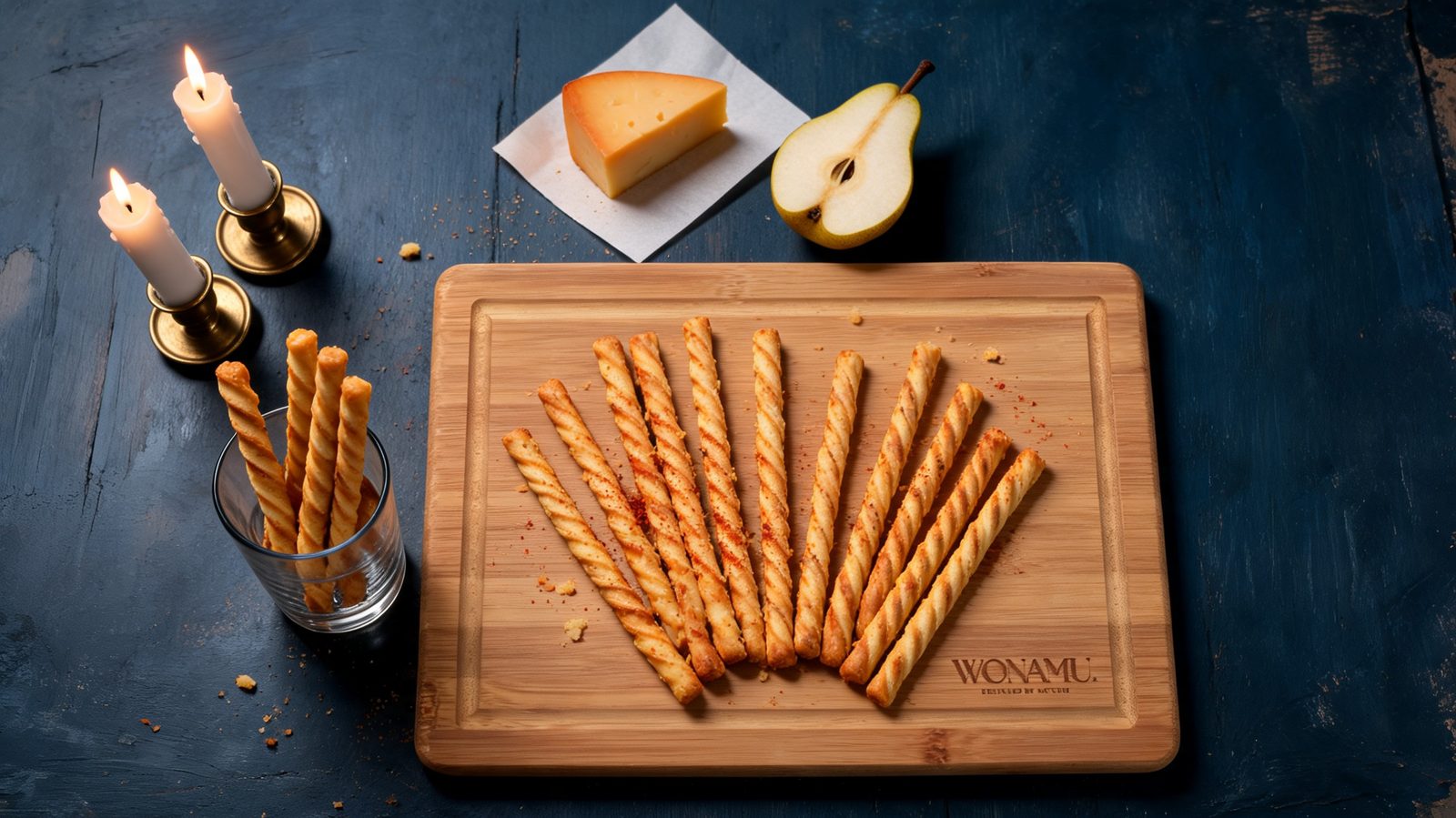
Cheese straws are thin, crisp sticks of savory dough made from butter, flour, sharp cheddar and a pinch of cayenne. To make them for a Christmas party, mix the dough, chill it, roll it out in small portions to about 1/4 inch thick, cut it into strips about 1/2 inch wide and 5 inches long, twist them if you like, and bake at 350°F for 12 to 15 minutes until golden and crisp at the edges.
They keep for days, they travel well, and a glass of them on a side table goes with anything anyone is drinking.
A little background
Cheese straws are a traditional snack in both England and the American South, and the usual dough is butter, flour, salt, cheddar and cayenne. An early English version, “Cayenne Cheeses,” appears in Isabella Beeton’s Book of Household Management, first published as a bound book in 1861: butter, flour, grated cheese, cayenne and salt, rolled out and cut into fingers about 4 inches long.
Some cooks push the dough through a cookie press into long ridged ribbons. This post makes the other kind, cut strips, because they need nothing more than a rolling pin, a knife and a board.
What you need
For about 40 straws:
- 8 ounces sharp cheddar, grated on the fine side of a box grater (about 2 cups, loosely packed).
- 1/2 cup (1 stick) unsalted butter, softened.
- 1 1/2 cups all-purpose flour.
- 1/2 teaspoon salt.
- 1/4 to 1/2 teaspoon cayenne, depending on how much heat you want.
- 1 to 2 tablespoons cold water, only if needed.
- Optional: smoked paprika, finely grated Parmesan, or a little dry mustard powder.
A sharper, older cheddar gives more flavor for the same amount of dough. Grate it yourself from a block, and grate it fine; long, coarse shreds make a lumpy dough that tears when you roll it.
Mix and chill the dough
- Beat the butter and cheese together in a bowl, or pulse them in a food processor, until fully combined.
- Add the flour, salt and cayenne and mix until the dough comes together in clumps. Squeeze a little in your hand: if it holds, it is ready. If it crumbles, add water a teaspoon at a time.
- Divide the dough into three or four portions, flatten each into a disk, wrap them, and refrigerate for 30 minutes.
Chilled dough rolls cleanly and holds its edges when cut. Warm dough smears and sticks to the knife.
Roll on the board, a portion at a time
A cutting board is a good surface for this dough, and a 12 × 9 board suits a small amount at a time. Rolling one portion at a time also keeps the rest of the dough cold until you need it. The general method for rolling dough on wood is in can you roll cookie dough on a cutting board.
Lay a damp towel under the board so it cannot slide. Dust the board lightly with flour and roll one disk into a rectangle about 1/4 inch thick, roughly 5 inches deep, with the long side running along the board. Give it a quarter turn and a light dust of flour whenever it starts to stick.
The WONAMU. bamboo cutting board is 12 by 9 inches, which fits one portion of this dough rolled out with room to cut, and the perimeter juice groove keeps stray flour on the board rather than on the counter.
Cut the strips
Trim the edges of the rectangle straight with a long knife. Then cut strips about 1/2 inch wide across the dough, pressing the blade straight down rather than sawing, so each strip comes away with clean sides.
A ruler laid on the dough keeps the widths even. Even strips bake at the same rate, so the whole sheet comes out of the oven done at once. A pizza wheel also works and is faster on a large batch.
Save the trimmings, press them together, and roll them out with the next portion.
Twist or leave flat
Flat strips are crisp all the way through and stack neatly in a tin. Twisted strips look more festive in a glass and have more crunchy edges.
To twist, lift each strip by both ends and turn the ends in opposite directions two or three times, then lay it on a parchment-lined baking sheet and press the ends down so it does not unwind. Leave about 1 inch between straws. If the strips go soft and break as you twist, chill them on the baking sheet for 10 minutes and try again.
Bake
Heat the oven to 350°F. Bake one sheet at a time for 12 to 15 minutes, until the straws are golden and slightly darker at the edges. Check them from 10 minutes on; thin strips go from golden to scorched in a few minutes.
Let them cool on the sheet for 5 minutes, then move them to a rack. They crisp as they cool.
The dough is made with raw flour, and the CDC warns against tasting raw dough or batter: most flour is not treated to kill germs such as E. coli. Wash your hands with soap and water, and the board and rolling pin with hot, soapy water, when the last sheet goes in.
Serving and storing
Stand a bundle of straws upright in a short glass or a small jar, or lay them in loose stacks on a board next to cheese, olives and nuts. They suit the slow, grazing kind of party where guests stand and talk. A full appetizer plan is in how to build a Christmas charcuterie board.
Cooled straws keep in an airtight tin at room temperature for about a week. If they soften, five minutes in a 325°F oven crisps them again.
They also make a good small gift for a host: a stack of straws tied in parchment travels better than cookies. Ideas for that kind of thank-you are in hostess gifts that are not wine.
The short version
Beat 8 ounces of finely grated sharp cheddar with a stick of butter, then mix in 1 1/2 cups flour, salt and cayenne. Chill the dough in portions.
Roll one portion at a time on a floured board to 1/4 inch, cut 1/2-inch strips, twist them, and bake at 350°F for 12 to 15 minutes until golden. Cool, then store airtight.
❋
WONAMU. makes a bamboo cutting board designed for daily prep, 12 × 9 inches, bamboo, with a perimeter juice groove. Available on Amazon.
Designed by nature.

