Most wedding registries include too much of the decorative and not enough of the functional. The matched dinnerware set gets registered because it photographs well. The Dutch oven gets added because it seems serious. And then the couple lives in their kitchen for a year and discovers what they reach for in practice — which is rarely the thing in the best box.
A good kitchen registry starts from the opposite direction. What does someone cook? What do they cook on? What surface do they return to every morning and every evening? Register for things that answer those questions honestly, and let the photography sort itself out.
The Work Surface
No piece of kitchen equipment gets more daily use than a cutting board. It is the first thing out in the morning and the last thing cleaned at night. Every meal begins here. And yet it is consistently undertreated in registries — either skipped entirely or replaced by a decorative serving board that does not hold up to real knife work.
A cutting board worth registering for has a specific material, a useful size, and no gap between how it looks and how it performs.
Bamboo is the material that earns that standard. It is harder than many traditional hardwoods, less porous, and reaches harvest maturity in three to five years compared to thirty or more for many hardwoods — which matters to couples who are building a kitchen around things that last and cost the earth less to make.
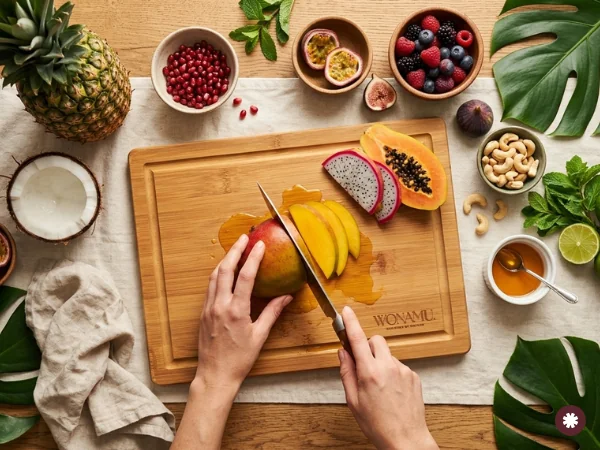
The WONAMU. bamboo cutting board is 12 by 9 inches — the daily prep size that handles a full head of vegetables or a resting roast without taking over the counter. Available on Amazon. It is the kind of registry item that gets used the week after the wedding and every week after that. For ongoing care, How to Oil a Bamboo Cutting Board covers the full routine.
For couples who want the choice, WONAMU. also makes an acacia cutting board. Acacia is a true hardwood — denser and heavier than bamboo, with warm grain that varies from board to board. Registered alongside the bamboo, it covers both temperaments: the lighter board for quick daily prep, the heavier hardwood that stays put under a full carving job. Twelve by nine inches.
The Knives (Two, Not Twelve)
A knife block with twelve pieces looks complete. In practice, most home cooking can be done with two knives: an eight-inch chef’s knife and a three-and-a-half-inch paring knife. Registering for a matched set of twelve often means receiving eleven knives that rarely leave the block.
Register for two knives that are excellent, and leave room for the couple to choose the rest themselves once they know what they prefer. The chef’s knife should feel balanced and heavy enough to be satisfying without being tiring. A forged blade from a German or Japanese maker in the $80–150 range is genuinely different from a stamped budget knife, and the difference reveals itself within a week of daily use.
A Pan That Teaches
Cast iron gets recommended often, and for good reason — a well-seasoned cast iron skillet handles the stovetop-to-oven transition, sears reliably, and lasts indefinitely. But it requires maintenance and can be intimidating for cooks who are building confidence.
A lighter and more forgiving option is a carbon steel skillet, which has most of cast iron’s virtues — natural non-stick when seasoned, stovetop-to-oven capable, durable — with less weight and a more responsive handle of heat. For couples who plan to cook seriously, a 10-inch carbon steel pan is one of the most used pieces of kitchen equipment they will ever own.
For couples who want straightforward non-stick for eggs and delicate fish, a high-quality ceramic non-stick pan in the $40–80 range is practical and honest about what it is.
A Dutch Oven or a Braiser
One of these belongs on most registries. A Dutch oven handles braises, soups, stocks, and bread. A braiser — wider, shallower — handles the same low-and-slow work with better browning capability because more food can contact the surface at once.
The choice depends on what the couple cooks day to day. A family that makes chili, beans, and stews will use the Dutch oven constantly. A couple that braises chicken thighs and makes short ribs will prefer the braiser. Register for the one that matches the real cooking, not the most photogenic option.
The Things Registries Always Miss
A kitchen scale. Baking by weight is faster, more accurate, and less messy than measuring by volume. A good digital scale — $20 to $40 — changes the way someone bakes and eliminates the measuring cup problem entirely. It is almost never on a registry and almost always wished for.
A bench scraper. Transfers chopped vegetables directly from board to pan. Sections dough. Cleans a work surface in one pass. Around $10–15. Lasts indefinitely. Many cooks who receive one wonder how they managed without it.
A salt cellar and finishing salt. An open ceramic or wood vessel on the counter, within arm’s reach of the stove, filled with good finishing salt. It costs almost nothing and changes how someone seasons food every day. Pair it with a tin of fleur de sel or Maldon flakes.
On Building the Registry
The most useful kitchen registries are built around how two people cook in practice — not around how a kitchen looks fully equipped. Register for the things that will be used daily, the things that are better in a higher-quality version, and the things that the couple would not splurge on themselves.
Leave off the matching everything. Leave off the twelve-piece knife block and the collection of gadgets with single functions. What remains is usually enough to build a kitchen that works from the first week.
If the couple already cooks and owns the basics, gifts for the cook who has everything is the more useful list. For board care afterwards, see how to care for a bamboo cutting board.
❋
WONAMU. cutting boards are available on Amazon: the bamboo board (12 × 9 inches) and the acacia board (12 × 9 inches, true hardwood).
Designed by nature.