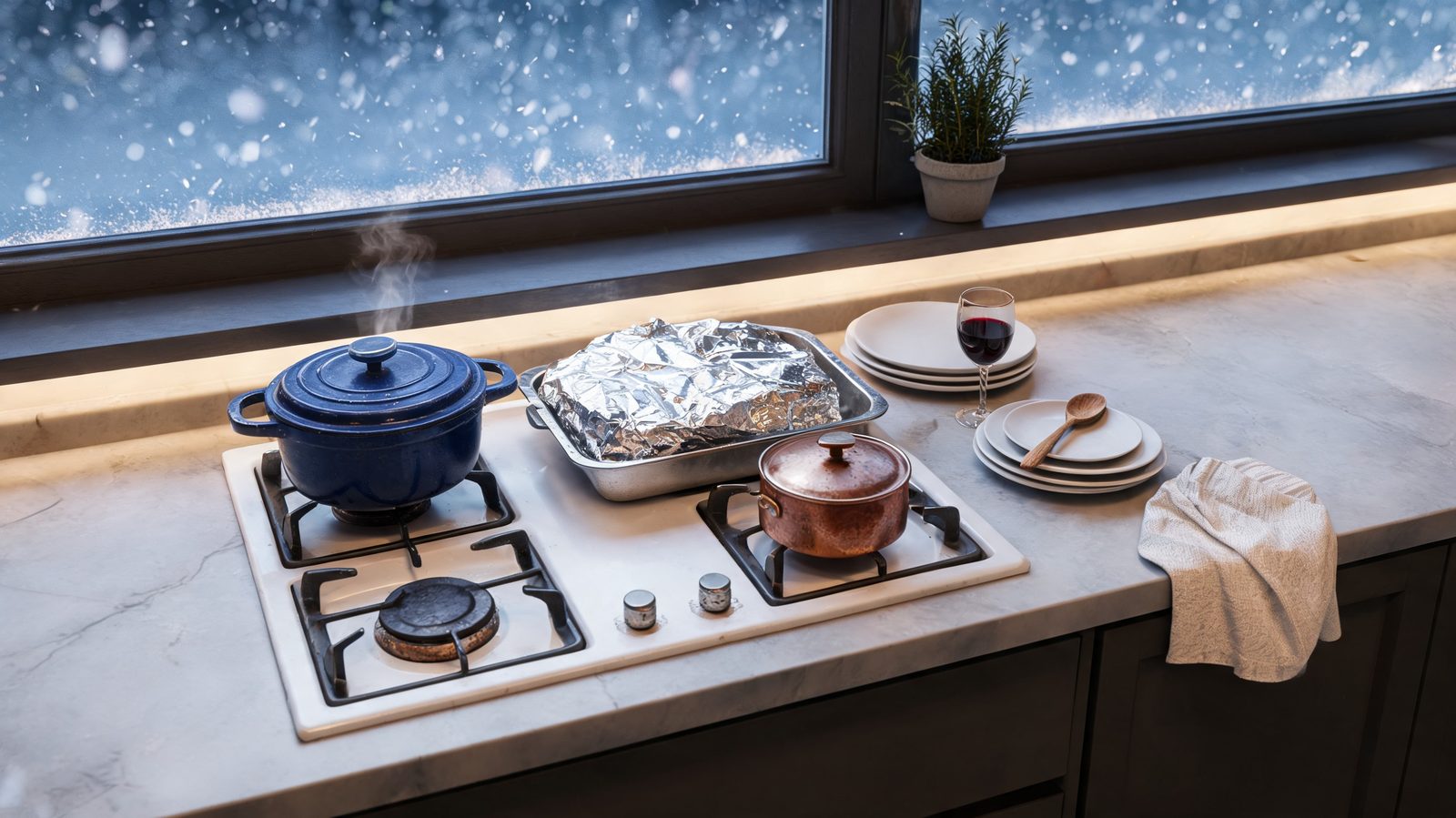
There is an hour before Christmas dinner when the cooking is done and the eating has not begun. The roast is resting under foil, the pots are covered on the back of the stove, the table is set, and for a little while there is nothing left to do. It is the best hour of the day for the cook, and it is the one most often given away. It is worth planning for as carefully as the meal.
Every big holiday dinner has this hour hidden inside it. Whether the cook ever gets to sit in it depends on decisions made days earlier.
An hour that has to be earned
The quiet hour does not arrive by luck. It is the reward for work done ahead: the vegetables cut the day before, the dessert finished in the morning, the table laid while the oven was still busy.
A cook who starts the day with everything still to do will spend the last hour before dinner at full speed, and will sit down to eat already tired. A cook who started early gets to the same moment with the work behind them and an hour that belongs to nobody.
That is why the hour is worth naming. Once a cook knows it exists, the whole schedule bends toward it. The question stops being “When does dinner need to be ready?” and becomes “When do I want to be finished?”
What the kitchen sounds like
A kitchen in full production is loud. Pans hiss, timers go off, the tap runs, someone asks where the serving spoons are.
In the quiet hour, the sound changes.
A lid ticks as the pot underneath it cools a little. The oven, turned low to keep plates warm, hums. From the next room there are voices, someone laughing, the clink of a glass. The kitchen has gone from a workshop to a room again.
Outside, if it is that kind of Christmas, the light is going and the snow is coming down past the window. Inside, the counters are wiped and the sink is close to empty. It is the closest a working kitchen comes to stillness.
The hour is for looking
Most of the cook’s day is spent looking down: at the knife, at the pan, at the recipe. The quiet hour is the one time to look up.
It is the moment to notice who is here this year. The cousin who came a long way. The child who was a baby last Christmas and is now pulling at the tablecloth. The older relative who sits closer to the kitchen than anyone else, because they used to be the one cooking.
It is also the moment to look at the meal itself before it is taken apart. The browned roast, the dishes lined up in the order they will go to the table, the gravy kept warm in its pan. A whole day of work, briefly complete. Once it is carried out, it starts to disappear, which is what it was made for.
Why it is hard to keep
The quiet hour is fragile, and the cook is usually the one who breaks it.
There is always one more thing that could be done: a garnish, a second sauce, rolls baked fresh instead of warmed.
Each one sounds small, and each one fills the hour. By the time dinner is called, the cook is flushed and distracted, and the hour has been spent on something nobody would have missed.
There is also the habit of being useful. Guests arrive, and the instinct is to keep moving, to refill glasses and fetch chairs and answer questions. Some of that is hospitality. Much of it is nervousness that the work is not finished, when it is.
The hour also asks for a little trust. Trust that the covered pots will stay warm, that the roast can sit a while longer under its foil, that the guests are happy in the next room without a host hovering at the door. A cook who has done the work can afford that trust. The meal will still be there in an hour, and so will everyone who came for it.
How to make room for it
The practical side is simple, and most of it happens well before the day:
- Plan backward from the hour. Decide when the cooking should be finished, an hour before dinner, and build the schedule from there.
- Cut what does not matter. If a dish can only be made in the last hour, ask whether the table needs it.
- Clean as you go. A sink that is empty before dinner is half of what makes the hour quiet. Cleaning as you go while hosting covers the rhythm.
- Set the table early. A table laid in the afternoon is one less task in the evening, and it tells everyone the meal is coming.
- Hand off the drinks. Give someone else the job of pouring, so the cook can sit down with a glass instead of carrying a tray.
- Leave the kitchen. Even ten minutes in the next room, among the guests, is enough to change the evening.
The hour is not about doing nothing. It is about letting the work end before the meal begins, so the cook arrives at the table as a guest at their own dinner. The kitchen will be busy again soon enough, and what to do with the Christmas leftovers is a question for tomorrow.
The short version
Before every Christmas dinner there is an hour when the cooking is done and the meal is not yet served. It is the best hour of the cook’s day, and it is earned by work done ahead. Plan backward to protect it, cut the dishes that would eat it, clean as you go, set the table early and let someone else pour. Then sit down, look around, and let the dinner arrive.
❋
WONAMU. makes a bamboo cutting board designed for daily prep, 12 × 9 inches, bamboo, with a perimeter juice groove. Available on Amazon.
Designed by nature.

