No. Bamboo is not too hard for your knives. On the Janka hardness scale bamboo measures about 1,380 lbf, which puts it above white oak and walnut and close to hard maple, the classic butcher-block wood. A board in that range is firm enough to resist deep gouging and still gives under the edge the way a wooden surface does.
The claim that bamboo wrecks knives is a common one online. The honest answer is more useful than either camp allows. What dulls a kitchen knife is a surface that does not yield at all, and a set of habits that have nothing to do with the board.
What a hardness number means on a board
The Janka test measures the force needed to push a steel ball halfway into a piece of wood. It is a measure of resistance to denting. For a cutting board, the useful range is wide.
Too soft and the board scores deeply and holds moisture in the cuts. Too hard and the edge meets something it cannot sink into at all.
Bamboo at roughly 1,380 lbf, hard maple at about 1,450 and acacia at roughly 1,400 to 1,750 depending on species all sit in the band that cutting board makers have long worked in. None of them is in the category that damages an edge. Cutting board thickness covers the other number that matters, and what wood should never be used for a cutting board covers the species that fall outside the band.
The surfaces that do dull knives
The materials that take an edge off in minutes are the ones with no give at all.
- Glass. The hardest common cutting surface. A knife edge rolls or chips against it almost at once, and the surface is slippery.
- Stone, marble and granite. The same problem. These are serving surfaces, not cutting surfaces.
- Ceramic plates. Cutting on a dinner plate is a common habit and one of the fastest ways to dull a knife.
- Steel. The stainless boards that circulate online are easy to sanitize and hard on edges, for the same reason as glass.
Bamboo belongs with the woods, not with these. When the edge lands on a bamboo board, the fibers compress slightly and the blade stops in the surface rather than on it. That small amount of give is what protects the edge.
Why opinions differ
Two things explain the gap between that claim and daily experience. First, when the comparison is a thick butcher block in a softer species, which is gentle on an edge but also heavy, expensive and demanding to maintain, every other board looks harder.
Second, bamboo boards vary. Bamboo boards are made from strips of bamboo pressed and glued into a panel, and the quality of that construction decides how the surface behaves under a knife. A dense, tightly bonded board behaves like good hardwood. This is a reason to buy a well-made board rather than a reason to avoid the material.
The habits that matter more than the board
For a home cook, these four things change edge life more than the choice between bamboo and maple.
Cut, do not chop. A push cut or a rocking slice lets the edge do the work. Bringing the knife down hard enough to thump the board stresses the edge on any surface.
Clear the board with the spine. Scraping cut vegetables across the board with the sharp edge is the most common edge-killer in the home kitchen. Flip the knife and scrape with the spine, or use a bench scraper.
Hone before each session. A few strokes on a honing rod straighten the edge. It takes seconds and keeps the edge cutting cleanly between sharpenings.
Sharpen on a schedule. A home knife in daily use wants a whetstone every few months. How to sharpen a knife at home without ruining it sets out the method.
Keep the board surface in good condition
A board that is oiled regularly keeps a smooth, slightly supple surface. A dry board feels harsher under the edge and shows knife marks sooner. Wipe on food-grade mineral oil when the surface looks pale, let it soak in and buff off the excess. Bamboo cutting board maintenance covers the full routine.
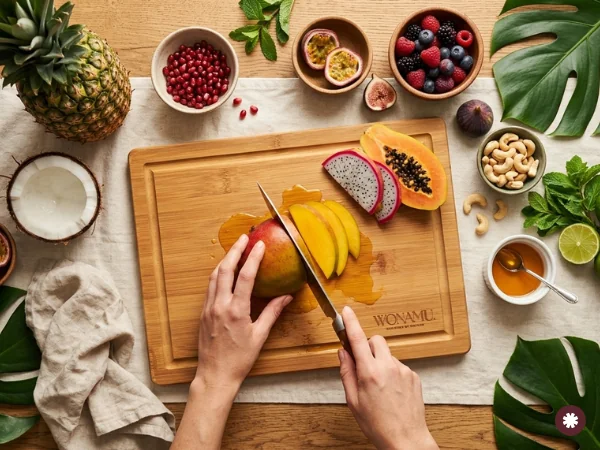
The WONAMU. bamboo cutting board is 12 by 9 inches, a size that sits flat and stable on a standard counter so the knife lands square rather than at an angle on a board that rocks.
The short version
Bamboo sits close to hard maple on the hardness scale and yields under the blade the way wood does. Glass, stone, ceramic and steel are the surfaces that dull a knife. Technique, honing and a sharpening schedule do more for your edge than the choice between bamboo and any other wood. Buy a well-made board, keep it oiled and clear it with the spine of the knife.
❋
WONAMU. makes a bamboo cutting board designed for daily prep, 12 × 9 inches, bamboo, with a perimeter juice groove. Available on Amazon.
Designed by nature.