To cut Brussels sprouts, trim a thin slice off the dry stem end, pull away any yellow or loose outer leaves, and halve each sprout from top to bottom through the core. That cut keeps both halves intact and gives them a flat face to brown on a sheet pan. With a sharp knife and a sensible setup, two pounds take about ten minutes.
The details below are about doing that fast, and about the three other cuts worth knowing: whole, quartered and shredded.
Set up before the first cut
Speed with small vegetables comes from the setup, not from knife speed.
- Wash first, dry well. Rinse the sprouts in a colander and roll them on a towel. Wet sprouts steam instead of browning in the oven, and they slip under the knife.
- Three zones on the counter. Whole sprouts on the left, the board in the middle, a bowl or the sheet pan on the right. Trimmings go into a scrap bowl, not into a pile on the board.
- A stable board. Small round vegetables roll, and a board that slides makes them roll further. A damp towel underneath keeps it still, as covered in why your cutting board slides.
- A sharp chef’s knife. A paring knife works but takes twice as long. A dull blade crushes the leaves instead of cutting through them.
Trim the stem and the outer leaves
Line up five or six sprouts on the board with their stem ends facing your knife hand. Slice a thin sliver off each stem, only enough to remove the dry, browned end. Cut too much and the leaves fall apart; the core is what holds the sprout together.
Loose or yellowed outer leaves come away as you trim. Pull them off and discard them, or keep the green ones: loose leaves roasted on the same pan turn crisp and are often the best part.
Halve through the core
Stand each trimmed sprout on its stem end, or lay it on its side with the stem facing away, and cut straight down from top to stem. The knife should pass through the middle of the core, so each half keeps a piece of it.
Halved sprouts are the standard for roasting: the flat cut face goes down on the pan and browns deeply, while the rounded side stays tender. For roasting, 400 to 425°F for 25 to 35 minutes, tossed in oil and salt, is a reliable starting point.
To go faster, work in rows: trim six, halve six, slide them off the board with the flat of the knife, repeat.
Whole, quartered or shredded
Whole. Small sprouts, about the size of a large grape, can stay whole after trimming. Score a shallow X in the stem end if boiling or steaming so the core cooks at the same pace as the leaves.
Quartered. Very large sprouts, wider than a walnut, cook unevenly when halved: the outside is done before the center. Halve them, then halve each half again through the core. Aim for pieces of similar size across the whole batch.
Shredded. For a raw salad or a quick sauté, halve each sprout, lay the halves cut side down, and slice them thinly across, about an eighth of an inch. The layers fall apart into fine ribbons. Work with the curled fingertips of your guiding hand tucked back from the blade, the same claw grip used for any fine slicing. The basics of that cut are in five basic knife cuts.
For large quantities of shredded sprouts, a food processor with a slicing disc is faster; the knife gives more even ribbons.
Make-ahead and holiday timing
Brussels sprouts are one of the best vegetables to prep a day early. Trimmed and halved sprouts keep for up to two days in an airtight container in the refrigerator, lined with a paper towel to absorb moisture. Shredded sprouts keep a day.
On a holiday menu, that frees the morning for the jobs that cannot be done ahead. Prep the sprouts the evening before, along with the onions and celery for the stuffing, and they go straight onto the pan. A full plan for the kitchen on the day is in clean as you go: how to host without a mountain of dishes.
Cleaning up
Brussels sprouts leave little behind: a few leaves, some green juice. Brush the trimmings into the scrap bowl with the back of the knife, never the edge, which dulls the blade. Wash the board in hot water with dish soap, rinse, towel it dry and stand it on edge.
Sprouts belong to the cabbage family and can leave a faint smell on the board after a large batch. A rub with coarse salt and a lemon half removes it.
The short version
Wash and dry. Trim a sliver off the stem, pull off loose leaves, halve through the core. Quarter the big ones, leave the small ones whole, shred halves thinly for salad. Work in rows of six, keep the board still, and two pounds are done before the oven is hot.
❋
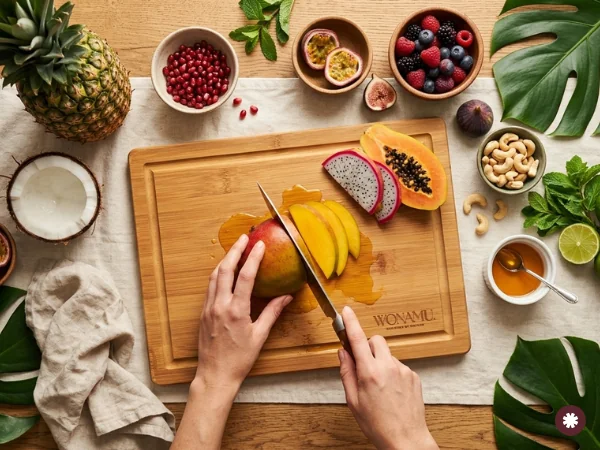
The WONAMU. bamboo cutting board — 12 × 9 inches, bamboo, with a perimeter juice groove and a cotton care cloth in the box — is available on Amazon.
Designed by nature.