To cut a kiwi, trim off both ends, then either scoop the flesh out with a spoon or peel the skin away with a paring knife and slice the fruit into rounds. For the spoon method, cut the kiwi in half across the middle and scoop each half like a soft-boiled egg. For neat rounds on a fruit plate or a pavlova, peel it first, then slice it crosswise on the board. Ripe kiwis give slightly when pressed, and they are much easier to cut cleanly than hard ones.
Kiwis are small, soft and slippery once peeled, which is why a few simple habits make a large difference. Here are the four ways worth knowing.
Pick a ripe kiwi
A ripe green kiwi yields gently to light pressure from your thumb, the way a ripe peach does. It should not feel mushy, and the skin should not be wrinkled.
Hard kiwis are sour and difficult to slice. Leave them at room temperature for a few days, or put them in a paper bag with an apple or a banana to speed things up. Once ripe, they keep in the refrigerator for a week or more.
Golden kiwis, with smooth, bronze, almost hairless skin and yellow flesh, are sweeter and less tart. They are cut the same way.
Method one: scoop with a spoon
This is the fastest way, and it wastes the least fruit.
- Cut off both ends with a paring knife.
- Slide a teaspoon between the skin and the flesh at one end.
- Run the spoon around the inside of the skin, turning the kiwi as you go, keeping the bowl of the spoon pressed against the skin.
- Push from the other end. The whole fruit slides out in one piece.
For a quick snack, skip the trimming: halve the kiwi across the middle and eat it straight from the skin with a spoon.
Method two: peel and slice into rounds
Rounds show the pattern of black seeds around the pale center, and they are the cut for fruit tarts, pavlova, fruit salads and breakfast plates.
- Trim both ends so the kiwi stands upright on the board.
- Hold it steady and cut the skin away in strips from top to bottom with a paring knife, following the curve. Take as little flesh as possible.
- Lay the peeled kiwi on its side.
- Slice across into rounds about a quarter inch thick.
A sharp knife keeps the rounds intact. A dull blade squashes soft fruit and smears the seeds.
Method three: wedges and dice
Wedges are good for lunch boxes and fruit platters, and dice for salsas and yogurt.
For wedges, trim the ends, peel the kiwi, stand it upright, and cut it lengthwise into quarters or sixths.
For dice, slice the peeled kiwi into rounds, stack two or three, and cut across in both directions. The guide to small, medium and large dice gives the sizes. Kiwi dice are soft, so use a gentle sawing motion and lift them off the board with the flat of the knife rather than scraping.
A kiwi salsa with diced red onion, jalapeño, cilantro and lime goes well with grilled fish and pork.
Method four: eat the skin
The skin is edible. It is thin, and its fuzz is the main reason most people peel it. Golden kiwis have almost no fuzz and are pleasant to eat whole.
To eat a green kiwi with the skin on, wash it well and rub off some of the fuzz with a clean towel. Trim off the hard stem end, then slice it into thin rounds. Thin slices make the texture of the skin much less noticeable.
The board and the knife
Peeled kiwi is slick and juicy. Cut it on a board with a little room around the fruit, and keep a bowl nearby so the slices do not slide around while you work.
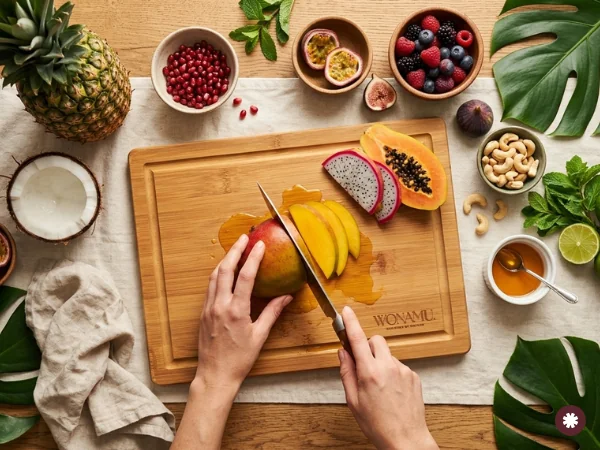
The WONAMU. bamboo cutting board has a perimeter juice groove that holds what runs from a few sliced kiwis, so the juice stays on the board. Rinse and dry it afterward; the sugar in fruit juice turns sticky if left to dry.
A small paring knife is the best tool for peeling. For slicing rounds, a sharp paring knife or a small serrated knife both work; the serrated edge grips the slick surface.
A note on kiwi in desserts
Raw kiwi contains an enzyme called actinidain that breaks down proteins. It is the reason kiwi works as a meat tenderizer, and the reason it causes trouble in some desserts.
Raw kiwi stops gelatin from setting, so a kiwi gelatin dessert stays liquid. It also digests milk proteins, so keep raw kiwi out of desserts made with milk, cream or yogurt until right before serving. Cooking the fruit first deactivates the enzyme.
On a pavlova or a tart topped with cream, add kiwi slices shortly before you serve, so the fruit and the cream spend as little time together as possible.
Where the name comes from
The fruit was long known in English as the Chinese gooseberry. In 1959, Turners & Growers, a New Zealand exporter, began selling it as kiwifruit, a name taken from the kiwi bird. Today it is grown in many countries, California among them.
Common mistakes
- Cutting hard kiwis. They are sour and hard to slice cleanly. Let them ripen.
- Peeling too thickly. It wastes good fruit. Follow the curve and take only the skin.
- Adding raw kiwi to gelatin or dairy desserts ahead of time. The enzyme liquefies gelatin and digests milk proteins.
- Using a dull knife. It crushes soft fruit.
The short version
For a snack, halve the kiwi and scoop it out with a spoon. To serve it, trim both ends, peel the skin away with a paring knife, and slice it into rounds, wedges or dice.
Choose kiwis that give slightly when pressed, and add raw kiwi to gelatin or dairy desserts only at the last minute.
❋
WONAMU. makes a bamboo cutting board designed for daily prep, 12 × 9 inches, bamboo, with a perimeter juice groove. Available on Amazon.
Designed by nature.