Sunday banchan prep means making a handful of Korean side dishes in one session, so that every weeknight dinner needs only rice, a protein or a soup. Five dishes cover the first half of the week: seasoned soybean sprouts, seasoned spinach, spicy radish salad, soy-braised potatoes and stir-fried zucchini. Cooked in the right order, they share one pot of boiling water and one cutting board, and the whole session takes about two hours.
Banchan are the small dishes served alongside rice at a Korean meal. A home cook rarely makes them all on the day they are eaten; most households keep a few in the refrigerator and rotate them through the week.
The plan
The order matters more than the recipes. Start with the dishes that need the most time, and blanch the vegetables in the same pot of water from cleanest to strongest.
- Put a large pot of salted water on to boil.
- Start the braised potatoes, which simmer unattended for about 25 minutes.
- Cut the radish and zucchini while the water heats and the potatoes cook.
- Blanch the spinach, then the soybean sprouts, in the same pot.
- Season everything, cook the zucchini, and pack the containers.
Each dish below gives the knife work first, because that is where the time goes.
Braised potatoes (gamja jorim)
Sweet, salty and glossy, these keep the best of the five and are often better on the second day.
Cut. Peel about a pound of waxy potatoes, such as Yukon Gold, and cut them into even three-quarter-inch cubes. Even cubes cook through together; mixed sizes leave some mushy and some hard. Rinse the cubes in cold water to remove surface starch, which keeps the sauce clear.
Cook. Combine the potatoes in a saucepan with a quarter cup of soy sauce, two tablespoons of sugar or rice syrup, a tablespoon of oil, a minced garlic clove and about a cup of water. Simmer, covered, for 15 minutes, then uncover and cook until the liquid reduces to a sticky glaze. Finish with sesame seeds.
Spicy radish salad (mu saengchae)
Crunchy, sharp and bright red, this one cuts through the richer dishes.
Cut. Peel a section of Korean radish about four inches long. Slice it into thin planks an eighth of an inch thick, stack the planks, and cut them into fine matchsticks. Cut along the length of the radish, not across it, so the matchsticks stay crisp. How to cut Korean radish covers the cuts in more detail.
Season. Toss the matchsticks with a teaspoon of salt and a tablespoon of gochugaru, Korean chili flakes, so the color sets. After ten minutes, add a teaspoon of sugar, a tablespoon of vinegar, a little minced garlic and sliced scallion.
Seasoned spinach (sigeumchi namul)
Blanch. Trim the root ends from a large bunch of spinach, keeping the clusters together, and wash it well. Drop it into the boiling water for about 30 seconds, until bright green and wilted, then move it straight to a bowl of cold water.
Cut. Squeeze out the water by the handful until the spinach is quite dry. Lay the squeezed bundle on the board and cut it into two-inch lengths, so it is easy to pick up with chopsticks.
Season. Toss with a teaspoon of soy sauce or salt, a teaspoon of toasted sesame oil, a little minced garlic and toasted sesame seeds. Mix gently with your fingers so every strand is coated.
Seasoned soybean sprouts (kongnamul muchim)
Blanch. Rinse a 12-ounce bag of soybean sprouts and pick out any loose hulls. Cook them in the same pot, covered, for about five minutes. Keep the lid on until they are done, which keeps any raw, beany smell from setting in.
Cut. Drain and spread the sprouts to cool. Slice two scallions thinly on the bias. Slicing scallions on the bias shows the angle.
Season. Toss with salt, sesame oil, minced garlic, scallions and sesame seeds. Add a pinch of gochugaru for a spicy version.
Stir-fried zucchini (hobak bokkeum)
The quickest of the five, and the one that keeps the least time, so make it last and eat it first.
Cut. Halve a medium zucchini lengthwise and slice it into half-moons about a quarter inch thick. Salt them lightly and let them sit five minutes, then pat dry.
Cook. Sauté in a little oil with minced garlic over medium-high heat for two to three minutes, until tender but still bright. Season with a few drops of fish sauce or salt and finish with sesame seeds.
Packing and keeping
Let every dish cool before it goes into the refrigerator, and pack each one in its own airtight container. Glass containers do not take on the color of gochugaru or the smell of garlic.
USDA guidance is to eat cooked leftovers within three to four days, so plan to finish these by midweek; the zucchini is best within two. A shorter second session on Wednesday, with one or two fresh dishes, carries the table through to the weekend. Use clean chopsticks or a spoon to serve, never fingers.
A bowl of rice, two or three banchan and a fried egg is a complete dinner. The Korean everyday table explains how a meal like that is arranged.
Keep the board moving
Five dishes on one board means planning the cutting order, the same way the cooking is planned. Cut the potatoes first, since they go on the stove first, then the radish and zucchini, and handle the blanched greens last. Wipe the board between dishes with a damp cloth.
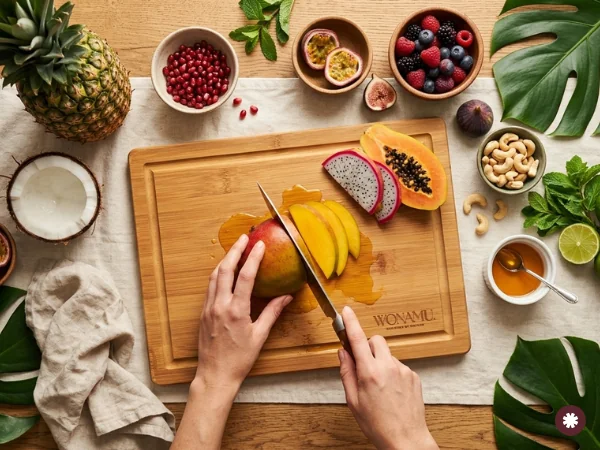
A steady, well-sized board makes a two-hour session feel shorter. The WONAMU. bamboo cutting board is 12 by 9 inches, with room for a pile of radish matchsticks on one side while you square off the next vegetable on the other. Wash it with warm soapy water at the end and dry it on edge.
The short version
Boil one pot of salted water. Start soy-braised potatoes cut in three-quarter-inch cubes, then cut radish into fine matchsticks and zucchini into half-moons.
Blanch the spinach, then the soybean sprouts, in the same water, squeeze and season them. Toss the radish with gochugaru, stir-fry the zucchini, cool everything and pack it in separate containers. Eat the zucchini first and finish everything within three to four days.
❋
WONAMU. makes a bamboo cutting board designed for daily prep, 12 × 9 inches, bamboo, with a perimeter juice groove. Available on Amazon.
Designed by nature.