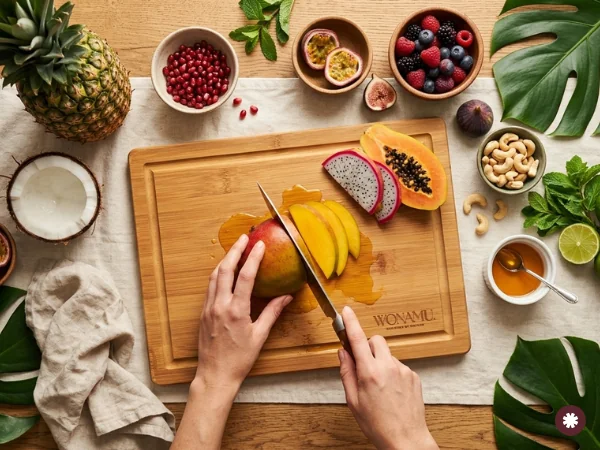
A plastic-free kitchen is not a realistic goal, and chasing one is a good way to spend money on things that change nothing. A lower-plastic kitchen is realistic, and three conditions decide where the effort pays: heat, friction, and direct food contact. Where two of those overlap, replace the plastic. Where none of them apply, leave it alone.
That filter is more useful than any list of swaps, because it tells you what to do about the items no list mentions.
Why heat and friction are the two that matter
Plastic wears away when it is cut or scraped, and heating it can make more chemicals leach into food. Those are different mechanisms with different fixes.
Abrasion is mechanical. Every cut into a plastic board, every scrape of a plastic spatula against a hot pan, removes a small amount of material — and some of it goes into the food. Research on plastic cutting boards has put the shedding at a scale that surprised most people when it was published, which is the subject of its own post here.
Heat is chemical. Harvard Health warns that microwaving food in plastic containers can cause more chemicals to leach into food, which makes it one of the easiest exposures in a home kitchen to avoid.
A plastic colander that only ever meets cold rinse water sits outside both categories. So does a storage bin in a pantry. Those are not the problem.
The swaps worth making, in order
1. Stop heating food in plastic
The highest-value change costs nothing. Move food to a ceramic or glass dish before it goes in the microwave, and do not use plastic containers for hot leftovers straight from the pan. A set of glass storage containers runs $30 to $60 and replaces the whole category.
Hand-wash the lids. The seal is usually still plastic, and hand-washing keeps it out of the dishwasher’s heat.
2. Replace the cutting board
This is the friction case at its clearest. A knife is designed to remove material from whatever is under it, and on a plastic board that material has nowhere to go but into the food.
Wood and bamboo behave differently under a blade. They also hold up on hygiene: washed and dried properly, wood and bamboo surfaces reduce bacterial counts well, and the reason wood boards resist bacteria lies in the material itself, not a coating that wears off.
Wood and bamboo are hand-wash surfaces, and they take an occasional coat of oil — a few minutes every few weeks that keeps the board sealed and looking new. That small routine is what lets a wooden board stay in service for years rather than cycling through the bin.
3. Get the black plastic utensils out
Black plastic spatulas and turners meet all three conditions at once: they are plastic, they are pressed against a hot pan, and they touch the food. That makes them the worst configuration on this list.
Wooden spoons, stainless steel tongs, and food-grade silicone spatulas cover everything a black nylon turner does. A workable set costs under $40.
4. Change the sponge
A synthetic sponge is plastic foam and fibre, and every scrub against a pan or a grater wears a little of it away, down the drain.
This is the cheapest swap on the list — a few dollars — and the one most people have never considered. Cellulose sponges and natural-fibre brushes do the same job and biodegrade at the end of it.
5. Move dry storage to glass or steel
Lower priority than the first four, because dry pantry goods at room temperature involve neither heat nor abrasion. Worth doing as containers wear out rather than as a project.
What is not worth replacing
Perfectly good plastic items that meet none of the three conditions: the pantry bins, the cold-water colander, the salad spinner, the dish rack. Throwing out functional objects to replace them with wood or steel generates waste and spends money on a risk that is not there.
There is also a category of swap that trades one problem for another. Glass and stone cutting boards are plastic-free and hard on knife edges — the surface does not give at all. A bamboo board is the better answer for the same reason a wooden one is: it gives slightly under the blade instead of fighting it.
The honest limits
No kitchen reaches zero. Plastic arrives in the groceries, lines the cans, and wraps most of what comes home from a store. The point of a lower-plastic kitchen is not purity — it is removing the exposures that are both meaningful and easy to remove, and then getting on with cooking.
Bamboo boards are built from strips bonded together, which is why construction quality is worth paying attention to. A well-made board holds together season after season — a good argument for buying one board worth keeping rather than three that are not.
A reasonable order of operations
If the whole list feels like a project, do it in this sequence and stop whenever it stops feeling worth it:
- Stop microwaving in plastic. Free, today.
- Swap the sponge. A few dollars.
- Replace black plastic utensils that touch heat.
- Replace the cutting board.
- Move to glass storage as the old containers fail.
The first three take an afternoon and cover most of the realistic exposure. The rest can happen over a year.
❋
WONAMU. makes a bamboo cutting board and an acacia cutting board, both sized for daily prep at 12 × 9 inches. Available on Amazon.
Designed by nature.