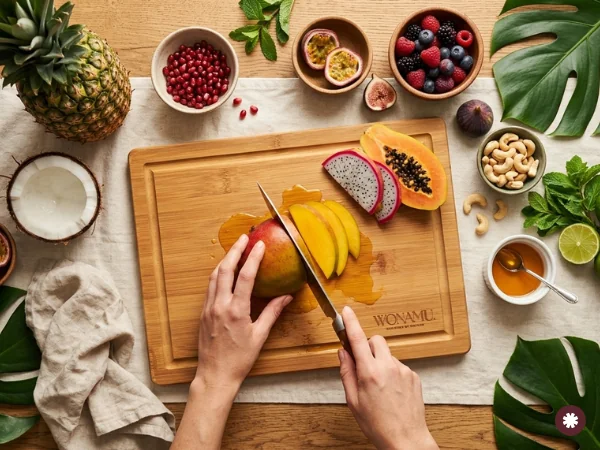
The kitchen tools that last longest have no plug. A good knife, a cutting board, a wooden spoon, a cast iron pan and a mortar and pestle can each outlive the cook who bought them, because there is nothing inside them to fail. No motor burns out, no circuit board goes obsolete, no replacement part is discontinued. When they wear, the cook can usually repair them at the sink.
That is not an argument against appliances. A stand mixer or a rice cooker earns its counter space in plenty of kitchens. It is an argument for knowing which tools do the real work, and for building a kitchen around the ones that will still work in forty years.
What a motor costs
Every appliance carries a lifespan set by its weakest part. A blender’s jar may last for decades, but the coupling, the switch or the motor gives out first, and once it does the whole machine usually goes to the curb. Many small appliances are not designed to be opened, let alone mended.
A tool without a motor has no weakest part in that sense. Its failure modes are ones you can see and fix: a dull edge, a dry surface, a little rust, a rough patch of grain.
That changes the relationship. An appliance is something you replace. A hand tool is something you maintain.
It also changes the kitchen’s sound. A kitchen run mostly on hand tools is quiet: the knock of a knife on a board, a spoon against the side of a pot, the grind of a pestle.
Five tools, and how each one is kept
The knife
A knife’s edge is meant to be renewed. Honing realigns it between uses, and sharpening on a whetstone removes a thin layer of steel to make a new edge entirely. A well-made blade can be sharpened for decades, and its profile changes a little over the years, the way an old pencil does. How to sharpen a knife at home covers the whole routine.
The cutting board
A wooden or bamboo board takes knife marks, dries out and darkens with use. All of it is reversible. Regular oiling keeps the surface conditioned, and a board that has grown rough or scarred can be sanded back to clean wood and oiled again. A board cared for this way improves with age instead of wearing out.
The wooden spoon
Wooden spoons are among the oldest utensils there are, and they ask for very little: wash by hand, dry, and rub with a little food-safe oil now and then. A spoon that turns fuzzy or develops a splinter can be sanded smooth and re-oiled. It never scratches a pan, never conducts heat to your hand, and never melts against the side of a hot pot.
The cast iron pan
Cast iron is the classic heirloom. A seasoned pan is protected by layers of polymerized oil, and it gets better with every use. Even a rusty pan found in a basement can be scrubbed back to bare metal and re-seasoned in an afternoon. Families hand these down for generations.
The mortar and pestle
The mortar and pestle is one of the oldest tools in any kitchen. A heavy stone, ceramic or wooden one does what a spice grinder does, more slowly and with more control, and it crushes rather than chops, which releases oils from garlic, herbs and seeds in a way a blade does not. There is almost nothing about it that can break, short of dropping it.
Repairable is a design choice
What these tools share is not age or nostalgia. It is that they were designed so the owner could keep them working. The Shakers built their kitchens on that principle two centuries ago, making plain, useful objects meant to be mended rather than replaced; what the Shakers knew about making things last looks at how.
That principle is easy to test when buying anything new:
- Can it be taken apart? A knife with a full tang and riveted handle can be rehandled. A pan with a riveted handle can be retightened.
- Can the working surface be renewed? An edge can be resharpened, a board can be sanded, cast iron can be re-seasoned. A nonstick coating cannot be restored once it wears through.
- Is it made of honest materials? Steel, wood, bamboo, cast iron and stone age predictably and can be cared for at home. Surface coatings are the part that tends to wear beyond repair.
- Does it need anything you cannot buy at a hardware store? Oil, sandpaper, a whetstone and steel wool keep most hand tools running indefinitely.
Skill stays in the hands
A hand tool also keeps the skill with the cook. A food processor makes an even mince without any practice. A knife makes an even mince only once you have learned to use it, and after that the skill travels with you to every kitchen you cook in.
The same is true of the pestle, the rolling pin and the whisk. Each one rewards practice with control: a coarser grind here, a thinner sheet of dough there, cream whipped to soft peaks and not a second past. That control is a large part of what makes cooking satisfying rather than merely efficient.
A short list worth owning
A kitchen built on tools with no plug does not need many of them. A sensible core:
- One chef’s knife and a paring knife, plus a whetstone.
- One everyday cutting board you reach for daily.
- Two or three wooden spoons and a wooden spatula.
- A 10 or 12 inch cast iron skillet.
- A mortar and pestle large enough to make a paste.
- A rolling pin, a balloon whisk and a box grater.
Everything on that list can be kept working with a sink, a cloth and a little oil. Buy-it-for-life kitchen tools goes further on choosing each one well.
The case, made plainly
Tools with no plug are not better because they are old. They are better because they are honest about how they wear and generous about how they can be restored. Bought once and kept with care, they become part of the kitchen’s character, carrying the marks of every meal made with them.
❋
WONAMU. makes a bamboo cutting board designed for daily prep, 12 × 9 inches, bamboo, with a perimeter juice groove. Available on Amazon.
Designed by nature.