Assign categories, not dishes. That is the whole trick. Tell six friends “bring something” and you get three pies, two bags of chips and a bottle of wine. Tell them “you have the green vegetable, you have the bread,” and dinner arrives balanced without anyone feeling managed.
For many friend groups, Friendsgiving has become a second holiday, and it is very often a potluck. The potlucks that work have a structure behind them. Here it is.
The eight categories
A Friendsgiving table needs eight things and no more. Write them down before you send a single message.
- The anchor. One roasted bird, a ham, a large braise, or a vegetarian centerpiece that can stand in for one. This is the host’s job. It is the only dish the host cooks.
- Two sides that reheat. Mashed potatoes, a gratin, stuffing, roasted root vegetables. Dishes that go into a low oven for twenty minutes and come out better.
- One green thing. A salad, a tray of charred broccoli, green beans with something sharp on them. It arrives cold or at room temperature and needs no oven time.
- One bread or starch. Rolls, cornbread, a loaf from a bakery. Nobody has to bake it.
- One sauce or condiment. Gravy, cranberry, a chutney. Small, essential, forgotten every year.
- Two desserts, maximum. One pie, one not-pie. A third dessert is where potlucks go to die.
- Drinks. One person brings wine, one brings something without alcohol. Ice is a job, not an afterthought.
- The opener. Something to eat in the first forty minutes while the oven is busy. A cheese board, a bowl of nuts, a dip. The host can own this too, because it needs no cooking.
Eight categories, six to ten guests. Some people double up, and some categories go unfilled. That is fine. A Friendsgiving without a sauce survives; one without a vegetable feels wrong by the second plate.
How to assign without sounding like a manager
The message matters. “Can you bring the green vegetable?” lands differently from “You’re on vegetables.” The first is a request to a competent adult. The second is a shift schedule.
Send individual messages, not a group thread. In a group, the fastest typist claims dessert and everyone else waits. One to one, each person gets a category that suits them.
The friend who cooks gets the sides. The friend who does not gets bread and drinks, and feels useful rather than exposed.
Give each person two pieces of information with the category: the headcount, and whether their dish needs the oven. “Eight people, and the oven will be full until 6:30, so something that holds at room temperature would be ideal.” That one sentence prevents the most common potluck failure, which is four dishes arriving cold with four people expecting to reheat them at the same moment.
Keep a list. A note on your phone with eight lines and a name next to each. When someone asks what to bring, you look at the list and give them the next empty line. This is the entire system.
The host cooks one thing
The anchor, and nothing else. This is the rule hosts break most often and regret most reliably.
A roast bird or a braise takes the oven for hours and the host’s attention for the last thirty minutes. If the host also makes two sides and a dessert, the kitchen becomes a one-person restaurant at five in the evening with guests standing in it.
If the host makes only the anchor, the last half hour is carving, plating and pouring. The difference in how the evening feels is enormous.
The anchor should come out of the oven before the first guest arrives. A roasted bird rests for thirty to forty minutes without losing warmth, and it carves better for it. Set it on a board with a juice groove, tent it loosely, and let the arriving dishes take the oven.
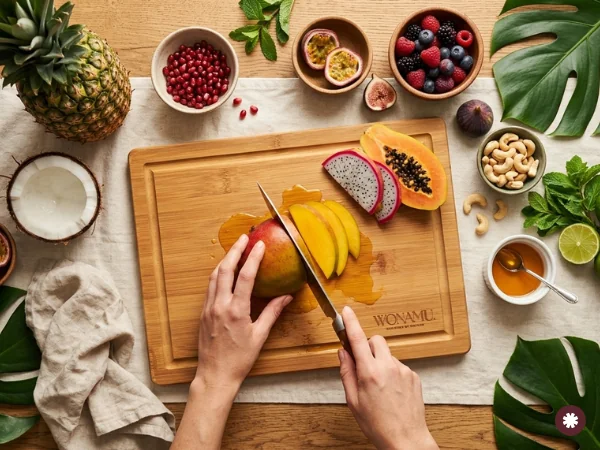
The board catches what the bird releases as it rests, and the groove keeps it off the counter. A WONAMU. bamboo cutting board at 12 by 9 inches holds a chicken or a turkey breast with room to carve, and the groove does the rest.
The counter has zones
Before anyone arrives, the counter is divided into three areas with painter’s tape or a mental line.
Landing. Nearest the door. Every dish goes here first, still covered, and gets a sticky-note label with its name and one of three words: cold, warm, or oven. Guests write their own. You will not remember who brought what, and labels let people serve themselves at the end without asking.
Oven queue. Next to the stove. Dishes labeled “oven” line up in the order they arrived, and twenty minutes at 325°F brings most sides back without drying them. Two dishes fit on one shelf, and nothing waits longer than it takes to eat the opener.
Serving. The table, or the far end of the counter if the table is for sitting. Dishes move here once they are hot. The carving board goes here last, when the bird is sliced.
Three zones, and the kitchen stops being a bottleneck. If you want a longer version of the whole evening, the earlier guide to hosting Friendsgiving without losing your mind covers timing from the morning onward.
The opener does real work
Forty minutes is a long time to stand in a kitchen with a drink and nothing to eat. The opener fills it, and it can be assembled in ten minutes with no heat.
A cheese board is the obvious answer, and a good one. Two cheeses, something crunchy, something sweet, a knife for each cheese. Lay it out on a board at the far end of the counter so people drift away from the oven. The principles in how to host a wine and cheese night scale down to one board and twenty minutes of attention.
If a cheese board feels like too much, a bowl of warm spiced nuts and a dish of olives does the same job.
What to do about the third pie
Someone will bring a dessert that was not assigned. They were nervous about arriving empty-handed, or they had a recipe they wanted to show off. This is a gift, not a problem.
Thank them, label it, and put it in the serving zone with the others. Dessert at a potluck is a buffet anyway, and three pies and a cake means leftovers go home in foil.
The system exists so that dinner is balanced. It does not exist to be enforced.
The two messages that save the evening
The morning of, send one message to everyone: “Oven is free from 4 to 5 if anyone needs it before they leave the house. Door opens at 5:30. Bring your dish in whatever you want to take it home in.”
The night before, send one message to yourself: the eight-line list, the oven temperature, and the time the bird goes in. Tape it inside a cabinet door. When the kitchen is full and someone asks where the serving spoons are, you will be glad the plan is on the wall and not in your head.
That is the whole method. Eight categories, individual messages, one dish for the host, three zones on the counter. The rest is friends in a kitchen, which was the point.
❋
The WONAMU. bamboo cutting board — 12 × 9 inches, bamboo, with a perimeter juice groove for carving and resting — is available on Amazon.
Designed by nature.